Demand
The law of demand says that as a good's price rises, the quantity demanded falls, other things equal, because of the income and substitution effects.
Part 1 · Hook
Why this matters
Part 2 · Before you start
What this builds on
Part 3 · Prerequisite check
Quick check before you start
1. A change in the variable on one of a graph's axes causes
- a movement along the curve
- a shift of the curve
- a new axis
- a steeper curve
Show the answer
Only a change off the axes shifts a curve.
- Correct: a movement along the curve:
- a shift of the curve:
- a new axis:
- a steeper curve:
2. A downward-sloping curve shows an
- inverse relationship
- direct relationship
- unrelated pair
- upward trend
Show the answer
Downward sloping means one rises as the other falls.
- Correct: inverse relationship:
- direct relationship:
- unrelated pair:
- upward trend:
Part 4 · See it
See it first
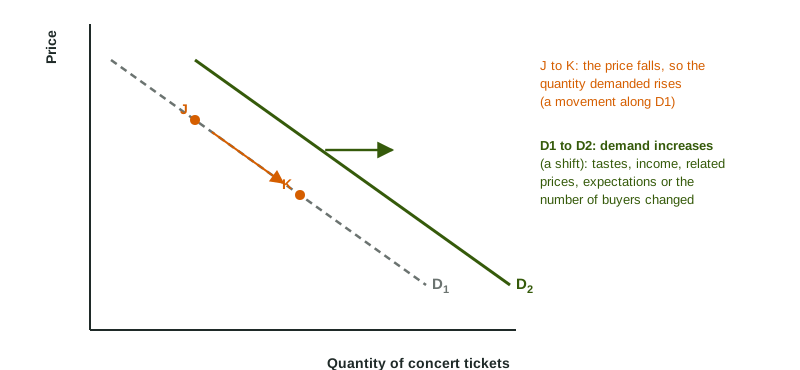
Part 5 · Step by step
How it works, step by step
- The price of a good fallsbuyers can afford more and the good is cheaper than its substitutes (income and substitution effects)
- Buyers respond to the lower pricethe quantity demanded rises: a movement along the demand curve
- Something other than the price changes (tastes, income, related prices, expectations, number of buyers)buyers want a different amount at every price
- Buyers want more at every pricedemand increases: the whole curve shifts right
Part 6 · Key ideas
Key ideas
- Law of demand: as a good's price rises, the quantity demanded falls, other things equal, because of the income and substitution effects.
- A change in the good's own price changes the quantity demanded (a movement along the curve). Anything else changes demand (a shift).
- Demand shifters: tastes, income (normal goods up, inferior goods down), prices of substitutes and complements, expectations, and the number of buyers.
Part 7 · Misconception
A common mistake
The wrong idea: When the price of a good rises, the demand for it falls.
What actually happens: A higher price lowers the quantity demanded, a movement along the demand curve. Demand itself, the whole curve, shifts only when something other than the good's own price changes.
Part 8 · Check yourself
Check yourself
Exam-style questions. Anything you miss goes into your review queue.
1. Buyers' incomes rise, and pizza is a normal good. Shift the right curve the right way in the market for pizza.
Work on the graph (it needs JavaScript), then check.
Show the answer
For a normal good, higher incomes raise the quantity demanded at every price: demand shifts right.
- Key: demand shifts right
2. The price of gasoline rises sharply. Shift the right curve the right way in the market for large, fuel-hungry SUVs.
Work on the graph (it needs JavaScript), then check.
Show the answer
Gasoline and SUVs are complements. Dearer gas makes owning an SUV more costly, so fewer SUVs are wanted at every price: demand shifts left.
- Key: demand shifts left
Data
A smoothie stand's demand schedule
| Price per smoothie ($) | Quantity demanded per day |
|---|---|
| 2 | 100 |
| 3 | 80 |
| 4 | 60 |
| 5 | 40 |
| 6 | 20 |
3. Which law does the table illustrate?
- The law of demand: as price rises, demand shifts to the left
- The law of demand: as price rises, quantity demanded falls
- A direct relationship between price and quantity demanded
- A change in demand caused by a change in income
Show the answer
Each $1 rise in price comes with 20 fewer smoothies wanted, along one demand curve: the law of demand.
- The law of demand: as price rises, demand shifts to the left: A price change moves along the curve; it does not shift demand.
- Correct: The law of demand: as price rises, quantity demanded falls: Right: price and quantity demanded move in opposite directions.
- A direct relationship between price and quantity demanded: Price and quantity demanded move in opposite directions: an inverse relationship.
- A change in demand caused by a change in income: Only the price changes in the table, so the curve itself does not move.
4. Using the table, by how many smoothies a day does the quantity demanded fall when the price rises from $3 to $5?
Type a number. A four-function calculator is allowed, as on the exam.
Show the answer
At $3 buyers want 80 and at $5 they want 40: fewer smoothies a day.
- Answer: 40
5. The stand raises its price from $4 to $5. How should you describe what happens?
- Quantity demanded falls from 60 to 40, a movement along the demand curve
- Demand decreases, so the demand curve shifts left
- Demand increases, because the stand earns more per smoothie
- Quantity demanded rises, because the price rose
Show the answer
A change in the good's own price changes the quantity demanded, a movement along the curve, not demand itself.
- Correct: Quantity demanded falls from 60 to 40, a movement along the demand curve: Right: a movement along the curve, from 60 to 40.
- Demand decreases, so the demand curve shifts left: Demand shifts only when something other than the smoothie price changes.
- Demand increases, because the stand earns more per smoothie: The stand's earnings do not change how many smoothies buyers want at each price.
- Quantity demanded rises, because the price rose: The law of demand says quantity demanded falls as price rises.
6. A heat wave arrives, and at every price buyers now want 30 more smoothies a day than the table shows. What happened?
- Quantity demanded increased along the same demand curve
- Demand decreased: the curve shifted left
- The law of demand stopped holding
- Demand increased: the whole demand curve shifted right
Show the answer
More wanted at every price, because of the weather, is a change in demand: a shift right.
- Quantity demanded increased along the same demand curve: A movement along the curve needs a change in the smoothie price.
- Demand decreased: the curve shifted left: More smoothies are wanted, so demand rose, not fell.
- The law of demand stopped holding: Price and quantity demanded still move in opposite directions on the new curve.
- Correct: Demand increased: the whole demand curve shifted right: Right: a non-price change shifts demand right.
7. A student writes, "The price of pizza went up, so the demand for pizza fell." How should the sentence be fixed?
- "The quantity demanded of pizza fell"; demand itself did not change
- "The demand for pizza rose"; higher prices raise demand
- "The supply of pizza fell"; prices affect sellers, not buyers
- "Demand fell and quantity demanded rose"; both changed
Show the answer
A change in the good's own price changes the quantity demanded (a movement along the curve). "Demand" means the whole curve.
- Correct: "The quantity demanded of pizza fell"; demand itself did not change: Right: the price change is a movement along the curve.
- "The demand for pizza rose"; higher prices raise demand: A price rise lowers the quantity demanded; it does not raise demand.
- "The supply of pizza fell"; prices affect sellers, not buyers: Buyers respond to the price too; the sentence is about buyers.
- "Demand fell and quantity demanded rose"; both changed: Quantity demanded falls when price rises, and demand stays put.
Part 9 · Summary
Summary
Part 10 · Up next
What comes next
Part 11 · Connections