Supply
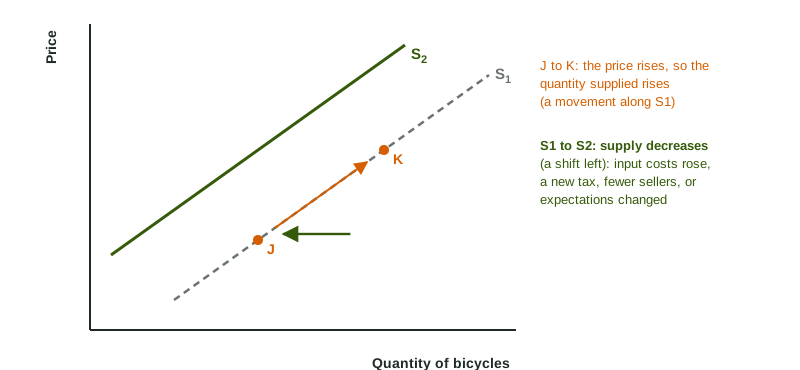
The law of supply says that as a good's price rises, the quantity supplied rises, other things equal.
Part 1 · Hook
Why this matters
Part 2 · Before you start
What this builds on
Part 3 · Prerequisite check
Quick check before you start
1. A rise in the price of a good, with nothing else changing, causes
- a movement along the demand curve
- a shift of the demand curve to the left
- a shift of the demand curve to the right
- no change in quantity demanded
Show the answer
The good's own price moves buyers along the demand curve.
- Correct: a movement along the demand curve:
- a shift of the demand curve to the left:
- a shift of the demand curve to the right:
- no change in quantity demanded:
2. An upward-sloping curve has a slope that is
- positive
- negative
- zero
- undefined
Show the answer
Rising to the right means a positive slope.
- Correct: positive:
- negative:
- zero:
- undefined:
Part 4 · See it
See it first
Part 5 · Step by step
How it works, step by step
- The price of a good risesproducing more becomes worthwhile even though extra output costs more
- Sellers respond to the higher pricethe quantity supplied rises: a movement along the supply curve
- Input costs rise (or a tax is added, or sellers leave the market)sellers offer less at every price
- Sellers offer less at every pricesupply decreases: the whole curve shifts left
Part 6 · Key ideas
Key ideas
- Law of supply: as a good's price rises, the quantity supplied rises, other things equal.
- A change in the good's own price changes the quantity supplied (a movement along the curve). Anything else changes supply (a shift).
- Supply shifters: input costs, technology, taxes and subsidies on producers, expectations, and the number of sellers. Lower costs and more sellers shift supply right.
Part 7 · Misconception
A common mistake
The wrong idea: When the price of a good rises, its supply increases.
What actually happens: A higher price raises the quantity supplied, a movement along the supply curve. Supply, the whole curve, shifts only when something other than the good's own price changes, such as input costs.
Part 8 · Check yourself
Check yourself
Exam-style questions. Anything you miss goes into your review queue.
1. The price of flour rises. Shift the right curve the right way in the market for bread.
Work on the graph (it needs JavaScript), then check.
Show the answer
Higher input costs make each loaf costlier to make, so bakers offer fewer loaves at every price: supply shifts left.
- Key: supply shifts left
2. A new machine lets furniture makers build chairs faster and more cheaply. Shift the right curve the right way in the market for chairs.
Work on the graph (it needs JavaScript), then check.
Show the answer
Better technology lowers the cost of each chair, so makers offer more at every price: supply shifts right.
- Key: supply shifts right
3. The market price of honey rises and nothing else changes. Place point X where the farm ends up on its supply curve.
Work on the graph (it needs JavaScript), then check.
Show the answer
A higher price moves sellers up along the supply curve to a larger quantity supplied. The curve does not shift.
- Key: see the explanation
Data
A honey farm's supply schedule
| Price per jar ($) | Quantity supplied per week |
|---|---|
| 4 | 20 |
| 6 | 40 |
| 8 | 60 |
| 10 | 80 |
4. Using the table, by how many jars a week does the quantity supplied rise when the price rises from $6 to $10?
Type a number. A four-function calculator is allowed, as on the exam.
Show the answer
At $6 the farm offers 40 jars and at $10 it offers 80: more jars.
- Answer: 40
5. What does the table show?
- An increase in supply as the price rises
- The law of supply: a higher price brings a larger quantity supplied
- An inverse relationship between price and quantity supplied
- A shift of the supply curve to the right each time the price changes
Show the answer
Each $2 rise in price brings 20 more jars offered, along one supply curve: the law of supply.
- An increase in supply as the price rises: A price change moves along the supply curve; supply itself does not change.
- Correct: The law of supply: a higher price brings a larger quantity supplied: Right: price and quantity supplied rise together.
- An inverse relationship between price and quantity supplied: Both rise together: a direct relationship.
- A shift of the supply curve to the right each time the price changes: The table is one supply curve; only the price changes.
6. A drought raises the farm's costs, and it now offers 10 fewer jars at every price in the table. What happened?
- Supply decreased: the supply curve shifted left
- Quantity supplied fell along the same supply curve
- Supply increased, because honey became scarcer
- Demand for honey decreased
Show the answer
Fewer jars offered at every price, because of higher costs, is a decrease in supply: a shift left.
- Correct: Supply decreased: the supply curve shifted left: Right: a cost increase shifts supply left.
- Quantity supplied fell along the same supply curve: A movement along the curve needs a change in the honey price.
- Supply increased, because honey became scarcer: Offering less at every price is a decrease in supply.
- Demand for honey decreased: The drought changed the farm's costs, not what buyers want.
7. A reporter writes, "The price of gasoline rose, so the supply of gasoline increased." How should the sentence be fixed?
- "The supply of gasoline decreased"; higher prices lower supply
- "The quantity supplied of gasoline increased"; supply itself did not change
- "The demand for gasoline increased"; price affects buyers
- "Supply and quantity supplied both increased"
Show the answer
A change in the good's own price changes the quantity supplied (a movement along the supply curve). "Supply" means the whole curve.
- "The supply of gasoline decreased"; higher prices lower supply: A higher price raises the quantity supplied; it does not lower supply.
- Correct: "The quantity supplied of gasoline increased"; supply itself did not change: Right: a price change is a movement along the curve.
- "The demand for gasoline increased"; price affects buyers: The sentence is about sellers, and buyers want less at a higher price.
- "Supply and quantity supplied both increased": Only the quantity supplied changes; the curve stays put.
Part 9 · Summary
Summary
Part 10 · Up next
What comes next
Part 11 · Connections