Banking and the Expansion of the Money Supply
Banks hold a fraction of deposits as reserves and lend the rest.
Part 1 · Hook
Why this matters
Part 2 · Before you start
What this builds on
Part 3 · Prerequisite check
Quick check before you start
1. Which of these is counted in M1?
- Checkable deposits
- Small time deposits
- Shares of stock
- Unused credit card limits
Show the answer
M1 counts currency held by the public and checkable deposits.
- Correct: Checkable deposits:
- Small time deposits:
- Shares of stock:
- Unused credit card limits:
2. You deposit $100 of cash into checking. What happens to M1 at that moment?
- It does not change
- It rises by $100
- It falls by $100
- It doubles
Show the answer
Currency turns into a checkable deposit; both are in M1.
- Correct: It does not change:
- It rises by $100:
- It falls by $100:
- It doubles:
Part 4 · See it
See it first
Part 5 · Step by step
How it works, step by step
- A bank receives a depositit keeps the required reserves (deposits x ratio) and has excess reserves to lend
- The bank lends its excess reservesa new checkable deposit is created, so the money supply rises
- The borrowed money is spent and redeposited in other banksthey lend again, so the money supply can grow by up to excess reserves x 1 / required reserve ratio
Part 6 · Key ideas
Key ideas
- In fractional reserve banking, banks keep part of deposits as reserves and lend the rest. A balance sheet lists assets (reserves, loans, bonds) and liabilities (deposits).
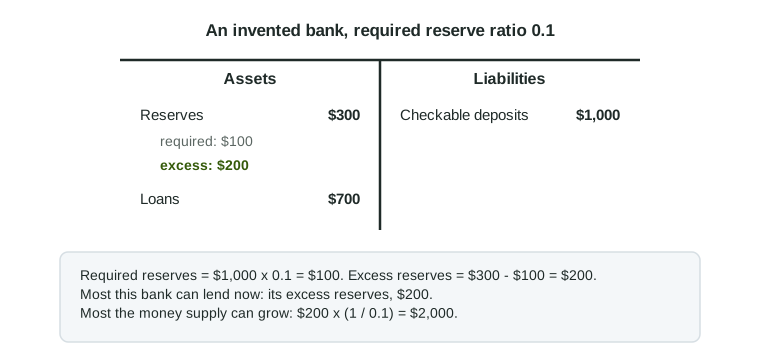
- Required reserves = deposits x required reserve ratio. Excess reserves = total reserves - required reserves. One bank can lend its excess reserves.
- The money multiplier is 1 / required reserve ratio. The most the money supply can grow is excess reserves x the money multiplier. This is the limited reserves picture: banks hold few reserves beyond the required amount, so the reserve requirement limits lending.
- A cash deposit does not change the money supply at first; new money is created when banks lend.
Part 7 · Misconception
A common mistake
The wrong idea: When $1,000 of cash is deposited and the ratio is 0.1, the money supply grows by $10,000.
What actually happens: The $1,000 was already money. Only the $900 of excess reserves is lent, so the money supply grows by at most $900 x 10 = $9,000.
Part 8 · Check yourself
Check yourself
Exam-style questions. Anything you miss goes into your review queue.
1. What is fractional reserve banking?
- Banks keep part of their deposits as reserves and lend out the rest
- Banks hold 100% of deposits as reserves
- Banks lend just the money their owners put in
- Banks hold a fraction of their loans as cash for customers
Show the answer
In fractional reserve banking, banks hold a fraction of deposits as reserves and lend the rest, which lets them create money.
- Correct: Banks keep part of their deposits as reserves and lend out the rest: Right: a fraction is held back; the rest becomes loans.
- Banks hold 100% of deposits as reserves: That would be 100% reserve banking; such banks create no money.
- Banks lend just the money their owners put in: Banks lend out depositors' money, not just owners' equity.
- Banks hold a fraction of their loans as cash for customers: Reserves are a share of deposits, not of loans.
2. The required reserve ratio is 0.25. What is the money multiplier?
Type a number. A four-function calculator is allowed, as on the exam.
Show the answer
Money multiplier =
- Answer: 4
3. A bank lends $8,000 to a customer by adding it to her checking account. What happens to the money supply right away?
- It is unchanged, because the bank lent its own money
- It falls by $8,000, because the bank's reserves fall
- It rises by $8,000
- It rises by $80,000
Show the answer
Banks create money when they lend: the loan becomes a new deposit the borrower can spend.
- It is unchanged, because the bank lent its own money: The new deposit is spendable money that did not exist before, so the money supply rises.
- It falls by $8,000, because the bank's reserves fall: Reserves in a bank are not counted in M1; the new deposit is.
- Correct: It rises by $8,000: Right: the loan creates a new checkable deposit, which is money.
- It rises by $80,000: The full multiplied amount comes only after many rounds of lending, if at all.
Scenario
A cash deposit in a fractional reserve banking system
In the invented country of Zell, the required reserve ratio is 0.1, banks lend all of their excess reserves, and people keep no extra cash. Jordan finds $5,000 in cash under a mattress and deposits it in a checking account at Zell First Bank.
4. How much do Zell First Bank's excess reserves rise because of the deposit, in dollars?
Type a number. A four-function calculator is allowed, as on the exam.
Show the answer
The bank's reserves and deposits both rise by $5,000. It must hold $5,000 x 0.1 = $500, so excess reserves rise by $4,500.
- Answer: 4500
5. What happens to the money supply (M1) at the moment Jordan makes the deposit?
- It rises by $5,000
- It does not change
- It falls by $5,000
- It rises by $50,000
Show the answer
A cash deposit changes the form of money, not the amount. New money is created when the bank lends its excess reserves.
- It rises by $5,000: Checkable deposits rise by $5,000, but currency held by the public falls by $5,000.
- Correct: It does not change: Right: currency becomes a checkable deposit, and both are counted in M1.
- It falls by $5,000: The cash left the public, but the same amount is now a checkable deposit.
- It rises by $50,000: That is the deposit times the multiplier, and money creation happens later, through new loans.
6. What is the most the money supply of Zell can increase as a result of Jordan's deposit, in dollars?
Type a number. A four-function calculator is allowed, as on the exam.
Show the answer
New money comes from lending the excess reserves: $4,500 x (1 / 0.1) = $45,000. The $5,000 deposit itself was already money.
- Answer: 45,000
Part 9 · Summary
Summary
Part 10 · Up next
What comes next
Part 11 · Connections