Changes in the AD-AS Model in the Short Run
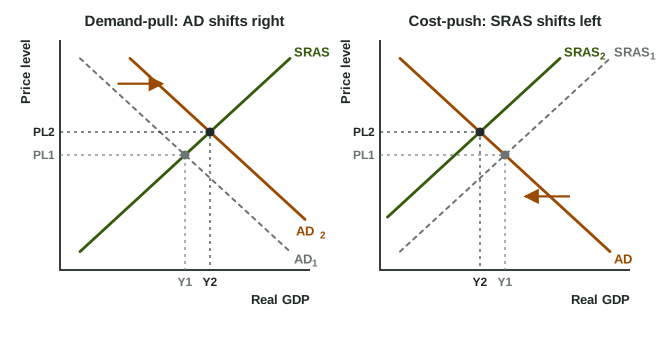
In the short run, a shift of AD moves the price level and real GDP in the same direction (demand-pull inflation when AD rises), while a shift of SRAS moves them in opposite directions (cost-push inflation and stagflation when SRAS falls).
Part 1 · Hook
Why this matters
Part 2 · Before you start
What this builds on
Part 3 · Prerequisite check
Quick check before you start
1. Which change shifts SRAS to the left?
- A rise in input prices
- A rise in consumer spending
- A fall in the price level
- A rise in productivity
Show the answer
Higher input prices raise costs at every price level: SRAS shifts left.
- Correct: A rise in input prices:
- A rise in consumer spending:
- A fall in the price level:
- A rise in productivity:
2. Where is short-run equilibrium in the AD-AS model?
- Where AD crosses SRAS
- Where AD crosses LRAS
- Where SRAS crosses LRAS
- At full-employment output
Show the answer
Short-run equilibrium is where planned spending (AD) equals output supplied (SRAS).
- Correct: Where AD crosses SRAS:
- Where AD crosses LRAS:
- Where SRAS crosses LRAS:
- At full-employment output:
Part 4 · See it
See it first
Part 5 · Step by step
How it works, step by step
- Spending rises at every price level (a positive demand shock)AD shifts right
- AD shifts right along SRASthe price level and real GDP rise; unemployment falls (demand-pull inflation)
- Input costs rise across the economy (a negative supply shock)SRAS shifts left
- SRAS shifts left along ADthe price level rises, real GDP falls and unemployment rises (cost-push inflation)
Part 6 · Key ideas
Key ideas
- A demand shock shifts AD: positive (right) raises the price level and real GDP; negative (left) lowers both.
- A supply shock shifts SRAS: negative (left) raises the price level and lowers real GDP; positive (right) does the reverse.
- Demand-pull inflation: AD right. Cost-push inflation: SRAS left, with higher unemployment too (stagflation).
- In the short run, unemployment moves opposite to real GDP.
- When AD and SRAS both shift, one outcome is indeterminate: say which, and why.
Part 7 · Misconception
A common mistake
The wrong idea: Any rise in the price level means aggregate demand rose, so output must have risen too.
What actually happens: A leftward SRAS shift also raises the price level, but output falls. Check what happened to output before naming the cause.
Part 8 · Check yourself
Check yourself
Exam-style questions. Anything you miss goes into your review queue.
Graph
A shift in Country F's AD-AS graph
1. According to the graph, what happens to the price level and real GDP after the shift?
- The price level and real GDP both rise
- The price level falls and real GDP rises
- The price level and real GDP both fall
- The price level rises and real GDP falls
Show the answer
The new SRAS crosses AD higher and further left: a higher price level and lower real GDP.
- The price level and real GDP both rise: Both rise when AD shifts right. Here SRAS shifted left.
- The price level falls and real GDP rises: That is a rightward SRAS shift, the opposite of the graph.
- The price level and real GDP both fall: Both fall when AD shifts left. Here AD did not move.
- Correct: The price level rises and real GDP falls: Right: SRAS shifted left, so the equilibrium moved up and to the left along AD.
2. What kind of inflation does the graph show?
- Cost-push inflation
- Demand-pull inflation
- Disinflation
- Deflation
Show the answer
A leftward SRAS shift raises the price level while output falls: cost-push inflation.
- Correct: Cost-push inflation: Right: rising costs shifted SRAS left and pushed the price level up.
- Demand-pull inflation: Demand-pull comes from AD shifting right; AD did not move here.
- Disinflation: Disinflation is a slowdown in inflation. Here the price level rises because of a cost increase.
- Deflation: Deflation is a falling price level. Here it rises.
3. In the short run, what happens to Country F's unemployment rate after the shift in the graph?
- It falls, because the price level rises
- It rises, as firms need fewer workers to produce less
- It stays the same, because AD did not move
- It falls, because higher costs force firms to hire more workers
Show the answer
Real GDP falls, so firms need fewer workers and unemployment rises: higher prices and higher unemployment together, stagflation.
- It falls, because the price level rises: A higher price level here comes with lower output, which cuts jobs.
- Correct: It rises, as firms need fewer workers to produce less: Right: lower output means fewer jobs, so unemployment rises along with the price level.
- It stays the same, because AD did not move: Output fell, so employment falls too, whichever curve moved.
- It falls, because higher costs force firms to hire more workers: Higher costs lead firms to produce less, so they hire fewer workers.
4. The world price of oil falls sharply. Shift the right curve and mark the new short-run equilibrium.
Work on the graph (it needs JavaScript), then check.
Show the answer
Cheaper oil lowers costs, so SRAS shifts right: the price level falls and real GDP rises.
- Key: short-run aggregate supply shifts right
5. How does demand-pull inflation differ from cost-push inflation in the short run?
- With demand-pull, real GDP rises; with cost-push, real GDP falls
- With demand-pull, the price level falls; with cost-push, it rises
- Demand-pull comes from higher wages; cost-push from more spending
- They have the same effects, but different names
Show the answer
Both raise the price level. Demand-pull (AD right) raises output and lowers unemployment; cost-push (SRAS left) lowers output and raises unemployment.
- Correct: With demand-pull, real GDP rises; with cost-push, real GDP falls: Right: AD right raises both prices and output, SRAS left raises prices but lowers output.
- With demand-pull, the price level falls; with cost-push, it rises: Both raise the price level. The difference is what happens to output.
- Demand-pull comes from higher wages; cost-push from more spending: Switched: higher wages raise costs (cost-push); more spending is demand-pull.
- They have the same effects, but different names: Their effects on output and unemployment are opposite.
6. Make it specific: explain the short-run effect of a rise in nominal wages across the economy.
Build the answer part by part, then write it in your own words.
Show the answer
Higher wages raise firms' costs, so SRAS shifts left: the price level rises and real output falls.
- An answer that earns the point: Nominal wages rise, so firms' costs increase and SRAS shifts to the left because firms supply less at each price level. The price level rises and real output falls.
Part 9 · Summary
Summary
Part 10 · Up next
What comes next
Part 11 · Connections