Consequences of Population Distribution
Geographers measure crowding in three ways.
Part 1 · Hook
Why this matters
Part 2 · Before you start
What this builds on
Part 3 · Prerequisite check
Quick check before you start
1. What is population distribution?
- The pattern of where people live
- The number of people in a country
- How fast a population grows
- The part of Earth where people live permanently
Show the answer
Population distribution is the pattern of where people live across an area.
- Correct: The pattern of where people live:
- The number of people in a country:
- How fast a population grows:
- The part of Earth where people live permanently:
2. Most Egyptians live in which part of the country?
- The Nile valley and delta
- The Western Desert
- The Red Sea mountains
- The Sinai Peninsula
Show the answer
The Nile gives water in a desert country, so people cluster along it.
- Correct: The Nile valley and delta:
- The Western Desert:
- The Red Sea mountains:
- The Sinai Peninsula:
Part 4 · See it
See it first
Part 5 · Step by step
How it works, step by step
- Many people live on a small area of farmlandphysiological density is high
- Physiological density is higheach person depends on very little farmland, so land is farmed hard or food is bought from other places
- Few farmers work large areas of farmland with machinesagricultural density is low
- People are spread thinly over a large areaservices such as clinics and schools are far apart and cost more per person
Part 6 · Key ideas
Key ideas
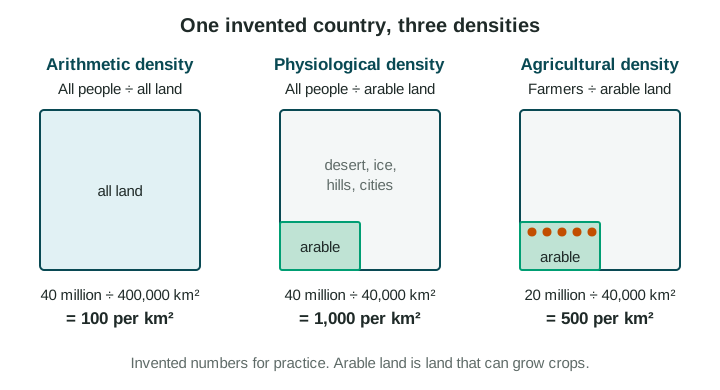
- Arithmetic density = all people ÷ all land. Physiological density = all people ÷ arable land (land that can grow crops). Agricultural density = farmers ÷ arable land.
- High physiological density means each person depends on little farmland. Low agricultural density usually means machines and large farms.
- Carrying capacity is how many people an area can support without damage. It depends on technology and trade, so it is not the same as density.
- Density shapes services: low density makes services far away and costly per person; high density crowds roads, housing and hospitals.
Part 7 · Misconception
A common mistake
The wrong idea: A place with a very high population density has passed its carrying capacity.
What actually happens: Density measures crowding. Carrying capacity is how many people an area can support, and it depends on technology, resources and trade. The Netherlands is very dense and grows food to export.
Part 8 · Check yourself
Check yourself
Exam-style questions. Anything you miss goes into your review queue.
Data
Land, farmland and people in three countries
| Country | Population | Land area (km²) | Arable land (km²) | Farmers |
|---|---|---|---|---|
| Country X | 40 million | 400,000 | 40,000 | 20 million |
| Country Y | 40 million | 2,000,000 | 400,000 | 2 million |
| Country Z | 10 million | 50,000 | 5,000 | 1 million |
Invented data for practice.
1. Use the table. What is the arithmetic density of Country X, in people per square kilometer?
Type a number (people/km²). No calculator needed: work it out by hand, as on the exam.
Show the answer
Arithmetic density is total population divided by total land area:
- Answer: 100 people/km²
2. Use the table. What is the physiological density of Country Y, in people per square kilometer of arable land?
Type a number (people/km²). No calculator needed: work it out by hand, as on the exam.
Show the answer
Physiological density is total population divided by arable land:
- Answer: 100 people/km²
3. Which country has the highest physiological density, and what does that suggest?
- Country X: it has the most farmers of the three countries
- Country Y: it has the most land and the most arable land of the three
- Country Z: its farmland must feed the most people per km²
- Countries X and Y: they have the same number of people
Show the answer
Physiological density compares people with arable land. Country Z has 2,000 people per km² of arable land, the most pressure on its farmland of the three.
- Country X: it has the most farmers of the three countries: X has the most farmers, which raises agricultural density, not physiological density (1,000 per km²).
- Country Y: it has the most land and the most arable land of the three: a large area of arable land lowers physiological density; Y has 100 per km².
- Correct: Country Z: its farmland must feed the most people per km²: Right: Z has 10 million people on 5,000 km² of arable land, 2,000 per km².
- Countries X and Y: they have the same number of people: the same population on different amounts of farmland gives different physiological densities.
4. A student says, "Country Z has the highest densities, so it has passed its carrying capacity." Why does the table NOT support this claim?
- Carrying capacity depends on technology and trade, not shown here
- Country Z has the fewest farmers, so its density is low
- Carrying capacity is the same thing as arithmetic density
- A density is not something you can work out from a population and a land area
Show the answer
Carrying capacity is the number of people an area can support without harming it. It depends on technology, water, soil and trade. A high density does not prove a place has passed its carrying capacity: the Netherlands is very dense and well fed.
- Correct: Carrying capacity depends on technology and trade, not shown here: Right: density measures crowding; carrying capacity is how many people an area can support.
- Country Z has the fewest farmers, so its density is low: Z has the highest arithmetic and physiological densities in the table.
- Carrying capacity is the same thing as arithmetic density: this is the mix-up the question is about; they are different ideas.
- A density is not something you can work out from a population and a land area: it can: arithmetic density is population divided by land area.
5. The Netherlands has one of the highest population densities in Europe, yet it grows a large surplus of food for export. Which idea does this best show?
- Agricultural density and carrying capacity are two names for the same measure
- Physiological density is low wherever farms export food
- Dense countries have to buy their food from other countries
- High density does not mean an area has passed its carrying capacity
Show the answer
Carrying capacity depends on technology and how land is used, so it differs from density. The Netherlands is crowded but its very productive farms keep it well within what its land and trade can support.
- Agricultural density and carrying capacity are two names for the same measure: they are different: one counts farmers per km² of farmland, the other people an area can support.
- Physiological density is low wherever farms export food: exports depend on how productive farms are, not on that ratio.
- Dense countries have to buy their food from other countries: the Netherlands is dense and still exports large amounts of food.
- Correct: High density does not mean an area has passed its carrying capacity: Right: technology and trade can let a crowded country feed itself and others.
6. Which are likely effects of very high population density in a city? Select all that apply.
- Crowded public transport and roads
- Pressure on water supply and waste systems
- Long travel distances to the nearest school
- Clinics closing because too few patients live nearby
- More land per person for homes and gardens
Show the answer
High density crowds roads and transit and strains water and waste systems. Low density brings the opposite problems: long distances and services with too few users.
- Correct: Crowded public transport and roads: Right: many people share the same space and routes.
- Correct: Pressure on water supply and waste systems: Right: more people per km² use more water and make more waste in one place.
- Long travel distances to the nearest school: High density usually puts schools close by.
- Clinics closing because too few patients live nearby: That is an effect of low density.
- More land per person for homes and gardens: High density means less land per person.
Part 9 · Summary
Summary
Part 10 · Up next
What comes next
Part 11 · Connections