Human Impacts on Wetlands and Mangroves
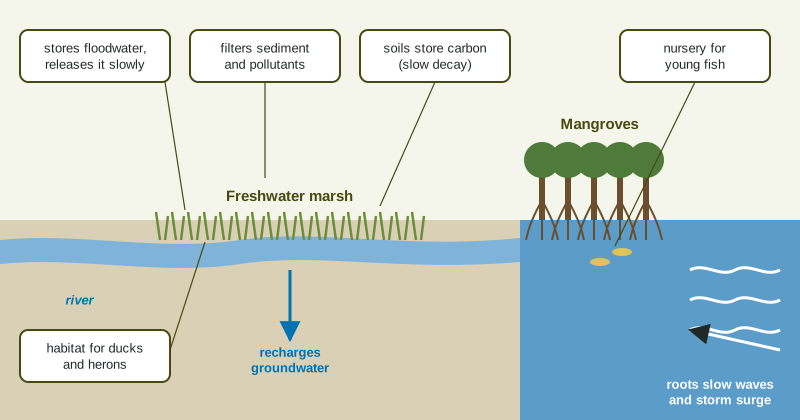
Wetlands and mangroves provide valuable ecosystem services: they store floodwater, recharge groundwater, filter pollutants, store carbon, buffer coasts against storm surge and shelter fish and birds.
Part 1 · Hook
Why this matters
Part 2 · Before you start
What this builds on
Part 3 · Prerequisite check
Quick check before you start
1. Which of these is a regulating ecosystem service?
- Flood control by a wetland
- Timber from a forest
- Fish caught for food
- A hiking trail
Show the answer
Regulating services control natural processes, such as floods and water quality.
- Correct: Flood control by a wetland:
- Timber from a forest:
- Fish caught for food:
- A hiking trail:
2. Where do mangroves grow?
- Along warm, tropical coasts in salty water
- In cold mountain streams
- In deserts far from water
- In the open ocean
Show the answer
Mangroves are salt-tolerant trees of tropical and subtropical coasts.
- Correct: Along warm, tropical coasts in salty water:
- In cold mountain streams:
- In deserts far from water:
- In the open ocean:
Part 4 · See it
See it first
Part 5 · Step by step
How it works, step by step
- Wetlands and mangroves are drained, filled or cleared for building, farming or shrimp pondstheir plants, soils and water storage are lost
- Floodwater has nowhere to spread and soak indownstream flooding becomes more frequent and severe
- Water no longer passes slowly through wetland plants and soilsmore sediment, nutrients and pollutants reach rivers and coasts
- Coasts lose their mangrove beltstorm surges and waves reach homes with more force, and nursery habitat for fish is lost
Part 6 · Key ideas
Key ideas
- Ecosystem services of wetlands: store floodwater, recharge groundwater, filter pollutants and sediment, store carbon, and give habitat and nurseries for fish and birds.
- Mangroves protect coasts from storm surge and erosion with their dense roots, and shelter young fish.
- Threats: wetland drainage and filling for development and farms, dams and water diversion, pollution, and clearing mangroves for shrimp aquaculture.
- Protection: laws such as the Clean Water Act permit process, mitigation (avoid, minimize, restore), conservation easements and restoration.
Part 7 · Misconception
A common mistake
The wrong idea: A wetland that is not farmed or built on is unused land.
What actually happens: A wetland is working all the time: storing floodwater, filtering water, storing carbon and sheltering wildlife. Filling it removes those services.
Part 8 · Check yourself
Check yourself
Exam-style questions. Anything you miss goes into your review queue.
Passage
A passage on a proposed wetland development
A developer has asked the county to drain and fill 120 hectares of freshwater marsh beside the Willow River to build 400 homes and a shopping center. The developer argues that the marsh is "unused land" that breeds mosquitoes, and that the project will bring 600 jobs and new tax money for schools. To offset the loss, the developer offers to build a 40-hectare artificial pond elsewhere in the county. A group of downstream farmers opposes the plan. They point out that the marsh soaks up water during spring storms, and they fear more frequent flooding of their fields. A local birding club adds that the marsh is a stopover for migrating ducks and herons. The county must decide next month.
Invented passage for practice.
1. What is the developer's main claim?
- The marsh protects downstream farms from flooding
- The marsh is unused land that jobs would put to use
- The marsh is an important stopover for migrating birds
- The county should delay its decision for a year
Show the answer
The developer claims the marsh is unused land and that building on it will bring jobs and tax money, with a pond to offset the loss.
- The marsh protects downstream farms from flooding: That is the farmers' point, not the developer's.
- Correct: The marsh is unused land that jobs would put to use: Right: that is the developer's argument.
- The marsh is an important stopover for migrating birds: That is the birding club's point.
- The county should delay its decision for a year: Nobody in the passage asks for a delay.
2. Which assumption underlies calling the marsh "unused land"?
- Land without buildings or crops is worth little
- Marshes store more water than any other ecosystem
- Migrating birds can find another stopover easily
- Farmers downstream will benefit from the new jobs
Show the answer
The phrase assumes land has value only when people build on it or farm it, ignoring the ecosystem services the marsh already provides, such as flood control and habitat.
- Correct: Land without buildings or crops is worth little: Right: it overlooks the services the marsh already gives.
- Marshes store more water than any other ecosystem: That is not an assumption the developer needs or makes.
- Migrating birds can find another stopover easily: The developer does not mention birds.
- Farmers downstream will benefit from the new jobs: The passage does not link the jobs to the farmers.
3. Which evidence would most strengthen the farmers' argument?
- A survey showing residents want a shopping center
- A count of the herons that use the marsh each spring
- A report that the new homes will be well insulated
- Floods rose after a similar marsh was filled
Show the answer
Their argument is that the marsh absorbs floodwater. Measurements showing how much water the marsh holds in storms, or flooding after similar marshes were filled, support it directly.
- A survey showing residents want a shopping center: That supports the developer, not the farmers.
- A count of the herons that use the marsh each spring: That supports the birding club, not the flood claim.
- A report that the new homes will be well insulated: Insulation has nothing to do with flooding.
- Correct: Floods rose after a similar marsh was filled: Right: that tests their claim about floodwater directly.
4. Which of these is an ecosystem service provided by wetlands?
- Producing most of the world's crude oil
- Making the air warmer in winter
- Raising the salinity of nearby rivers
- Filtering pollutants from the water
Show the answer
Wetland plants and soils filter sediment and pollutants from water and store floodwater, among many other services.
- Producing most of the world's crude oil: Oil forms deep underground over millions of years, not in wetlands today.
- Making the air warmer in winter: That is not a wetland ecosystem service.
- Raising the salinity of nearby rivers: Wetlands do not raise river salinity as a service.
- Correct: Filtering pollutants from the water: Right: wetlands clean water and reduce flooding.
Data
Mangrove cover and storm damage in five coastal villages
| Village | Mangrove belt width (m) | Homes damaged (%) |
|---|---|---|
| North Point | 0 | 78 |
| Fisher Bay | 50 | 61 |
| Long Shore | 200 | 34 |
| Palm Inlet | 500 | 15 |
| Delta Head | 1,000 | 9 |
5. What relationship do the data show between mangrove belt width and storm damage?
- Wider mangrove belts go with more storm damage
- Wider mangrove belts go with less storm damage
- Belt width makes no difference to the damage
- Damage falls until 200 m, then rises again
Show the answer
The wider the mangrove belt, the smaller the share of homes damaged: 78% with none, 9% behind 1,000 m.
- Wider mangrove belts go with more storm damage: Damage falls, not rises, as the belt widens.
- Correct: Wider mangrove belts go with less storm damage: Right: damage falls steadily as the belt widens.
- Belt width makes no difference to the damage: Damage ranges from 78% to 9% across the villages.
- Damage falls until 200 m, then rises again: It keeps falling at 500 m and 1,000 m.
6. How do mangroves reduce storm damage to the villages behind them?
- Dense roots and trunks slow waves and storm surge
- Mangroves make the cyclone's winds blow out to sea
- Mangroves raise the air temperature, which weakens storms
- Mangroves soak up the rain before it falls on homes
Show the answer
The dense tangle of mangrove roots and trunks slows waves and storm surge and holds sediment in place, so less water and energy reach the homes.
- Correct: Dense roots and trunks slow waves and storm surge: Right: they absorb wave energy before it reaches land.
- Mangroves make the cyclone's winds blow out to sea: Mangroves do not change the direction of a cyclone.
- Mangroves raise the air temperature, which weakens storms: They do not weaken cyclones by heating the air.
- Mangroves soak up the rain before it falls on homes: Trees do not stop the rain from falling.
7. A marsh covers 120 hectares. During a storm it stores water 0.5 meters deep across its whole area. Write the setup, with units, for the volume of water it stores in cubic meters (1 ha = 10,000 m²), then the answer.
Type the setup as on the exam, with brackets and units, then the answer.
Show the answer
- Setup: ; answer 600,000 m3
Part 9 · Summary
Summary
Part 10 · Up next
What comes next
Part 11 · Connections