Pollution and Human Health
Linking a pollutant to a disease is hard because people face many exposures over long times.
Part 1 · Hook
Why this matters
Part 2 · Before you start
What this builds on
Part 3 · Prerequisite check
Quick check before you start
1. What does the threshold dose on a dose-response curve show?
- The highest dose with no observed response
- The dose that kills half the test group
- The largest dose tested
- The dose that affects every animal
Show the answer
The threshold is where the curve leaves zero: below it, no effect is seen.
- Correct: The highest dose with no observed response:
- The dose that kills half the test group:
- The largest dose tested:
- The dose that affects every animal:
2. Which air pollutant forms near the ground from NOx and VOCs in sunlight?
- Ground-level ozone
- Carbon dioxide
- Radon
- Sulfur dioxide
Show the answer
Ground-level ozone is a secondary pollutant made in photochemical smog.
- Correct: Ground-level ozone:
- Carbon dioxide:
- Radon:
- Sulfur dioxide:
Part 4 · See it
See it first
Part 5 · Step by step
How it works, step by step
- People are exposed to many pollutants, at different doses, over many yearsit is hard to link one illness to one pollutant
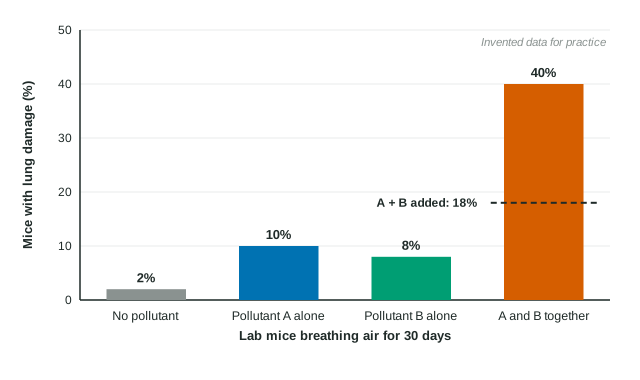
- Two pollutants that interact inside the bodycan cause more harm together than their separate effects add up to (synergism)
- A short, high exposurecauses acute effects soon after, such as dizziness or an asthma attack
- A long, low exposure, such as asbestos fibers or leadcauses chronic effects that may appear years later, such as mesothelioma
Part 6 · Key ideas
Key ideas
- Cause and effect are hard to prove in people: exposures are mixed and long, other factors vary, and many diseases take years to appear.
- Synergism: two or more substances together cause more harm than the sum of their separate effects.
- Acute effects follow a short, high exposure quickly. Chronic effects follow long or repeated exposure and may take years to appear.
- Examples to know: ground-level ozone lowers lung function and triggers asthma; asbestos causes mesothelioma; untreated sewage in drinking water spreads dysentery.
Part 7 · Misconception
A common mistake
The wrong idea: If pollutant A alone damages 10% of lungs and pollutant B alone damages 8%, together they must damage 18%.
What actually happens: Effects do not always add. With synergism, the combined harm can be much larger: 40% in the mouse study, more than twice the sum.
Part 8 · Check yourself
Check yourself
Exam-style questions. Anything you miss goes into your review queue.
1. A worker breathes in a large amount of a solvent in one afternoon and gets dizzy within minutes. Another worker breathes small amounts of the same solvent every day for 20 years and develops liver disease. Which statement is correct?
- The first is a chronic effect and the second an acute effect
- The first is an acute effect and the second a chronic effect
- Both are acute effects, since the same solvent caused them
- Both are chronic effects, since each harmed a body organ
Show the answer
Acute: a short exposure, effects soon after. Chronic: long or repeated exposure, effects that appear over months or years.
- The first is a chronic effect and the second an acute effect: Reversed: the quick reaction to one large exposure is acute, and harm after years of exposure is chronic.
- Correct: The first is an acute effect and the second a chronic effect: Right: acute effects come soon after a short, high exposure; chronic effects follow long, repeated exposure.
- Both are acute effects, since the same solvent caused them: Acute and chronic describe timing and length of exposure, not which chemical is involved.
- Both are chronic effects, since each harmed a body organ: Harm to an organ can be acute or chronic; the dizziness came within minutes of one exposure.
Data
Lung damage in mice from two air pollutants
2. If the two pollutants simply added their effects, what percent of the mice exposed to both would be expected to have lung damage? Add the two single-pollutant results.
Type a number, then its unit (%). Scale words (2.5 million) and powers of ten (2.5 × 10^6) are read.
Show the answer
Add the effects of each pollutant alone: . The observed 40% is far above this.
- Answer: 18 %
3. By how many times does the observed result for both pollutants exceed what simple addition predicts? Divide the observed percent by the sum of the single-pollutant percents.
Type a number. Scale words (2.5 million) and powers of ten (2.5 × 10^6) are read.
Show the answer
- Answer: 2.22
4. Which conclusion do the data support?
- Pollutant A is harmless, since it damaged the lungs of 10% of mice
- A and B are synergistic: over twice the expected damage
- A and B cancel each other out, since the effects are not added
- The control mice had lung damage, so the study shows nothing
Show the answer
The combined bar (40%) towers over the sum of the separate effects (18%), which is synergism.
- Pollutant A is harmless, since it damaged the lungs of 10% of mice: 10% is five times the control’s 2%, so A does cause damage.
- Correct: A and B are synergistic: over twice the expected damage: Right: 40% observed is more than twice the 18% that adding their effects would give.
- A and B cancel each other out, since the effects are not added: Cancelling would give less damage than either alone; the result is far more.
- The control mice had lung damage, so the study shows nothing: 2% damage in the control is the baseline every group is compared with.
5. What is the purpose of the group of mice that breathed clean air?
- To prove that clean air causes 2% of the mice to have lung damage
- To give the researchers more mice in the study for less money
- A baseline: the lung damage with neither pollutant
- To expose the mice to a smaller dose of pollutant A and B together
Show the answer
A control group is a baseline: it shows what happens without the treatment, so the effect of each pollutant can be measured against it.
- To prove that clean air causes 2% of the mice to have lung damage: The control is not a test of clean air; it shows the background level of damage.
- To give the researchers more mice in the study for less money: Saving money is not the reason; the group is there for comparison.
- Correct: A baseline: the lung damage with neither pollutant: Right: the 2% in clean air shows damage from other causes, so effects can be measured against it.
- To expose the mice to a smaller dose of pollutant A and B together: The control gets neither pollutant; that is what makes it a baseline.
6. Untreated sewage flows into a river that a village uses for drinking water. Which illness is the village most likely to see more of?
- Dysentery, spread by microbes in feces
- Mesothelioma, a cancer of the lining of the lungs
- Skin cancer from more ultraviolet light
- Asthma from ground-level ozone
Show the answer
Sewage carries microbes from human waste. Drinking that water spreads dysentery, a leading cause of illness where sanitation is poor.
- Correct: Dysentery, spread by microbes in feces: Right: dysentery spreads through water contaminated with untreated sewage.
- Mesothelioma, a cancer of the lining of the lungs: Mesothelioma is caused mainly by breathing asbestos fibers, not by sewage.
- Skin cancer from more ultraviolet light: Sewage in water does not change ultraviolet light.
- Asthma from ground-level ozone: Ozone is an air pollutant; sewage contaminates water.
7. Which are examples of chronic exposure? Select all that apply.
- A farmworker handles small amounts of a pesticide every season for 15 years
- A worker breathes chlorine gas from one spill and coughs for a day
- A driver breathes thick smoke for ten minutes during a single fire
- A hiker is stung once by a bee
Show the answer
Chronic exposure is long or repeated; acute exposure is short, often a single event. Only the farmworker’s 15 years of exposure is chronic.
- Correct: A farmworker handles small amounts of a pesticide every season for 15 years: Right: repeated, long-term exposure is chronic.
- A worker breathes chlorine gas from one spill and coughs for a day: One short, high exposure with effects within hours is acute.
- A driver breathes thick smoke for ten minutes during a single fire: One short, high exposure is acute.
- A hiker is stung once by a bee: A single short exposure is acute, not chronic.
Part 9 · Summary
Summary
Part 10 · Up next
What comes next
Part 11 · Connections