Pathogens and Infectious Diseases
Pathogens are bacteria, viruses, protozoa, fungi and worms that cause infectious diseases.
Part 1 · Hook
Why this matters
Part 2 · Prerequisite check
Quick check before you start
1. In which treatment stage of a sewage plant do bacteria break down dissolved organic matter?
- Secondary treatment
- Primary treatment
- Septic tank
- Sludge removal
Show the answer
Secondary treatment uses bacteria to break down organic matter that primary settling leaves behind.
- Correct: Secondary treatment:
- Primary treatment:
- Septic tank:
- Sludge removal:
2. An effect that shows up only after many years of exposure is called what?
- A chronic effect
- An acute effect
- A threshold dose
- Synergism
Show the answer
Chronic effects follow long or repeated exposure.
- Correct: A chronic effect:
- An acute effect:
- A threshold dose:
- Synergism:
Part 3 · See it
See it first
Part 4 · Step by step
How it works, step by step
- A pathogen (a bacterium, virus, protozoan, fungus or worm) infects a person or animalit multiplies and causes an infectious disease
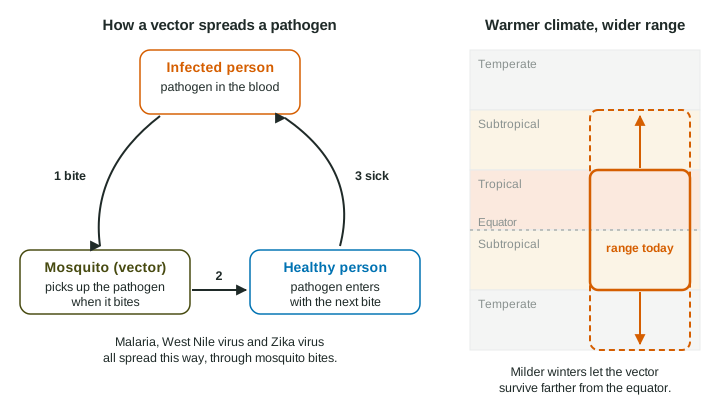
- Contaminated water, the air, food, contact or a vector carries it onthe disease spreads to new hosts
- Poor sanitation, crowding and little health caremake spread easier, so developing countries carry much of the burden
- A warming climatelets vectors such as mosquitoes survive in new places, widening the disease’s range
Part 5 · Key ideas
Key ideas
- A pathogen causes disease: bacteria, viruses, protozoa, fungi and parasitic worms. An infectious disease is one that can spread to new hosts.
- A disease vector is a living thing, often an insect, that carries a pathogen between hosts: mosquitoes (malaria, West Nile virus, Zika virus), fleas (plague).
- Routes to know: waterborne (cholera, dysentery), airborne (tuberculosis; SARS and MERS are respiratory viruses that jumped from animals), vector-borne (malaria, plague, West Nile, Zika).
- Climate change can spread vectors to new latitudes and elevations; floods can push sewage into drinking water.
Part 6 · Misconception
A common mistake
The wrong idea: The mosquito is the cause of malaria.
What actually happens: Malaria is caused by a protozoan parasite. The mosquito is the vector: it carries the parasite from one person to the next. Controlling the vector breaks the chain.
Part 7 · Check yourself
Check yourself
Exam-style questions. Anything you miss goes into your review queue.
1. What is a pathogen?
- A bacterium, virus or other agent that causes disease
- An animal, such as a mosquito, that carries disease to people
- A chemical pollutant that builds up in body fat
- An illness that does not pass from person to person
Show the answer
A pathogen is a disease-causing agent: a bacterium, virus, protozoan, fungus or parasitic worm.
- Correct: A bacterium, virus or other agent that causes disease: Right: pathogens include bacteria, viruses, protozoa, fungi and parasitic worms.
- An animal, such as a mosquito, that carries disease to people: An animal that carries a pathogen is a vector, not the pathogen itself.
- A chemical pollutant that builds up in body fat: That describes a persistent organic pollutant, not a pathogen.
- An illness that does not pass from person to person: Pathogens cause infectious diseases, which can spread.
2. In the spread of malaria, what is the role of the Anopheles mosquito?
- It is the pathogen that infects people’s red blood cells
- It is the vector: it carries the parasite between people
- It is the host that becomes sick with malaria symptoms
- It kills the parasite before it can reach people
Show the answer
Malaria is caused by a protozoan parasite; Anopheles mosquitoes are the vector that carries it between people.
- It is the pathogen that infects people’s red blood cells: The pathogen is a protozoan parasite (Plasmodium); the mosquito carries it.
- Correct: It is the vector: it carries the parasite between people: Right: the mosquito picks up the parasite in one bite and passes it on in the next.
- It is the host that becomes sick with malaria symptoms: People get sick with malaria; the mosquito carries the parasite.
- It kills the parasite before it can reach people: The mosquito spreads the parasite; it does not kill it.
Data
Six infectious diseases and how they spread
| Disease | Pathogen | Main route of spread |
|---|---|---|
| Malaria | protozoan (Plasmodium) | bites of Anopheles mosquitoes |
| Cholera | bacterium | water or food contaminated with feces |
| Tuberculosis | bacterium | air, from the coughs of an infected person |
| Plague | bacterium | bites of fleas from infected rodents |
| West Nile virus | virus | bites of Culex mosquitoes that fed on infected birds |
| Zika virus | virus | bites of Aedes mosquitoes |
3. Which disease in the table spreads mainly through water or food contaminated with feces?
- Malaria
- Tuberculosis
- Cholera
- Zika virus
Show the answer
Cholera is a waterborne bacterial disease; improving sanitation and treating drinking water prevent it.
- Malaria: Malaria spreads through the bites of infected mosquitoes, not water.
- Tuberculosis: Tuberculosis spreads through the air when an infected person coughs.
- Correct: Cholera: Right: cholera bacteria spread in water and food contaminated with sewage.
- Zika virus: Zika spreads mainly through the bites of Aedes mosquitoes.
4. Which two diseases in the table are spread by the same kind of vector?
- Cholera and tuberculosis, both spread by mosquitoes
- Plague and cholera, both spread by fleas
- Tuberculosis and plague, both spread by drinking water
- Malaria and West Nile virus, both spread by mosquitoes
Show the answer
Malaria, West Nile virus and Zika virus all use mosquitoes as vectors.
- Cholera and tuberculosis, both spread by mosquitoes: Neither has a mosquito vector: cholera is waterborne and tuberculosis airborne.
- Plague and cholera, both spread by fleas: Plague spreads through flea bites; cholera spreads through dirty water.
- Tuberculosis and plague, both spread by drinking water: Neither spreads mainly through drinking water.
- Correct: Malaria and West Nile virus, both spread by mosquitoes: Right: both are carried by mosquitoes (Anopheles for malaria, Culex for West Nile).
5. For which disease in the table would building sewage treatment plants and safe water supplies do the most to cut cases?
- Cholera
- Plague
- West Nile virus
- Tuberculosis
Show the answer
Match the solution to the route: for a waterborne disease, keep sewage out of drinking water.
- Correct: Cholera: Right: cholera spreads through water contaminated with feces, so clean water and sewage treatment stop it.
- Plague: Plague is spread by fleas on rodents; water treatment does not stop it.
- West Nile virus: West Nile spreads by mosquito bites, not drinking water.
- Tuberculosis: Tuberculosis spreads through the air; ventilation and treatment matter more.
6. A region reported 2,400 cholera cases in the year before its main city opened a water treatment plant, and 600 cases the year after. What was the percent change in cases?
Type a number, then its unit (%). Scale words (2.5 million) and powers of ten (2.5 × 10^6) are read.
Show the answer
- Answer: -75 %
Model or diagram
A mosquito-borne disease cycle and a warming climate
7. Which action would break the cycle in the diagram at the vector?
- Draining standing water where mosquitoes lay their eggs
- Treating the town’s drinking water with chlorine
- Asking sick people to cover their mouths when they cough
- Cooking meat to a higher temperature
Show the answer
Mosquito control (removing standing water, bed nets, repellents) targets the vector step of the cycle.
- Correct: Draining standing water where mosquitoes lay their eggs: Right: fewer breeding sites means fewer mosquitoes to carry the pathogen.
- Treating the town’s drinking water with chlorine: Chlorine stops waterborne diseases, but this pathogen is carried by mosquitoes.
- Asking sick people to cover their mouths when they cough: Covering coughs slows airborne diseases, not mosquito-borne ones.
- Cooking meat to a higher temperature: Cooking stops foodborne pathogens; this one is spread by bites.
Part 8 · Summary
Summary
Part 9 · Up next
What comes next
Part 10 · Connections