Impacts of Mining
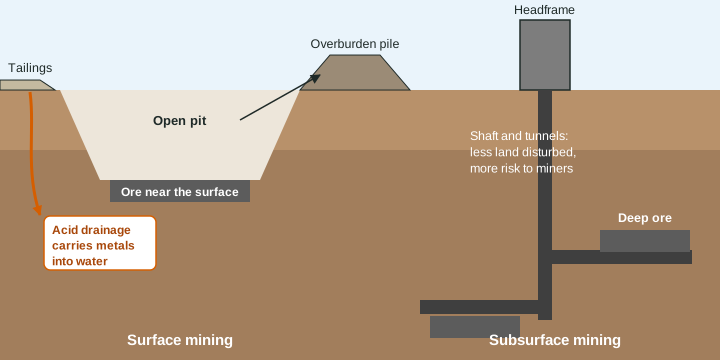
Mining extracts ore and coal by surface methods (strip, open-pit, mountaintop removal), which remove overburden over large areas, or by subsurface methods, which are more dangerous for miners.
Part 1 · Hook
Why this matters
Part 2 · Before you start
What this builds on
Part 3 · Prerequisite check
Quick check before you start
1. A stream has a pH of 4. Compared with a stream at pH 7, it is
- 1,000 times more acidic
- 3 times more acidic
- 1,000 times less acidic
- 30 times more acidic
Show the answer
Each pH unit is a factor of 10: 10 × 10 × 10 = 1,000.
- Correct: 1,000 times more acidic:
- 3 times more acidic:
- 1,000 times less acidic:
- 30 times more acidic:
2. Which land change usually increases erosion?
- Removing the plants and topsoil from a hillside
- Planting grass on bare ground
- Leaving leaf litter on a forest floor
- Covering bare soil with straw
Show the answer
Bare soil without roots or cover erodes quickly.
- Correct: Removing the plants and topsoil from a hillside:
- Planting grass on bare ground:
- Leaving leaf litter on a forest floor:
- Covering bare soil with straw:
Part 4 · See it
See it first
Part 5 · Step by step
How it works, step by step
- Mining exposes sulfide minerals in rock and waste piles to air and rainthe minerals react to form sulfuric acid
- Acid water flows out of the mine and waste pilesthe pH of nearby streams falls
- Acidic water dissolves metals such as lead, mercury and arsenic from the rocktoxic metals enter streams and groundwater
- Low pH and metals reach aquatic lifefish and insects die and the stream can stay polluted for decades
Part 6 · Key ideas
Key ideas
- Ore is rock with enough valuable mineral to mine at a profit. As rich ores run out, lower-grade ore means more rock moved and more waste per kilogram of metal.
- Surface mining (strip, open-pit, mountaintop removal) removes the overburden to reach shallow ore: cheaper and safer for miners, but it destroys habitat and leaves huge waste piles.
- Subsurface mining uses shafts and tunnels for deep ore: less land disturbed, but more dangerous for miners and the ground above can sink.
- Mine waste causes acid mine drainage, metal pollution, sediment and dust. Land reclamation regrades the land, replaces topsoil and replants it.
Part 7 · Misconception
A common mistake
The wrong idea: Once a mine closes, its pollution stops.
What actually happens: Waste rock and tailings keep reacting with air and rain for decades or centuries. Acid mine drainage from mines closed long ago still pollutes thousands of kilometers of streams.
Part 8 · Check yourself
Check yourself
Exam-style questions. Anything you miss goes into your review queue.
1. What is overburden?
- The soil and rock removed from on top of a deposit
- The valuable mineral that is left after the ore is processed
- The water that is pumped out of a deep mine shaft
- The machine that lifts ore to the top of a mine shaft
Show the answer
Overburden lies above the ore and is stripped away in surface mining.
- Correct: The soil and rock removed from on top of a deposit: Right: the material above the ore.
- The valuable mineral that is left after the ore is processed: The waste left after processing is tailings, not the mineral itself.
- The water that is pumped out of a deep mine shaft: Pumped water is mine water, not overburden.
- The machine that lifts ore to the top of a mine shaft: The structure over a shaft is a headframe.
2. How does acid mine drainage form?
- Sulfide minerals in exposed rock react with air and water
- Acidic rainwater falls on the mine and collects in the pit as acid
- Miners pour acid into the mine to dissolve the ore and leave it there
- Coal burned at the mine releases acid that drips into nearby streams
Show the answer
Mining exposes sulfide minerals such as pyrite to oxygen and water, which form sulfuric acid.
- Correct: Sulfide minerals in exposed rock react with air and water: Right: sulfides plus air and water make sulfuric acid.
- Acidic rainwater falls on the mine and collects in the pit as acid: Rain is only slightly acidic; acid mine drainage comes from the exposed rock itself.
- Miners pour acid into the mine to dissolve the ore and leave it there: Acid drainage forms naturally from the rock; it is not poured in.
- Coal burned at the mine releases acid that drips into nearby streams: Coal is not burned at the mine to make drainage.
Data
A stream above and below an old mine
| Measurement | Upstream of the mine | Downstream of the mine |
|---|---|---|
| pH | 7.0 | 4.0 |
| Dissolved iron (mg/L) | 0.1 | 12 |
| Dissolved zinc (mg/L) | 0.01 | 1.5 |
| Kinds of insects found in 1 m² of stream bottom | 22 | 3 |
3. Which comparison does the table show?
- The downstream water is more acidic and has more iron and zinc
- The downstream water is less acidic and has less dissolved iron and zinc
- The two samples have the same pH but different numbers of insects
- The upstream water is more acidic and has more kinds of insects
Show the answer
Downstream pH is 4.0 (more acidic) and iron and zinc are far higher.
- Correct: The downstream water is more acidic and has more iron and zinc: Right: lower pH and higher metals downstream.
- The downstream water is less acidic and has less dissolved iron and zinc: Downstream has a lower pH, which is more acidic, and more metal.
- The two samples have the same pH but different numbers of insects: The pH values differ, 7.0 against 4.0.
- The upstream water is more acidic and has more kinds of insects: Upstream is neutral (pH 7.0), not more acidic.
4. How many times more acidic (higher in hydrogen ion concentration) is the downstream water than the upstream water?
Type a number, then its unit (times). Scale words (2.5 million) and powers of ten (2.5 × 10^6) are read.
Show the answer
Each pH unit is a factor of 10. The difference is units, so times more acidic.
- Answer: 1000 times
5. Write the setup for the percent change in the number of kinds of insects from upstream to downstream, then give the answer.
Type the setup as on the exam, with brackets and units, then the answer.
Show the answer
- Setup: ; answer -86.4 %
6. Using the data, explain why fewer kinds of insects live downstream of the mine.
Build the answer part by part, then write it in your own words.
Show the answer
A full chain from the data: acid drainage lowers the pH to 4.0 and carries dissolved iron and zinc; many insects cannot tolerate acid water or metals; so only 3 kinds survive instead of 22.
- An answer that earns the point: Water leaving the mine is acidic (pH 4.0 instead of 7.0) and carries much more dissolved iron and zinc, so many kinds of insects cannot survive, and as a result the number of kinds falls from 22 to 3.
7. In the United States, a federal law requires coal mine operators to post money before mining that is used to restore the land if they do not. Why require the money in advance?
- So reclamation is paid for if the company goes out of business
- So the mine can dig deeper without a permit later on
- So the price of coal falls for people who use electricity
- So the miners are paid if the mine closes early
Show the answer
A bond in advance means taxpayers are not left with the cost of an abandoned mine.
- Correct: So reclamation is paid for if the company goes out of business: Right: the money is there even if the company is gone.
- So the mine can dig deeper without a permit later on: The money is for reclamation, not for permits to dig deeper.
- So the price of coal falls for people who use electricity: The aim is to restore land, not change coal prices.
- So the miners are paid if the mine closes early: The money is for land, not wages.
Part 9 · Summary
Summary
Part 10 · Up next
What comes next
Part 11 · Connections