Aquaculture
Aquaculture, raising fish and shellfish in ponds, tanks and net pens, supplies about half of the fish people eat and can ease pressure on wild stocks with high yields on little space.
Part 1 · Hook
Why this matters
Part 2 · Before you start
What this builds on
Part 3 · Prerequisite check
Quick check before you start
1. What is bycatch?
- Animals caught by fishing gear that were not the target
- Fish raised in ponds
- Fish caught by sport anglers
- The largest fish in a catch
Show the answer
Bycatch is the nontarget catch of fishing gear.
- Correct: Animals caught by fishing gear that were not the target:
- Fish raised in ponds:
- Fish caught by sport anglers:
- The largest fish in a catch:
2. Why do farm animals kept close together in large numbers often get antibiotics?
- Disease spreads quickly when many animals are crowded together
- Antibiotics make the animals grow wings
- Antibiotics add nitrogen to manure
- Crowded animals cannot eat grain
Show the answer
Crowding spreads disease, so antibiotics are used, which can select for resistant bacteria.
- Correct: Disease spreads quickly when many animals are crowded together:
- Antibiotics make the animals grow wings:
- Antibiotics add nitrogen to manure:
- Crowded animals cannot eat grain:
Part 4 · See it
See it first
Part 5 · Step by step
How it works, step by step
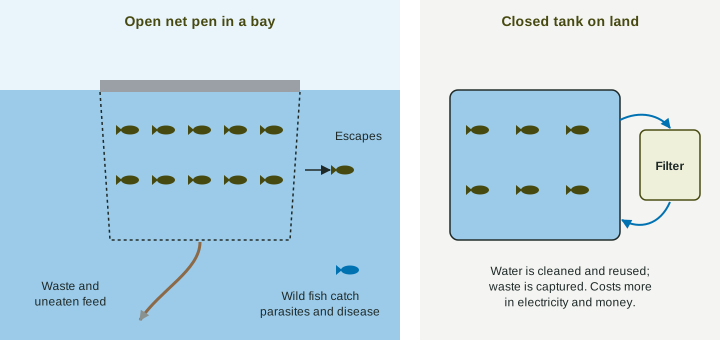
- Many fish are crowded in an open net pentheir waste and uneaten feed fall to the sea floor
- Nutrients from the waste build up under and around the pendecomposers use oxygen, so the water near the bottom loses oxygen
- Crowding spreads parasites such as sea lice and diseasewild fish swimming past the pens can be infected
- Farmed fish escape through torn netsthey compete or breed with wild fish and can weaken wild populations
Part 6 · Key ideas
Key ideas
- Aquaculture raises fish, shellfish and seaweed in ponds, tanks or net pens. It now supplies about half of the fish and shellfish people eat.
- Benefits: a lot of food from a small area, less pressure on wild fish stocks, little fuel compared with fishing fleets, and fish that turn feed into body mass efficiently.
- Costs: concentrated waste, disease and parasites that spread to wild fish, antibiotics, escaped fish, and wild fish caught to make feed for carnivorous farmed species. Shrimp ponds have replaced mangrove forests.
- Lower-impact options: closed tanks with filters, farming plant-eating fish (tilapia, carp) and filter feeders (mussels, oysters) that need no feed.
Part 7 · Misconception
A common mistake
The wrong idea: Farming fish always takes pressure off wild fish.
What actually happens: Carnivorous farmed fish such as salmon are fed fish meal and fish oil made from wild fish, so farming them still takes wild fish. Farming plant eaters like carp and tilapia, or filter feeders like mussels, takes much less.
Part 8 · Check yourself
Check yourself
Exam-style questions. Anything you miss goes into your review queue.
1. Which is an example of aquaculture?
- Raising salmon in net pens in a bay
- Catching tuna with longlines at sea
- Trawling the sea floor for shrimp
- Fishing for trout with a rod in a river
Show the answer
Aquaculture is farming fish in controlled conditions; the others catch wild fish.
- Correct: Raising salmon in net pens in a bay: Right: farmed fish in pens.
- Catching tuna with longlines at sea: Longlining catches wild fish.
- Trawling the sea floor for shrimp: Trawling catches wild shrimp.
- Fishing for trout with a rod in a river: Sport fishing catches wild fish.
2. Which is a benefit of aquaculture compared with wild fishing?
- It grows a lot of food on little space
- It removes the need to give the fish any feed
- It is unable to spread disease to any wild fish
- It produces no waste in the water
Show the answer
Farms grow fish densely and can reduce demand on wild fisheries.
- Correct: It grows a lot of food on little space: Right: high yield on little space and less wild catch.
- It removes the need to give the fish any feed: Many farmed fish are fed.
- It is unable to spread disease to any wild fish: Open pens can spread disease to wild fish.
- It produces no waste in the water: Farmed fish produce waste.
Model or diagram
Two ways to farm fish
3. In the diagram, what happens to waste and uneaten feed from the open net pen?
- It sinks to the sea floor below the pen
- It passes through a filter and is reused
- It is eaten by the escaped fish
- It floats to the surface and evaporates
Show the answer
The arrow from the pen points down to the sea floor.
- Correct: It sinks to the sea floor below the pen: Right: it sinks below the pen.
- It passes through a filter and is reused: The filter is part of the closed tank.
- It is eaten by the escaped fish: The diagram does not show escaped fish eating waste.
- It floats to the surface and evaporates: Waste does not evaporate.
4. Which problem shown for the open pen is solved by the closed tank design?
- Farmed fish escaping into the wild
- The cost of electricity for pumps
- The need to feed the fish
- The need to clean the water
Show the answer
Fish in a tank on land cannot escape into the bay.
- Correct: Farmed fish escaping into the wild: Right: no escapes from a tank on land.
- The cost of electricity for pumps: Electricity cost is a drawback of the tank.
- The need to feed the fish: Tank fish still need feed.
- The need to clean the water: The tank needs water cleaning (its filter).
5. Why are many fish farms still built as open pens even though closed tanks cause less pollution?
- Open pens cost much less to build and run
- Open pens produce no waste in the water
- Closed tanks are unable to hold saltwater fish
- Closed tanks spread more disease to wild fish
Show the answer
Tanks need pumps, filters and electricity; pens use the sea for free.
- Correct: Open pens cost much less to build and run: Right: cost is the main reason.
- Open pens produce no waste in the water: Open pens do produce waste, as shown.
- Closed tanks are unable to hold saltwater fish: Saltwater fish can be raised in tanks.
- Closed tanks spread more disease to wild fish: Closed tanks keep disease away from wild fish.
Data
Wild catch and fish farming worldwide, rounded
| Year | Wild capture | Aquaculture |
|---|---|---|
| 1990 | 85 | 15 |
| 2000 | 95 | 35 |
| 2010 | 90 | 60 |
| 2022 | 90 | 95 |
6. Which trend does the table show from 1990 to 2022?
- Aquaculture grew to 95 while wild capture stayed near 90
- Wild capture grew from 85 to 95 million metric tons while aquaculture fell
- Both wild capture and aquaculture fell between 1990 and 2022
- Aquaculture stayed near 15 while wild capture grew to 95
Show the answer
Aquaculture rose steadily; wild capture leveled off around 90 million metric tons.
- Correct: Aquaculture grew to 95 while wild capture stayed near 90: Right: aquaculture grew about sixfold; capture leveled off.
- Wild capture grew from 85 to 95 million metric tons while aquaculture fell: Aquaculture rose sharply.
- Both wild capture and aquaculture fell between 1990 and 2022: Aquaculture rose.
- Aquaculture stayed near 15 while wild capture grew to 95: Aquaculture rose from 15 to 95.
7. A fish farm produces 1,200 metric tons of salmon. It takes about 1.3 kg of feed to grow 1 kg of salmon. How many metric tons of feed does the farm use?
Type a number, then its unit (metric tons). Scale words (2.5 million) and powers of ten (2.5 × 10^6) are read.
Show the answer
- Answer: 1560 metric tons
Part 9 · Summary
Summary
Part 10 · Up next
What comes next
Part 11 · Connections