Sustainable Forestry
Sustainable forestry harvests wood no faster than forests regrow while protecting soil, water and habitat.
Part 1 · Hook
Why this matters
Part 2 · Before you start
What this builds on
Part 3 · Prerequisite check
Quick check before you start
1. Which is a cost of clearcutting a hillside?
- Bare soil erodes and the stream below warms
- Shade over the stream increases
- Carbon stored on the site increases
- Habitat for mature-forest animals grows
Show the answer
Removing all the trees bares the soil and the stream.
- Correct: Bare soil erodes and the stream below warms:
- Shade over the stream increases:
- Carbon stored on the site increases:
- Habitat for mature-forest animals grows:
2. What is maximum sustainable yield?
- The largest harvest a population can replace each year
- The total size of a population at its carrying capacity
- The smallest harvest that pays for itself
- The harvest taken in one year by clearcutting
Show the answer
It is the largest harvest that can be taken year after year without shrinking the population.
- Correct: The largest harvest a population can replace each year:
- The total size of a population at its carrying capacity:
- The smallest harvest that pays for itself:
- The harvest taken in one year by clearcutting:
Part 4 · See it
See it first
Part 5 · Step by step
How it works, step by step
- Fires are put out for decadesdead wood and brush build up on the forest floor
- A large load of fuel is on the grounda wildfire burns hotter and climbs into the treetops
- A crown fire kills large trees and bakes the soilthe forest takes much longer to recover
- Prescribed burns clear the fuel under safe conditionslater wildfires stay lower and cooler, and large trees survive
Part 6 · Key ideas
Key ideas
- Sustainable forestry harvests wood no faster than the forest regrows and protects soil, water and habitat.
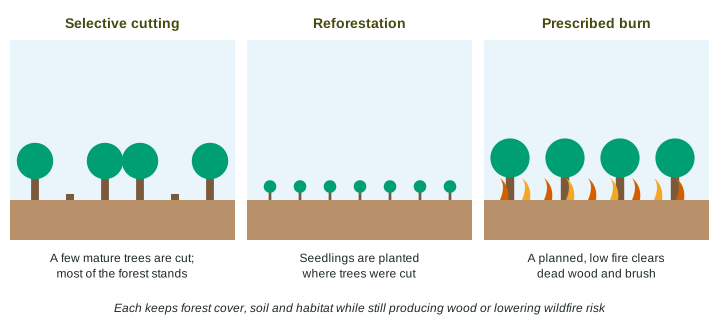
- Selective cutting takes some trees and leaves most standing, so the forest keeps its cover, shade and habitat. It costs more than clearcutting.
- Reforestation replants or lets trees regrow on cut land. Mixed native species restore more habitat than a single-species plantation.
- Prescribed burns clear dead wood and brush to prevent hotter wildfires. Using recycled wood and paper, and protecting trees along streams, also help.
Part 7 · Misconception
A common mistake
The wrong idea: The best way to protect a forest is to put out every fire as soon as it starts.
What actually happens: Many forests evolved with frequent low fires. Putting out every fire lets fuel build up, so the fire that finally escapes is far hotter and more destructive. Prescribed burns keep fuel low.
Part 8 · Check yourself
Check yourself
Exam-style questions. Anything you miss goes into your review queue.
1. Which forestry method harvests some trees and leaves most of the forest standing?
- Selective cutting
- Clearcutting
- Prescribed burning
- Slash-and-burn
Show the answer
Selective cutting removes chosen trees, often single mature ones, from a standing forest.
- Correct: Selective cutting: Right: some trees are taken, most remain.
- Clearcutting: Clearcutting removes all the trees.
- Prescribed burning: Prescribed burning removes brush, not timber.
- Slash-and-burn: Slash-and-burn clears land for farming.
2. Why does selective cutting cause less erosion than clearcutting?
- Most trees stay, so roots hold the soil
- The cut trees are left on the ground to block the stream
- Selective cutting is done in winter, when there is no rain
- The soil under selected trees is harder, so it does not move
Show the answer
Standing trees keep roots in the soil and leaves over it.
- Correct: Most trees stay, so roots hold the soil: Right: roots and canopy remain.
- The cut trees are left on the ground to block the stream: Logs in streams are not the reason.
- Selective cutting is done in winter, when there is no rain: Logging season is not what limits erosion.
- The soil under selected trees is harder, so it does not move: Soil hardness is not the reason.
Model or diagram
Three sustainable forestry practices
3. In the reforestation panel, what is shown?
- Rows of seedlings planted on cut land
- A few mature trees cut from a standing forest
- A low fire burning brush under large trees
- Large trees standing with no young trees
Show the answer
The middle panel shows small trees planted where trees were cut.
- Correct: Rows of seedlings planted on cut land: Right: seedlings planted.
- A few mature trees cut from a standing forest: That is selective cutting.
- A low fire burning brush under large trees: That is a prescribed burn.
- Large trees standing with no young trees: The middle panel shows young trees.
4. In the prescribed burn panel, why do the large trees survive the fire?
- The fire is low, below the large trees' crowns
- The large trees are cut down before the fire is set
- The fire is set in the treetops, away from the trunks
- The large trees are sprayed with water by the fire crew
Show the answer
The flames are drawn low on the forest floor, below the crowns.
- Correct: The fire is low, below the large trees' crowns: Right: a low ground fire spares the crowns.
- The large trees are cut down before the fire is set: The trees are standing in the panel.
- The fire is set in the treetops, away from the trunks: The flames are on the ground.
- The large trees are sprayed with water by the fire crew: No water spraying is shown.
5. Which panel's practice best matches the idea of maximum sustainable yield?
- Selective cutting, matched to the yearly growth
- Prescribed burn, because it produces the most timber
- Reforestation, because seedlings can be harvested in a year
- Neither, because sustainable yield applies to fish and not trees
Show the answer
Taking only a portion of the trees, matched to growth, keeps the forest producing year after year.
- Correct: Selective cutting, matched to the yearly growth: Right: harvest matched to growth.
- Prescribed burn, because it produces the most timber: Prescribed burns do not produce timber.
- Reforestation, because seedlings can be harvested in a year: Seedlings take decades to reach harvest size.
- Neither, because sustainable yield applies to fish and not trees: Sustainable yield applies to any renewing population, including trees.
Data
Wildfire in burned and unburned forest plots
| Measure | Plots with prescribed burns | Plots without prescribed burns |
|---|---|---|
| Fuel on forest floor before the wildfire (metric tons per ha) | 8 | 40 |
| Average flame height (m) | 1.2 | 12 |
| Large trees killed (%) | 10 | 75 |
6. Write the setup for the percent change in fuel on the forest floor from the unburned plots to the plots with prescribed burns, then give the answer.
Type the setup as on the exam, with brackets and units, then the answer.
Show the answer
: prescribed burns removed 80% of the fuel.
- Setup: ; answer -80 %
7. A 5,000-hectare forest grows 4 m³ of new wood per hectare each year. To harvest sustainably, how many cubic meters of wood can be cut each year at most?
Type a number, then its unit (m3). Scale words (2.5 million) and powers of ten (2.5 × 10^6) are read.
Show the answer
Yearly growth:
- Answer: 20,000 m3
Part 9 · Summary
Summary
Part 10 · Up next
What comes next
Part 11 · Connections