Photoelectron Spectroscopy
Photoelectron spectroscopy ejects electrons with high-energy light and measures each one's binding energy.
Part 1 · Hook
Why this matters
Part 2 · Before you start
What this builds on
Part 3 · Prerequisite check
Quick check before you start
1. What is the electron configuration of magnesium (12 electrons)?
- 1s² 2s² 2p⁶ 3s²
- 1s² 2s² 2p⁸
- 1s² 2s² 2p⁶ 3p²
- 1s² 2s⁶ 2p⁴
Show the answer
Fill 1s, 2s, 2p, then 3s: 2 + 2 + 6 + 2 = 12.
- Correct: 1s² 2s² 2p⁶ 3s²:
- 1s² 2s² 2p⁸:
- 1s² 2s² 2p⁶ 3p²:
- 1s² 2s⁶ 2p⁴:
2. According to Coulomb's law, what happens to the attraction between two opposite charges as they move farther apart?
- It weakens
- It strengthens
- It stays the same
- It becomes a repulsion
Show the answer
F ∝ q₁q₂/r²: a larger distance gives a weaker force.
- Correct: It weakens:
- It strengthens:
- It stays the same:
- It becomes a repulsion:
Part 4 · See it
See it first
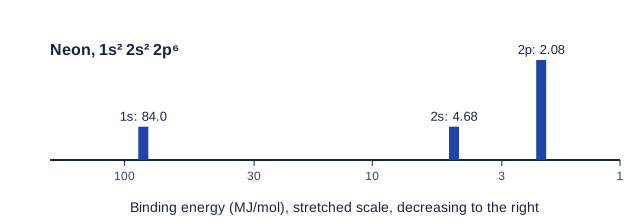
Part 5 · Step by step
How it works, step by step
- High-energy light hits an atomeach photon can knock out one electron if it carries enough energy
- The energy the light supplies minus the energy the electron leaves withgives the binding energy, how tightly that electron was held
- Electrons in one subshell all have the same binding energythey form one peak, whose height counts the electrons
- Closer, less shielded electrons, and more protons, mean stronger Coulombic attractioninner subshells and heavier elements have peaks at higher binding energy
Part 6 · Key ideas
Key ideas
- A photon is a packet of light energy. In photoelectron spectroscopy (PES), high-energy photons eject electrons and the energy each needed is measured.
- That energy is the binding energy. One peak per subshell; position = binding energy; height = number of electrons.
- Highest binding energy (left) is 1s; lowest (right) is the valence subshell. Within a shell, s is above p.
- More protons shift every matching peak to higher energy (Coulomb's law). A new subshell adds a new peak at the low-energy end.
Part 7 · Misconception
A common mistake
The wrong idea: The tallest peak in a photoelectron spectrum is the most tightly held subshell.
What actually happens: Height counts electrons; position shows how tightly they are held. In silicon the 2p peak is tallest (6 electrons), but the 1s peak, short and far to the left, is held most tightly.
Part 8 · Check yourself
Check yourself
Exam-style questions. Anything you miss goes into your review queue.
Graph
Photoelectron spectrum of an unknown element
The spectrum of a neutral atom of an unknown element. Peak heights are proportional to the number of electrons; the numbers above the peaks are binding energies in MJ/mol.
1. Which element produced this spectrum?
- Magnesium, 1s² 2s² 2p⁶ 3s²
- Sulfur, 1s² 2s² 2p⁶ 3s² 3p⁴
- Silicon, [Ne] 3s² 3p²
- Carbon, 1s² 2s² 2p²
Show the answer
One peak per subshell, with height = number of electrons: 2 + 2 + 6 + 2 + 2 = 14 electrons, silicon.
- Magnesium, 1s² 2s² 2p⁶ 3s²: Magnesium has four subshells, so four peaks; this spectrum has five.
- Sulfur, 1s² 2s² 2p⁶ 3s² 3p⁴: Sulfur's lowest-energy peak would be 4 electrons tall, twice the 3s peak.
- Correct: Silicon, [Ne] 3s² 3p²: Right: peak heights 2, 2, 6, 2, 2 add to 14 electrons.
- Carbon, 1s² 2s² 2p²: Carbon has three peaks; this spectrum has five.
2. Which subshell gives the peak at 10.3 MJ/mol?
- 2p
- 2s
- 3p
- 1s
Show the answer
Read from high to low binding energy in filling order: 1s (178), 2s (15.1), 2p (10.3), 3s (1.46), 3p (0.79). The 6-electron height also marks a p subshell.
- Correct: 2p: Right: it is the tallest peak (6 electrons) and the third from the left, after 1s and 2s.
- 2s: 2s holds 2 electrons; the peak at 15.1 MJ/mol is 2s.
- 3p: 3p is the outermost subshell, at the lowest energy (0.79 MJ/mol).
- 1s: 1s is closest to the nucleus, with by far the highest energy, 178 MJ/mol.
3. Why is the 1s peak at a far higher binding energy than any other peak?
- 1s electrons have more charge than the other electrons
- The 1s subshell holds the fewest electrons, so each is held more tightly
- 1s electrons are the valence electrons, which are the most tightly held
- They are closest to the nucleus, with no shielding electrons
Show the answer
Binding energy reflects Coulombic attraction. The 1s electrons are nearest the nucleus and are not shielded, so they feel nearly all 14 protons.
- 1s electrons have more charge than the other electrons: Every electron has the same charge, −1.
- The 1s subshell holds the fewest electrons, so each is held more tightly: Peak height (number of electrons) does not set the binding energy; distance and shielding do.
- 1s electrons are the valence electrons, which are the most tightly held: The 1s electrons are core electrons; valence electrons are the most loosely held.
- Correct: They are closest to the nucleus, with no shielding electrons: Right: least distance and no shielding give the strongest Coulombic attraction.
Graph
Spectra of two neighboring elements
Photoelectron spectra of neutral sodium (11 protons) and magnesium (12 protons). Numbers above the peaks are binding energies in MJ/mol.
4. Every peak in magnesium's spectrum is at a higher binding energy than the matching peak for sodium. Which explanation is best?
- Magnesium has more electrons, which pull each other closer to the nucleus
- Its extra proton pulls harder on each subshell
- Magnesium atoms are larger, so their electrons are held more tightly
- Magnesium's electrons are in higher shells than sodium's
Show the answer
Coulomb's law: more protons (12 vs 11) pull harder on electrons in the same subshell, so every binding energy rises.
- Magnesium has more electrons, which pull each other closer to the nucleus: Electrons repel each other; the extra pull comes from the extra proton.
- Correct: Its extra proton pulls harder on each subshell: Right: same subshells and similar distances, but a larger nuclear charge.
- Magnesium atoms are larger, so their electrons are held more tightly: Larger distance would mean weaker attraction; and magnesium is in fact smaller.
- Magnesium's electrons are in higher shells than sodium's: Both atoms fill the same shells, 1 to 3.
5. How do the lowest-energy peaks of the two spectra differ in height?
- They are the same height, since both are 3s peaks
- Sodium's is taller, since sodium loses its electron more easily
- Magnesium's is six times as tall, like its 2p peak
- Magnesium's is twice as tall: 3s² against 3s¹
Show the answer
Peak height is proportional to the number of electrons in the subshell: 1 for Na 3s, 2 for Mg 3s.
- They are the same height, since both are 3s peaks: Same subshell, but height counts the electrons in it.
- Sodium's is taller, since sodium loses its electron more easily: Height shows the number of electrons, not how easily they are removed.
- Magnesium's is six times as tall, like its 2p peak: Only the 2p peak is 6 electrons tall.
- Correct: Magnesium's is twice as tall: 3s² against 3s¹: Right: Na 3s¹, Mg 3s².
6. A spectrum has three peaks with relative heights 2, 2 and 5. Which element is it?
- Fluorine
- Phosphorus
- Boron
- Neon
Show the answer
Add the heights for the total: 9 electrons, fluorine.
- Correct: Fluorine: Right: 2 + 2 + 5 = 9 electrons in 1s, 2s and 2p.
- Phosphorus: Phosphorus has five subshells, so five peaks.
- Boron: Boron is 1s² 2s² 2p¹, with peak heights 2, 2, 1.
- Neon: Neon's 2p peak would be 6 electrons tall.
Part 9 · Summary
Summary
Part 10 · Up next
What comes next
Part 11 · Connections