Composition of Mixtures
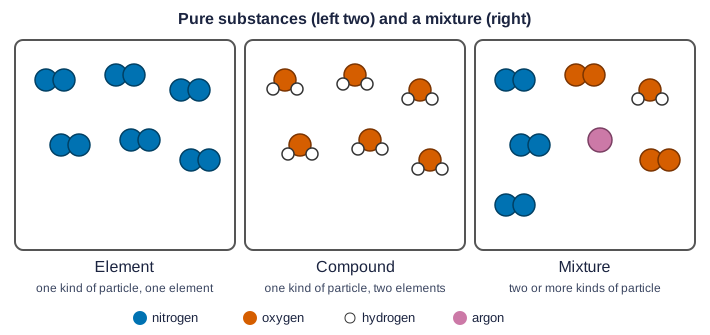
Pure substances have one kind of particle and a fixed composition; mixtures have more than one, in variable proportions, and can be homogeneous or heterogeneous.
Part 1 · Hook
Why this matters
Part 2 · Before you start
What this builds on
Part 3 · Prerequisite check
Quick check before you start
1. What is the mass percent of oxygen in water, H₂O (molar mass 18.02 g/mol)?
- 88.8%
- 11.2%
- 33.3%
- 50.0%
Show the answer
16.00 / 18.02 × 100 = 88.8%.
- Correct: 88.8%:
- 11.2%:
- 33.3%:
- 50.0%:
2. Which describes a compound?
- Two or more elements joined in a fixed ratio
- Two substances stirred together in any ratio
- A single kind of atom
- Any substance that is a gas
Show the answer
A compound has its elements in a fixed ratio, which gives it a fixed composition.
- Correct: Two or more elements joined in a fixed ratio:
- Two substances stirred together in any ratio:
- A single kind of atom:
- Any substance that is a gas:
Part 4 · See it
See it first
Part 5 · Step by step
How it works, step by step
- A pure substance contains one kind of particleits composition is fixed, the same in every sample
- A mixture contains two or more substances that are not bonded into one kind of particleits proportions can vary from sample to sample
- Each pure compound has a known mass percent of each elementmeasuring one element in a sample shows how much of that compound it holds
- Comparing that amount with the sample's massgives the purity, as long as no other part of the mixture holds the same element
Part 6 · Key ideas
Key ideas
- A mixture holds two or more substances in proportions that can vary. A homogeneous mixture is uniform throughout; a heterogeneous mixture is not.
- In a particulate diagram, a pure substance shows one kind of particle; a mixture shows more than one. What you see and measure in bulk is the macroscopic level.
- Elemental analysis: measure the mass of one element, convert it to the compound with the compound's mass percent.
- Purity = mass of the wanted compound ÷ mass of the sample × 100.
Part 7 · Misconception
A common mistake
The wrong idea: Anything that contains two or more elements is a mixture.
What actually happens: Compounds also contain two or more elements, joined in a fixed ratio into one kind of particle. A mixture has more than one kind of particle, and its proportions can vary.
Part 8 · Check yourself
Check yourself
Exam-style questions. Anything you miss goes into your review queue.
Particle view
Four samples at the particle level
Key: blue circle, nitrogen atom; orange circle, oxygen atom; small white circle, hydrogen atom; pink circle, argon atom.
1. Which box shows a pure compound?
- Box W
- Box Y
- Box X
- Box Z
Show the answer
A pure substance has one kind of particle. If those particles contain more than one element, it is a compound.
- Box W: One kind of particle, but each has only nitrogen atoms: an element.
- Box Y: Three kinds of particles: a mixture.
- Correct: Box X: Right: one kind of particle, and each particle contains two different elements.
- Box Z: Several kinds of particles: a mixture, even though it contains a compound.
2. Which boxes show mixtures?
- Boxes Y and Z
- Boxes W and Y
- Boxes X and Z
- Box Z by itself
Show the answer
A mixture contains two or more substances, so its particles are not all alike. Y and Z qualify.
- Correct: Boxes Y and Z: Right: each holds more than one kind of particle.
- Boxes W and Y: Box W has one kind of particle, so it is pure.
- Boxes X and Z: Box X has one kind of particle, so it is pure even though its molecules have two elements.
- Box Z by itself: Box Y also holds three kinds of particles.
3. Box Y represents a sample of air. Why is air described as a mixture and not a compound?
- It contains more than one element
- It is a gas, and gases are mixtures
- Each of its molecules contains one kind of atom
- Its N₂, O₂ and Ar are separate, in proportions that can vary
Show the answer
Air is several substances side by side, not one substance with a fixed formula. Its makeup (for example, its water vapor) can change from day to day.
- It contains more than one element: A compound also contains more than one element; what matters is whether they form one kind of particle.
- It is a gas, and gases are mixtures: Some gases are pure, such as the nitrogen in Box W.
- Each of its molecules contains one kind of atom: That describes each component, not why the whole sample is a mixture.
- Correct: Its N₂, O₂ and Ar are separate, in proportions that can vary: Right: the substances are not bonded into one kind of particle, and their amounts are not fixed.
Data table
How pure is a calcium supplement?
A calcium supplement tablet is calcium carbonate, CaCO₃ (100.09 g/mol), mixed with fillers that contain no calcium. A student analyzes three 1.250 g tablets from three brands for calcium.
| Brand | Tablet mass (g) | Mass of Ca found (g) |
|---|---|---|
| P | 1.250 | 0.4505 |
| Q | 1.250 | 0.4955 |
| R | 1.250 | 0.3753 |
4. What is the mass percent of calcium in pure CaCO₃? (Ca 40.08)
Type a number in %.
Show the answer
40.08 g Ca per 100.09 g CaCO₃: 40.08 / 100.09 × 100 = 40.04%.
- Answer: 40.04 %
5. What is the percent purity (percent CaCO₃ by mass) of Brand P's tablet?
Type a number in %.
Show the answer
Mass of CaCO₃ = 0.4505 g Ca × (100.09 g CaCO₃ / 40.08 g Ca) = 1.125 g. Purity = 1.125 / 1.250 × 100 = 90.00%.
- Answer: 90.00 %
6. Which brand's tablet contains the most filler?
- Brand Q
- Brand P
- Brand R
- The three have equal filler, since the tablets have equal masses
Show the answer
Purity: P 90.0%, Q 99.0%, R 75.0%. The less calcium found, the less CaCO₃ and the more filler.
- Brand Q: Brand Q has the most calcium, so the least filler.
- Brand P: Brand P has 10.0% filler, less than Brand R.
- Correct: Brand R: Right: least calcium, so least CaCO₃ (75.0%), so the most filler (25.0%).
- The three have equal filler, since the tablets have equal masses: Equal tablet masses, but different calcium contents, so different amounts of CaCO₃.
7. Suppose some of the filler in a tablet also contained calcium. How would the calculated purity compare with the true purity?
- Too low, since the filler adds to the tablet's mass
- Unchanged, since the CaCO₃ itself is weighed
- Too high, since extra calcium is counted as CaCO₃
- It could no longer be calculated from these data
Show the answer
Elemental analysis is only as good as the assumption about where the element comes from. Calcium from the filler is wrongly counted as CaCO₃, so purity comes out too high.
- Too low, since the filler adds to the tablet's mass: The filler's mass is already in the tablet mass; the problem is the extra calcium.
- Unchanged, since the CaCO₃ itself is weighed: The method weighs calcium, not CaCO₃, and assumes it all came from CaCO₃.
- Correct: Too high, since extra calcium is counted as CaCO₃: Right: the method assumes all Ca is in CaCO₃, so extra Ca inflates the CaCO₃ estimate.
- It could no longer be calculated from these data: It can be calculated; it would just be wrong in a predictable direction.
Part 9 · Summary
Summary
Part 10 · Up next
What comes next
Part 11 · Connections