Atomic Structure and Electron Configuration
Electrons are attracted to the nucleus by Coulomb's law: more charge pulls harder and distance weakens the pull.
Part 1 · Hook
Why this matters
Part 2 · Before you start
What this builds on
Part 3 · Prerequisite check
Quick check before you start
1. What charge do protons and electrons carry?
- Protons +1, electrons −1
- Protons −1, electrons +1
- Both are neutral
- Protons 0, electrons −1
Show the answer
Protons are positive and electrons negative; neutrons are neutral.
- Correct: Protons +1, electrons −1:
- Protons −1, electrons +1:
- Both are neutral:
- Protons 0, electrons −1:
2. A neutral atom of magnesium has 12 protons. How many electrons does it have?
- 12
- 24
- 10
- 14
Show the answer
A neutral atom has as many electrons as protons.
- Correct: 12:
- 24:
- 10:
- 14:
Part 4 · See it
See it first
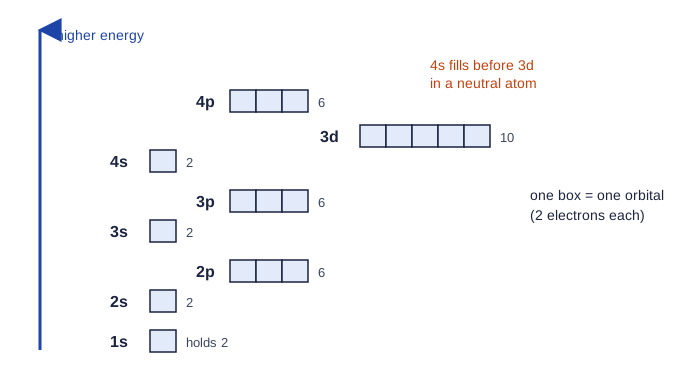
Part 5 · Step by step
How it works, step by step
- The positive nucleus and negative electrons attract (Coulomb's law)electrons closer to the nucleus are held more strongly and have lower energy
- Electrons occupy shells at increasing distances, divided into s, p and d subshellseach subshell has its own energy and holds 2, 6 or 10 electrons
- Electrons fill the lowest-energy open subshell first (aufbau)every atom has a predictable electron configuration
- Inner (core) electrons sit between the nucleus and the outer electronsthey shield the valence electrons, which are held less tightly and take part in chemistry
Part 6 · Key ideas
Key ideas
- Coulomb's law: F ∝ q₁q₂/r². Larger charges attract more; greater distance attracts much less. Potential energy ∝ q₁q₂/r.
- Electrons sit in shells (n = 1, 2, 3…) made of subshells s, p, d (2, 6, 10 electrons), each made of orbitals holding 2.
- Aufbau order: 1s 2s 2p 3s 3p 4s 3d 4p. Na: 1s² 2s² 2p⁶ 3s¹, or [Ne] 3s¹.
- Valence electrons are in the outermost shell; core electrons shield them. Ionization energy is the energy to remove an electron.
Part 7 · Misconception
A common mistake
The wrong idea: Sodium loses its outer electron easily because it "wants" a full shell.
What actually happens: Atoms do not want anything. Sodium's 3s electron is far from the nucleus and shielded by 10 core electrons, so the Coulombic attraction on it is weak and little energy removes it.
Part 8 · Check yourself
Check yourself
Exam-style questions. Anything you miss goes into your review queue.
Model
Four pairs of charged particles
Each row shows two charged particles a distance apart. Charges are in units of the proton's charge; distances are in picometers (pm).
| Pair | Charge 1 | Charge 2 | Distance (pm) |
|---|---|---|---|
| P | +1 | −1 | 200 |
| Q | +2 | −1 | 200 |
| R | +1 | −1 | 400 |
| S | +2 | −2 | 400 |
1. According to Coulomb's law, which pair attracts each other most strongly?
- Pair S
- Pair P
- Pair Q
- Pair R
Show the answer
F ∝ q₁q₂/r². In units of P's force: P = 1, Q = 2, R = 1/4, S = 4/4 = 1. Q is strongest.
- Pair S: S has the largest product of charges (4), but twice the distance cuts the force by 4, so it ties with P.
- Pair P: P is half as strong as Q, which has double the charge at the same distance.
- Correct: Pair Q: Right: q₁q₂/r² = (2)(1)/200² is the largest: twice pair P's value.
- Pair R: Same charges as P at twice the distance: one quarter of P's force, the weakest.
2. How does the force in pair R compare with the force in pair P?
- One quarter as strong
- Half as strong
- Twice as strong
- The same strength, since the charges match
Show the answer
F ∝ 1/r²: twice the distance gives (1/2)² = 1/4 of the force.
- Correct: One quarter as strong: Right: doubling the distance divides the force by 2² = 4.
- Half as strong: Force falls with the square of distance, not the distance itself.
- Twice as strong: A larger distance weakens the attraction.
- The same strength, since the charges match: Matching charges, but the distance doubled, so the force changes.
3. A student claims pair S attracts most strongly because it has the largest charges. Which reply best uses the data?
- The student is right; charge outweighs distance in Coulomb's law
- S is the weakest, because its charges are the most spread out
- S is not comparable with the others, since both its charges are 2
- S has 4 times P's charges but twice the distance, so S equals P
Show the answer
Compare q₁q₂/r²: S has (2)(2)/400² = 4/160,000 = 1/40,000; P has 1/40,000. Equal.
- The student is right; charge outweighs distance in Coulomb's law: Distance is squared, so it matters at least as much as charge.
- S is the weakest, because its charges are the most spread out: S is not the weakest: R, with smaller charges at the same distance, is.
- S is not comparable with the others, since both its charges are 2: Coulomb's law compares any pairs using the product of charges and the distance.
- Correct: S has 4 times P's charges but twice the distance, so S equals P: Right: both the charges and the distance matter, and here they cancel.
Data table
Three atoms compared
The table compares three atoms.
| Atom | Protons | Electron configuration |
|---|---|---|
| Lithium | 3 | 1s² 2s¹ |
| Sodium | 11 | 1s² 2s² 2p⁶ 3s¹ |
| Neon | 10 | 1s² 2s² 2p⁶ |
4. It takes more energy to remove the outermost electron from lithium than from sodium. Which explanation is best?
- Sodium is a bigger atom, so it has a weaker hold on each of its electrons
- Lithium has fewer protons, so it holds its electron more tightly
- Sodium's valence electron is in shell 3, farther out, behind 10 core electrons
- Sodium has more mass, which makes its electrons easier to remove
Show the answer
Lithium's 2s electron is close to the nucleus behind 2 core electrons. Sodium's 3s electron is in a farther shell behind 10 core electrons, so it is held less tightly.
- Sodium is a bigger atom, so it has a weaker hold on each of its electrons: "Bigger" needs a cause; name the outer shell (3 vs 2) and the core electrons.
- Lithium has fewer protons, so it holds its electron more tightly: Fewer protons would mean a weaker pull; something else must outweigh that.
- Correct: Sodium's valence electron is in shell 3, farther out, behind 10 core electrons: Right: more distance and more shielding outweigh sodium's extra protons.
- Sodium has more mass, which makes its electrons easier to remove: Mass does not appear in Coulomb's law; charge and distance do.
5. Neon has fewer protons than sodium, yet removing neon's outermost electron takes about four times as much energy. Which explanation fits Coulomb's law?
- Neon's outer electron is in shell 2, closer, behind just 2 core electrons
- Neon is a gas, and electrons are harder to remove from gases
- Neon has a full shell, which wants to stay full
- Sodium has more electrons, so it can spare one more easily
Show the answer
Neon's 2p electron feels 10 protons shielded by only 2 core electrons, at a small distance. Sodium's 3s electron feels 11 protons through 10 core electrons, much farther out.
- Correct: Neon's outer electron is in shell 2, closer, behind just 2 core electrons: Right: sodium's 3s electron is farther away and behind 10 core electrons.
- Neon is a gas, and electrons are harder to remove from gases: Every atom here is studied as a gas; the state is not the cause.
- Neon has a full shell, which wants to stay full: Atoms do not want things; the reason is distance and shielding.
- Sodium has more electrons, so it can spare one more easily: The energy depends on how strongly that electron is attracted, not on how many there are.
6. How many core electrons does sodium have?
Type a number in core electrons.
Show the answer
Core electrons are those in the inner shells: 1s² 2s² 2p⁶ = 10. Sodium has 11 electrons, 1 of them valence.
- Answer: 10 core electrons
7. What is the electron configuration of sulfur (16 electrons)?
- 1s² 2s² 2p⁶ 3s² 3p⁶
- 1s² 2s² 2p⁶ 3s² 3p⁴
- 1s² 2s² 2p⁶ 2d⁶
- 1s² 2s⁶ 2p⁸
Show the answer
Fill in energy order: 1s² 2s² 2p⁶ 3s² 3p⁴. The superscripts add to 16.
- 1s² 2s² 2p⁶ 3s² 3p⁶: This holds 18 electrons, which is argon.
- Correct: 1s² 2s² 2p⁶ 3s² 3p⁴: Right: 2 + 2 + 6 + 2 + 4 = 16 electrons, filled in order of energy.
- 1s² 2s² 2p⁶ 2d⁶: There is no 2d subshell; the second shell has only s and p.
- 1s² 2s⁶ 2p⁸: An s subshell holds at most 2 electrons and a p subshell 6.
Part 9 · Summary
Summary
Part 10 · Up next
What comes next
Part 11 · Connections