Logarithms
A base-10 logarithm is the exponent of ten that gives a number; the natural logarithm uses base e.
Part 1 · Hook
Why this matters
Part 2 · Before you start
What this builds on
Part 3 · Prerequisite check
Quick check before you start
1. What is 10⁻³ × 10⁵?
- 10²
- 10⁻¹⁵
- 10⁸
- 10⁻²
Show the answer
Multiplying powers adds the exponents: −3 + 5 = 2.
- Correct: 10²:
- 10⁻¹⁵:
- 10⁸:
- 10⁻²:
2. Which is 0.00047 in scientific notation?
- 4.7 × 10⁻⁴
- 4.7 × 10⁴
- 47 × 10⁻⁵
- 4.7 × 10⁻³
Show the answer
Move the point 4 places right to reach 4.7, so the exponent is −4.
- Correct: 4.7 × 10⁻⁴:
- 4.7 × 10⁴:
- 47 × 10⁻⁵:
- 4.7 × 10⁻³:
Part 4 · See it
See it first
Part 5 · Step by step
How it works, step by step
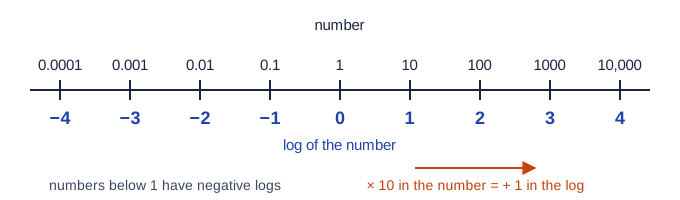
- A logarithm is the exponent that 10 must be raised tolog 1000 = 3 and log 0.001 = −3
- Multiplying numbers adds their exponentsthe log of a product is the sum of the logs, so a factor of 10 adds 1
- The natural log uses base e (about 2.718) instead of 10ln x = 2.303 log x, and mixing them up gives answers 2.303 times off
- An antilog raises the base to the log10ˣ undoes log and eˣ undoes ln
Part 6 · Key ideas
Key ideas
- log x (base 10) is the power of ten that gives x: log 10⁻⁵ = −5. Numbers between 0 and 1 have negative logs.
- log (A × B) = log A + log B; log (A/B) = log A − log B; log (Aⁿ) = n log A.
- ln x is the natural log, base e. ln x = 2.303 log x. Use the key the equation names.
- Digits after the decimal point in a log are its significant figures: log (3.2 × 10⁻⁴) = −3.49. Undo log with 10ˣ and ln with eˣ (the antilog).
Part 7 · Misconception
A common mistake
The wrong idea: log and ln are two names for the same button, so either one works.
What actually happens: They use different bases. ln x is 2.303 times log x, so using the wrong one makes the answer 2.303 times off. Equations that say ln need LN; equations that say log need LOG.
Part 8 · Check yourself
Check yourself
Exam-style questions. Anything you miss goes into your review queue.
1. What is log 1000?
- 1000
- 0.001
- 3
- 30
Show the answer
A logarithm answers "10 to what power?". 10³ = 1000, so log 1000 = 3.
- 1000: The log is the exponent, not the number itself.
- 0.001: That is 10⁻³, the reciprocal of 1000.
- Correct: 3: Right: 10³ = 1000, so the base-10 logarithm of 1000 is 3.
- 30: log 1000 asks "10 to what power gives 1000?", which is 3.
2. Calculate log (3.2 × 10⁻⁴). Give the right number of decimal places.
Type a number.
Show the answer
log (3.2 × 10⁻⁴) = log 3.2 + log 10⁻⁴ = 0.505 − 4 = −3.49. The coefficient 3.2 has two significant figures, so the log has two decimal places.
- Answer: -3.49
3. Calculate ln (0.50). Give the right number of decimal places.
Type a number.
Show the answer
ln (0.50) = −0.693, written −0.69: two significant figures in 0.50 give two decimal places.
- Answer: -0.69
4. Find x if log x = 2.45. Give x with the right number of significant figures.
Type a number.
Show the answer
x = 10^2.45 = 281.8…, written 2.8 × 10². The two decimal places in 2.45 give two significant figures in x.
- Answer: 2.8e+2
5. log 2 = 0.301. What is log 200?
- 0.602
- 60.2
- 2.301
- 200.301
Show the answer
Split 200 into 2 × 10². Then log 200 = 0.301 + 2 = 2.301.
- 0.602: This is log 4 (2 × log 2). 200 is 2 × 100, not 2².
- 60.2: This multiplies log 2 by 200. The log of a product adds, it does not multiply.
- Correct: 2.301: Right: log (2 × 10²) = log 2 + log 10² = 0.301 + 2.
- 200.301: Add log 100, which is 2, not 200.
6. A student needs log (4.7 × 10⁻³) but presses LN and gets −5.36. How far off is the answer, and what is the fix?
- It is correct, since ln and log are two names for one function
- It is 2.303 times too large in size; press LOG to get −2.33
- It is off by 10; divide −5.36 by 10
- It has the wrong sign; the answer is +5.36
Show the answer
log (4.7 × 10⁻³) = −2.33. The 2.303 factor between ln and log is a slip the exam readers see every year.
- It is correct, since ln and log are two names for one function: They use different bases (e and 10) and give different numbers.
- Correct: It is 2.303 times too large in size; press LOG to get −2.33: Right: ln x = 2.303 log x, so −5.36 ÷ 2.303 = −2.33.
- It is off by 10; divide −5.36 by 10: The logs differ by a factor of 2.303 (ln 10), not 10.
- It has the wrong sign; the answer is +5.36: Numbers below 1 have negative logs in both bases; the sign is right.
Part 9 · Summary
Summary
Part 10 · Up next
What comes next
Part 11 · Connections