Kinetic Molecular Theory
The kinetic molecular theory models a gas as tiny particles in constant random motion, with no attractions and elastic collisions, whose average kinetic energy is proportional to kelvin temperature.
Part 1 · Hook
Why this matters
Part 2 · Before you start
What this builds on
Part 3 · Prerequisite check
Quick check before you start
1. At constant n and V, how does the pressure of a gas change when its kelvin temperature doubles?
- It doubles
- It halves
- It stays the same
Show the answer
P = (nR/V)T, so P is proportional to T in kelvin.
- Correct: It doubles:
- It halves:
- It stays the same:
2. In which state are particles far apart and moving freely?
- Gas
- Liquid
- Solid
Show the answer
A gas is mostly empty space; its particles fly between collisions.
- Correct: Gas:
- Liquid:
- Solid:
Part 4 · See it
See it first
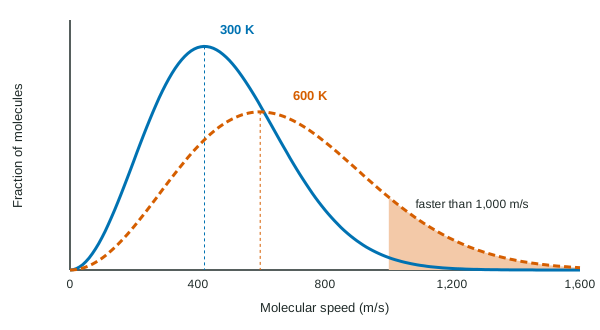
Part 5 · Step by step
How it works, step by step
- Gas particles move constantly and collide elasticallythey keep moving and hitting the walls, which is the pressure
- The average kinetic energy of the particles is proportional to kelvin temperatureheating speeds particles up, so they hit the walls more often and harder
- Every gas has the same average kinetic energy at a given temperature, and KE = ½mv²lighter particles move faster
- Collisions constantly swap energy between particlesspeeds form a Maxwell-Boltzmann distribution that shifts and flattens as temperature rises
Part 6 · Key ideas
Key ideas
- Model: tiny particles, negligible volume, no attractions, elastic collisions, average KE ∝ kelvin T.
- Same temperature means same average kinetic energy; lighter particles move faster, by the square root of the mass ratio.
- Pressure comes from collisions with the walls: more particles, less volume or higher temperature all raise it.
- Maxwell-Boltzmann curves: higher T or lighter gas moves the peak right and makes it lower and wider; the area is constant.
Part 7 · Misconception
A common mistake
The wrong idea: At the same temperature, heavier gas particles have more kinetic energy because they have more mass.
What actually happens: At the same temperature, all gases have the same average kinetic energy. Heavier particles simply move more slowly.
Part 8 · Check yourself
Check yourself
Exam-style questions. Anything you miss goes into your review queue.
Graph
Speeds of three gases
Speed distributions for three gas samples, X, Y and Z. Two are at 300 K; one is at a different temperature. Samples X and Z are the same gas.
X: O₂ at 300 KY: He at 300 KZ: O₂ at another temperature
Data table
| Molecular speed (m/s) | X: O₂ at 300 K | Y: He at 300 K | Z: O₂ at another temperature |
|---|---|---|---|
| 0 | 0 | 0 | 0 |
| 100 | 0.344 | 0.016 | 0.069 |
| 200 | 1.135 | 0.063 | 0.259 |
| 300 | 1.853 | 0.136 | 0.524 |
| 400 | 2.102 | 0.228 | 0.802 |
| 500 | 1.844 | 0.332 | 1.034 |
| 600 | 1.311 | 0.437 | 1.176 |
| 700 | 0.775 | 0.536 | 1.213 |
| 800 | 0.387 | 0.621 | 1.149 |
| 900 | 0.164 | 0.686 | 1.011 |
| 1000 | 0.06 | 0.727 | 0.832 |
| 1100 | 0.019 | 0.743 | 0.642 |
| 1200 | 0.005 | 0.736 | 0.467 |
| 1300 | 0.001 | 0.706 | 0.321 |
| 1400 | 0 | 0.66 | 0.209 |
| 1500 | 0 | 0.6 | 0.129 |
| 1600 | 0 | 0.532 | 0.076 |
| 1700 | 0 | 0.461 | 0.042 |
| 1800 | 0 | 0.39 | 0.022 |
| 1900 | 0 | 0.323 | 0.011 |
| 2000 | 0 | 0.262 | 0.005 |
1. Compared with sample X, what does sample Z's curve show about its temperature?
- It is higher, because the peak is at a higher speed and the curve is flatter.
- It is lower, because the peak of the curve is lower and the curve is flatter.
- It is the same, because X and Z are samples of the same gas.
- It is unknowable, because the two curves cover different total areas.
Show the answer
Same gas, so a faster, wider distribution means a higher average kinetic energy and a higher temperature. Z's peak is near 684 m/s, against 395 m/s for X.
- Correct: It is higher, because the peak is at a higher speed and the curve is flatter.: Right: the same gas moving faster is hotter.
- It is lower, because the peak of the curve is lower and the curve is flatter.: A lower peak means the speeds are spread out, not that the gas is colder; the peak moved right.
- It is the same, because X and Z are samples of the same gas.: Being the same gas does not fix the temperature; the curves differ, so the temperatures do.
- It is unknowable, because the two curves cover different total areas.: Both curves enclose the same area, which stands for all the molecules.
2. Samples X and Y are both at 300 K. Which statement about their particles is correct?
- They have the same average kinetic energy, but He atoms move faster on average.
- He atoms have the greater average kinetic energy, because they move faster.
- O₂ molecules have the greater average kinetic energy, because they are heavier.
- They have the same average speed, because they are at the same temperature.
Show the answer
Average kinetic energy depends only on kelvin temperature, so X and Y match. With the same ½mv², the lighter He atoms must move faster.
- Correct: They have the same average kinetic energy, but He atoms move faster on average.: Right: same temperature, same average KE; lighter means faster.
- He atoms have the greater average kinetic energy, because they move faster.: Faster He atoms are lighter, so their kinetic energy is the same as that of O₂.
- O₂ molecules have the greater average kinetic energy, because they are heavier.: Heavier O₂ molecules move more slowly, so their kinetic energy is the same.
- They have the same average speed, because they are at the same temperature.: Temperature sets the average kinetic energy, not the average speed.
3. By what factor is the average speed of the He atoms (4.003 g/mol) greater than that of the O₂ molecules (32.00 g/mol) at 300 K?
Type a number.
Show the answer
Equal average kinetic energies: ½m(He)v(He)² = ½m(O₂)v(O₂)². So v(He)/v(O₂) = √(32.00/4.003) = √7.994 = 2.8274, which is 2.83.
- Answer: 2.83
Particle view
Two gas samples
Key: green circle, one gas particle (same gas in both boxes); arrow length, the particle's speed.
4. Which box has the higher pressure, and why?
- Box 2, because its faster particles hit the walls more often and with more force.
- Box 1, because its slower particles spend more time pressing against the walls.
- Neither, because both boxes hold the same number of particles in the same volume.
- Box 2, because its particles are larger and take up more of the space in the box.
Show the answer
With n and V the same, P rises with T. At the particle level, faster particles collide with the walls more frequently and push harder in each collision.
- Correct: Box 2, because its faster particles hit the walls more often and with more force.: Right: more frequent and harder collisions.
- Box 1, because its slower particles spend more time pressing against the walls.: Pressure comes from collisions; slower particles hit less often and less hard.
- Neither, because both boxes hold the same number of particles in the same volume.: Same n and V, but different T, so the pressure differs.
- Box 2, because its particles are larger and take up more of the space in the box.: The particles are the same gas and the same size in both boxes.
5. Box 2 is now squeezed to half its volume at constant temperature. What happens to the average speed of its particles, and to the pressure?
- The average speed is unchanged and the pressure doubles.
- The average speed doubles and the pressure doubles.
- The average speed is unchanged and the pressure is unchanged.
- The average speed halves and the pressure doubles.
Show the answer
Constant temperature means constant average kinetic energy, so the speeds are unchanged. In half the volume the particles reach the walls twice as often, so the pressure doubles (P ∝ 1/V).
- Correct: The average speed is unchanged and the pressure doubles.: Right: speed follows temperature; pressure follows collision frequency.
- The average speed doubles and the pressure doubles.: Squeezing at constant temperature does not change the speeds.
- The average speed is unchanged and the pressure is unchanged.: The particles hit the walls more often in less volume, so the pressure rises.
- The average speed halves and the pressure doubles.: Temperature, not volume, sets the average speed.
6. A student says: "When a gas is heated from 10 °C to 20 °C, the average kinetic energy of its particles doubles." What is wrong?
- Kinetic energy is proportional to kelvin temperature, and 283 K to 293 K is a rise of only about 3.5%.
- Heating a gas leaves the kinetic energy unchanged; it increases the potential energy of the particles.
- The kinetic energy is halved, because hotter particles spread out and collide with each other less.
- The statement is correct, because 20 is twice 10, so the energy doubles as the temperature doubles.
Show the answer
The proportionality is to the kelvin temperature. 10 °C = 283.15 K and 20 °C = 293.15 K; 293.15/283.15 = 1.035, so the average kinetic energy rises by 3.5%.
- Correct: Kinetic energy is proportional to kelvin temperature, and 283 K to 293 K is a rise of only about 3.5%.: Right: use kelvin for every proportion.
- Heating a gas leaves the kinetic energy unchanged; it increases the potential energy of the particles.: Heating a gas speeds up its particles, so the kinetic energy does rise.
- The kinetic energy is halved, because hotter particles spread out and collide with each other less.: Hotter particles move faster, so their kinetic energy rises.
- The statement is correct, because 20 is twice 10, so the energy doubles as the temperature doubles.: Celsius is not an absolute scale; the ratio 20/10 has no physical meaning here.
Part 9 · Summary
Summary
Part 10 · Up next
What comes next
Part 11 · Connections