Deviation from Ideal Gas Law
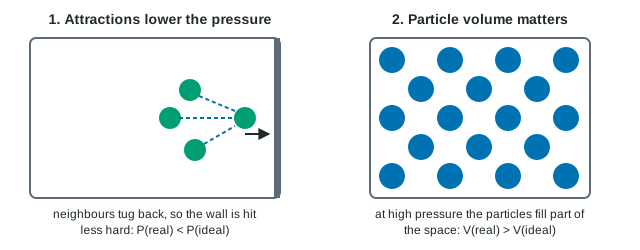
Real gases depart from PV = nRT because their particles attract each other, which lowers the pressure, and take up space, which raises the volume at very high pressure.
Part 1 · Hook
Why this matters
Part 2 · Before you start
What this builds on
Part 3 · Prerequisite check
Quick check before you start
1. Which assumption of the kinetic molecular theory concerns attractions?
- Particles do not attract or repel each other
- Particles move in straight lines
- Average KE is proportional to T
Show the answer
The ideal model ignores attractions between particles.
- Correct: Particles do not attract or repel each other:
- Particles move in straight lines:
- Average KE is proportional to T:
2. Which has the strongest attractions between its molecules?
- NH₃
- CH₄
- Ne
Show the answer
NH₃ hydrogen-bonds; CH₄ and Ne have dispersion forces only.
- Correct: NH₃:
- CH₄:
- Ne:
Part 4 · See it
See it first
Part 5 · Step by step
How it works, step by step
- Real particles attract each othera particle near the wall is pulled back, so the measured pressure is lower than ideal
- Attractions matter more when particles are close and slowdeviations grow at high pressure and low temperature
- Real particles take up spaceat very high pressure the real volume is larger than ideal
- High temperature and low pressure make both effects smallreal gases behave most ideally there, especially small, weakly attracting ones like He
Part 6 · Key ideas
Key ideas
- Ideal gas: PV/nRT = 1. Below 1, attractions dominate; above 1, particle volume dominates.
- Attractions lower the pressure: worst for polar or polarizable molecules, at low T and high P.
- Particle volume raises the volume: worst at very high P and for large molecules.
- Most ideal: high temperature, low pressure, small particles with weak attractions.
Part 7 · Misconception
A common mistake
The wrong idea: A real gas deviates from ideal behavior only because its molecules take up space.
What actually happens: At ordinary high pressures the bigger effect is usually attraction, which makes the pressure lower than ideal. Particle volume only takes over at very high pressure.
Part 8 · Check yourself
Check yourself
Exam-style questions. Anything you miss goes into your review queue.
Graph
PV/nRT for four gases at 350 K
HeArCH4CO2
Data table
| Pressure (atm) | He | Ar | CH4 | CO2 |
|---|---|---|---|---|
| 1 | 1 | 1 | 0.999 | 0.997 |
| 50 | 1.02 | 0.991 | 0.959 | 0.842 |
| 100 | 1.04 | 0.988 | 0.93 | 0.656 |
| 150 | 1.06 | 0.992 | 0.918 | 0.502 |
| 200 | 1.079 | 1.003 | 0.924 | 0.494 |
| 250 | 1.099 | 1.02 | 0.947 | 0.542 |
| 300 | 1.118 | 1.043 | 0.982 | 0.603 |
1. Which gas never falls below PV/nRT = 1 at any pressure shown?
- He
- Ar
- CH₄
- CO₂
Show the answer
Helium’s curve starts at 1 and only rises. Its atoms attract each other so weakly that only the volume effect shows, and it grows with pressure.
- Correct: He: Right: above 1 throughout.
- Ar: Ar dips just below 1 at moderate pressure before rising above it near 200 atm.
- CH₄: CH₄ dips below 1 at moderate pressure.
- CO₂: CO₂ falls well below 1.
2. Why does CO₂ show the largest dip below PV/nRT = 1?
- CO₂ molecules attract each other most strongly, lowering the pressure most.
- CO₂ molecules are the smallest of the four, so they slip between the others and lower the pressure.
- CO₂ molecules take up the most volume, which lowers the measured pressure below the ideal value.
- CO₂ molecules move fastest at 350 K, so they collide with the walls less often than the others do.
Show the answer
A value below 1 means the pressure is lower than ideal, which is the effect of attractions. CO₂ has the most electrons (22) and polar bonds, so its attractions are the strongest of the four.
- Correct: CO₂ molecules attract each other most strongly, lowering the pressure most.: Right: below 1 points to attractions.
- CO₂ molecules are the smallest of the four, so they slip between the others and lower the pressure.: CO₂ is one of the larger molecules here, not the smallest.
- CO₂ molecules take up the most volume, which lowers the measured pressure below the ideal value.: Particle volume makes PV/nRT larger than 1, not smaller.
- CO₂ molecules move fastest at 350 K, so they collide with the walls less often than the others do.: CO₂ is the heaviest gas here, so it moves slowest at 350 K.
3. Above about 200 atm, Ar’s PV/nRT rises above 1, and it keeps rising. Which explanation fits?
- The molecules' own volume becomes a real share of the container, so real V exceeds ideal V.
- At very high pressure the attractions between Ar atoms become repulsions, which push the walls outward.
- At very high pressure the Ar atoms are squeezed smaller, so each one pushes harder on the walls.
- At very high pressure the temperature of the gas rises, so the molecules hit the walls harder.
Show the answer
When the atoms are packed close, the space they cannot enter (their own volume) is no longer negligible. Real V is larger than ideal V, so PV/nRT exceeds 1.
- Correct: The molecules' own volume becomes a real share of the container, so real V exceeds ideal V.: Right: particle volume dominates at very high pressure.
- At very high pressure the attractions between Ar atoms become repulsions, which push the walls outward.: The effect is from the particles' own volume, not from attractions turning into repulsions at a distance.
- At very high pressure the Ar atoms are squeezed smaller, so each one pushes harder on the walls.: Atoms are not squeezed smaller; their fixed size is exactly why the volume effect appears.
- At very high pressure the temperature of the gas rises, so the molecules hit the walls harder.: The data are all at 350 K, so the temperature is constant.
4. Under which conditions does a real gas behave most like an ideal gas?
- High temperature and low pressure
- Low temperature and high pressure
- Low temperature and low pressure
- High temperature and high pressure
Show the answer
Fast particles (high T) are barely affected by attractions, and particles far apart (low P) have negligible volume and few neighbors.
- Correct: High temperature and low pressure: Right: fast, far-apart particles.
- Low temperature and high pressure: These conditions make both deviations largest, near condensation.
- Low temperature and low pressure: Low temperature makes attractions matter.
- High temperature and high pressure: High pressure makes particle volume and attractions matter.
5. At the same temperature and pressure, which gas deviates most from ideal behavior?
- SO₂ (polar, 32 electrons)
- Ne (nonpolar, 10 electrons)
- H₂ (nonpolar, 2 electrons)
- He (nonpolar, 2 electrons)
Show the answer
Deviations from attractions grow with intermolecular forces. SO₂ is polar with many electrons, so it attracts its neighbors most strongly.
- Correct: SO₂ (polar, 32 electrons): Right: polar and polarizable.
- Ne (nonpolar, 10 electrons): Ne has few electrons and weak dispersion forces.
- H₂ (nonpolar, 2 electrons): H₂ has the weakest attractions of almost any gas.
- He (nonpolar, 2 electrons): He is the most nearly ideal real gas.
6. At 300 K, PV/nRT for He is 1.005 at 10 atm. A student concludes that helium atoms repel each other. Which response is best?
- Above 1 comes from the atoms' own volume; helium's attractions are too weak to offset it.
- The student is right: a value above 1 means the particles repel, so they push harder on the walls.
- A value above 1 means helium has strong attractions, which makes its measured pressure higher.
- The value is within error of 1, so helium is exactly ideal and no explanation is needed.
Show the answer
Two departures compete: attractions lower PV/nRT, and particle volume raises it. Helium attracts so weakly that only the volume effect remains, giving a value slightly above 1.
- Correct: Above 1 comes from the atoms' own volume; helium's attractions are too weak to offset it.: Right: volume, not repulsion, raises the value.
- The student is right: a value above 1 means the particles repel, so they push harder on the walls.: The volume effect raises the value; long-range repulsion is not needed to explain it.
- A value above 1 means helium has strong attractions, which makes its measured pressure higher.: Attractions push PV/nRT below 1, not above.
- The value is within error of 1, so helium is exactly ideal and no explanation is needed.: A steady deviation that grows with pressure is real, not error; it has a physical cause.
Part 9 · Summary
Summary
Part 10 · Up next
What comes next
Part 11 · Connections