Thermodynamic and Kinetic Control
A negative ΔG° means a process is thermodynamically favored, not that it is fast.
Part 1 · Hook
Why this matters
Part 2 · Before you start
What this builds on
Part 3 · Prerequisite check
Quick check before you start
1. What is the activation energy of a reaction?
- The minimum energy colliding particles need to react
- The total energy released by the reaction
- The energy of the products minus the reactants
- The energy of the reactants
Show the answer
Only collisions with at least Ea of energy (and the right orientation) lead to reaction.
- Correct: The minimum energy colliding particles need to react:
- The total energy released by the reaction:
- The energy of the products minus the reactants:
- The energy of the reactants:
2. A process is thermodynamically favored when…
- ΔG° < 0
- ΔH° > 0
- ΔS° < 0
- ΔG° > 0
Show the answer
ΔG° = ΔH° − TΔS° < 0 is the test for favorability.
- Correct: ΔG° < 0:
- ΔH° > 0:
- ΔS° < 0:
- ΔG° > 0:
Part 4 · See it
See it first
Part 5 · Step by step
How it works, step by step
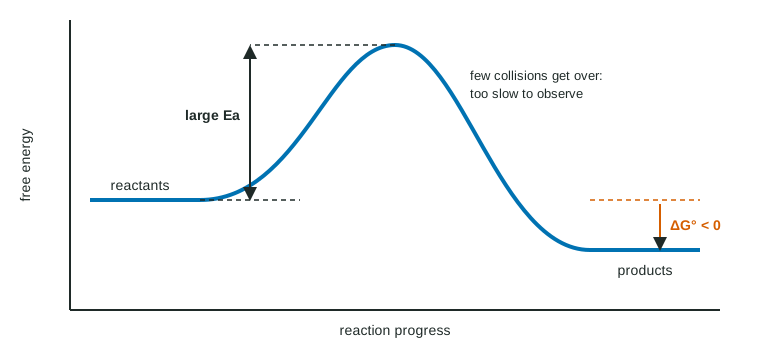
- ΔG° compares only the starting and ending statesit says whether a reaction can go, not how fast
- The rate depends on how many collisions have at least the activation energya large Ea makes the rate tiny, however negative ΔG° is
- A favored reaction with a very large Ea barely proceeds at room temperatureit is under kinetic control: the reactants are kinetically stable
- Heat, a spark or a catalyst gets more particles over the barrierthe favored reaction then runs at a measurable rate; ΔG° is unchanged
Part 6 · Key ideas
Key ideas
- Thermodynamics (ΔG°) answers can it go? Kinetics (Ea, rate) answers how fast? They are independent.
- A thermodynamically favored process with a very large activation energy may show no measurable change: it is under kinetic control.
- Examples: diamond → graphite, paper and gasoline in air, H₂ and O₂ without a spark.
- A spark, heat or a catalyst can start such a reaction; none of them changes ΔG°.
- No visible reaction does not prove ΔG° > 0.
Part 7 · Misconception
A common mistake
The wrong idea: If a reaction has a negative ΔG°, it happens quickly, and if nothing happens, ΔG° must be positive.
What actually happens: ΔG° says nothing about rate. A favored reaction with a large activation energy can be unmeasurably slow (diamond to graphite); only thermodynamic data, not watching, tell you the sign of ΔG°.
Part 8 · Check yourself
Check yourself
Exam-style questions. Anything you miss goes into your review queue.
Data table
Three reactions at 298 K
A student compares three reactions at 298 K. Each is mixed under standard conditions and watched for one hour.
| Reaction | ΔG° (kJ/mol) | Ea (kJ/mol) | Observed in 1 hour |
|---|---|---|---|
| 1: diamond → graphite | −2.9 | very large (over 300) | no change |
| 2: H⁺(aq) + OH⁻(aq) → H₂O(l) | −79.9 | very small | complete, instantly |
| 3: 2 H₂(g) + O₂(g) → 2 H₂O(l), no spark | −474.2 | large | no detectable change |
1. Which reactions in the table are thermodynamically favored at 298 K?
- Reaction 2 alone, because it is the one that is observed
- All three
- Reactions 2 and 3, because their ΔG° values are large
- No reaction in the table, because two show no change
Show the answer
Favorability depends on the sign of ΔG° alone. All three have ΔG° < 0.
- Reaction 2 alone, because it is the one that is observed: Being observed is about rate. Favorability is decided by the sign of ΔG°, which is negative for all three.
- Correct: All three: Right: every ΔG° is negative, so every reaction is favored, whether or not it is fast.
- Reactions 2 and 3, because their ΔG° values are large: Any negative ΔG° means favored; −2.9 kJ/mol counts too.
- No reaction in the table, because two show no change: A reaction can be favored and still too slow to see.
2. Which statement best explains why Reaction 3 shows no change in an hour?
- Its ΔG° is positive at 298 K, so the mixture has to be heated before water can form.
- The mixture is already at equilibrium, so no further change can occur.
- The reaction absorbs too much heat from the surroundings to proceed.
- Its activation energy is large, so few H₂–O₂ collisions have enough energy to react.
Show the answer
A favored reaction with a large activation energy is too slow to observe: it is under kinetic control.
- Its ΔG° is positive at 298 K, so the mixture has to be heated before water can form.: ΔG° is −474.2 kJ/mol, strongly negative. The problem is the rate, not favorability.
- The mixture is already at equilibrium, so no further change can occur.: With ΔG° this negative, equilibrium lies almost entirely on the product side; the mixture is far from it.
- The reaction absorbs too much heat from the surroundings to proceed.: Forming water from H₂ and O₂ releases a large amount of heat.
- Correct: Its activation energy is large, so few H₂–O₂ collisions have enough energy to react.: Right: the reaction is under kinetic control. It is favored, but the rate is negligible.
3. A spark is passed through the mixture in Reaction 3 and it reacts explosively. What does the spark do?
- It gets some molecules over the barrier; the heat they release lets others react.
- It changes ΔG° from positive to negative, which makes the reaction favored.
- It lowers the activation energy permanently, the way a catalyst does.
- It shifts the equilibrium constant to favor products for as long as the spark lasts.
Show the answer
The barrier, not ΔG°, kept the mixture unreacted. A spark supplies enough energy to start the reaction, and the energy it releases keeps it going.
- Correct: It gets some molecules over the barrier; the heat they release lets others react.: Right: the spark supplies the activation energy to start; the exothermic reaction then supplies its own.
- It changes ΔG° from positive to negative, which makes the reaction favored.: ΔG° was already negative; the spark changes the rate, not the thermodynamics.
- It lowers the activation energy permanently, the way a catalyst does.: A spark adds energy; it does not provide a new pathway, so Ea is unchanged.
- It shifts the equilibrium constant to favor products for as long as the spark lasts.: K depends on temperature, not on a spark, and was already very large.
4. Diamonds kept for centuries do not turn into graphite. Which statement is correct?
- Diamond is thermodynamically more stable than graphite at 298 K.
- The conversion is not favored, because its ΔG° is small.
- Diamond is kinetically stable: the change is favored but has a huge Ea.
- The conversion is at equilibrium, so equal amounts of diamond and graphite are present.
Show the answer
Kinetic stability (a slow rate) and thermodynamic stability (the sign of ΔG°) are different. Diamond is the first, not the second.
- Diamond is thermodynamically more stable than graphite at 298 K.: ΔG° for diamond → graphite is negative, so graphite is the more stable form.
- The conversion is not favored, because its ΔG° is small.: A small negative ΔG° is still negative: the conversion is favored, just slowly.
- Correct: Diamond is kinetically stable: the change is favored but has a huge Ea.: Right: ΔG° < 0, yet breaking and rearranging the strong covalent network is extremely slow.
- The conversion is at equilibrium, so equal amounts of diamond and graphite are present.: There is no graphite forming at a measurable rate, so this is not an equilibrium mixture.
5. What does a negative ΔG° tell you about a reaction?
- It is favored, but it may be fast or very slow.
- It will happen quickly once the reactants are mixed.
- It has a small activation energy barrier.
- It needs a continuous input of energy to keep going.
Show the answer
Thermodynamics (ΔG°) answers "can it go?"; kinetics (Ea) answers "how fast?".
- Correct: It is favored, but it may be fast or very slow.: Right: ΔG° says whether a reaction can go on its own, not how fast.
- It will happen quickly once the reactants are mixed.: ΔG° says nothing about rate; rate depends on the activation energy.
- It has a small activation energy barrier.: ΔG° and Ea are independent; a very favored reaction can have a huge barrier.
- It needs a continuous input of energy to keep going.: That describes a process with ΔG° > 0.
6. Paper burns in air with ΔG° far below zero, yet a book can sit on a shelf for a hundred years. Which explanation is best?
- ΔG° for burning paper becomes positive at room temperature.
- Paper is at equilibrium with the oxygen in the air.
- Burning paper has a large Ea, so at 25 °C its rate is negligible.
- There is not enough oxygen in the air for the reaction to be favored.
Show the answer
Favored processes can be kinetically stable when the activation energy is large.
- ΔG° for burning paper becomes positive at room temperature.: Combustion has ΔH° < 0 and ΔS° > 0, so ΔG° is negative at every temperature.
- Paper is at equilibrium with the oxygen in the air.: Equilibrium would lie almost entirely on the side of CO₂ and H₂O; the book is far from it.
- Correct: Burning paper has a large Ea, so at 25 °C its rate is negligible.: Right: it is favored, but under kinetic control at 298 K.
- There is not enough oxygen in the air for the reaction to be favored.: Air holds plenty of oxygen; the reaction is favored but slow.
7. A student mixes two solutions, sees no reaction after an hour, and concludes "ΔG° for this reaction must be positive." Which reply is best?
- That is correct, because any reaction with ΔG° < 0 happens within minutes.
- That is correct, because a reaction that does not happen has ΔG° = 0.
- That does not follow, because ΔG° is negative for any reaction that releases heat.
- It does not follow: a favored reaction can be too slow to see; ΔG° comes from data.
Show the answer
An observation of no change cannot separate "not favored" from "favored but slow". You need ΔG° data to decide.
- That is correct, because any reaction with ΔG° < 0 happens within minutes.: Many favored reactions are extremely slow (diamond to graphite, paper burning at room temperature).
- That is correct, because a reaction that does not happen has ΔG° = 0.: ΔG° = 0 means neither direction is favored under standard conditions; it is not what "no visible change" shows.
- That does not follow, because ΔG° is negative for any reaction that releases heat.: Not so: an exothermic reaction with ΔS° < 0 can have ΔG° > 0 at high temperature.
- Correct: It does not follow: a favored reaction can be too slow to see; ΔG° comes from data.: Right: no visible change could mean ΔG° > 0 or could mean a large Ea.
Part 9 · Summary
Summary
Part 10 · Up next
What comes next
Part 11 · Connections