Non-Mendelian Genetics
Mendel's ratios assume genes on different chromosome pairs, one dominant and one recessive allele, one gene per trait and nuclear genes.
Part 1 · Hook
Why this matters
In 1910 Thomas Hunt Morgan's lab was breeding fruit flies to test Mendel's rules. Some pairs of traits refused to give 9:3:3:1: offspring kept the same combinations as their grandparents far more often than chance allowed. Elsewhere, red and white snapdragons gave pink flowers, people turned out to have blood types A, B, AB and O, and some plant traits were passed on only by the mother. None of this overturns Mendel. It shows what his simple ratios assumed, and what happens when those assumptions fail.
Part 2 · Before you start
What this builds on
Part 3 · Prerequisite check
Quick check before you start
1. In a dihybrid cross AaBb × AaBb with genes on different chromosome pairs, the phenotype ratio is
- 9:3:3:1
- 3:1
- 1:2:1
Show the answer
Independent assortment gives four gamete types in equal numbers, and 16 equally likely combinations give 9:3:3:1.
- Correct: 9:3:3:1:
- 3:1:
- 1:2:1:
2. Crossing over between homologs in prophase I produces
- recombinant chromosomes carrying new combinations of alleles
- extra copies of a chromosome
- alleles that neither parent had
Show the answer
Crossing over swaps matching pieces between homologs, mixing their alleles onto one chromosome.
- Correct: recombinant chromosomes carrying new combinations of alleles:
- extra copies of a chromosome:
- alleles that neither parent had:
3. In a chi-square test with 3 degrees of freedom, χ² = 9.4 and the critical value at p = 0.05 is 7.82. The conclusion is
- reject the null hypothesis
- fail to reject the null hypothesis
- accept the null hypothesis as proven
Show the answer
χ² is larger than the critical value, so a difference this large would be unlikely by chance if the null hypothesis were true: reject it.
- Correct: reject the null hypothesis:
- fail to reject the null hypothesis:
- accept the null hypothesis as proven:
Part 4 · See it
See it first
Part 5 · Step by step
How it works, step by step
- Mendel's 9:3:3:1 assumes the two genes are on different chromosome pairs, so they assort independently.When two genes sit close together on one chromosome (linked genes), their alleles go into gametes together and that assumption fails.
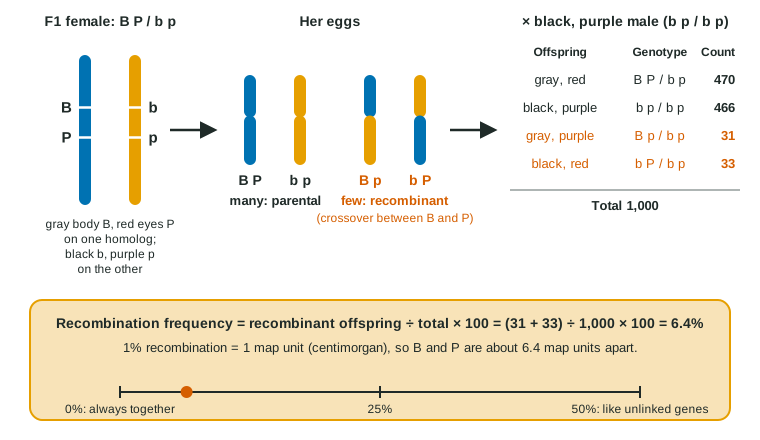
- In a testcross of a fly with B P on one homolog and b p on the other, most eggs carry one of those two chromosomes unchanged.Parental-type offspring far outnumber the other classes, instead of the 1:1:1:1 that independent assortment predicts.
- In some meioses, crossing over happens in the stretch between the two genes.A few gametes carry recombinant combinations (B p, b P), and their share, the recombination frequency, rises with the distance between the genes: 1% = 1 map unit.
- Alleles do not always act as simply dominant and recessive, and many genes can act on one trait or one gene on many.Crosses give other ratios: 1:2:1 phenotypes with incomplete dominance or codominance, continuous variation for polygenic traits, 9:3:4 with epistasis.
- Mitochondria and chloroplasts carry their own genes and are passed on in the egg's cytoplasm.Their traits are inherited from the mother, so reciprocal crosses give different results.
- A chi-square test compares observed counts with the counts expected from a hypothesis.A large χ² (above the critical value) rejects the hypothesis, for example independent assortment for linked genes.
Part 6 · Key ideas
Key ideas
- Linked genes are close together on one chromosome and tend to be inherited together. Recombination frequency = recombinants ÷ total × 100; 1% = 1 map unit. Values near 50% look like unlinked genes. Frequencies give gene order on a linkage map.
- Incomplete dominance: the heterozygote is in between (pink snapdragons). Codominance: both alleles show fully (AB blood type, roan cattle). The ABO gene has multiple alleles.
- Polygenic traits (height, skin color) depend on many genes and show continuous variation. Pleiotropy: one gene, many traits. Epistasis: one gene masks another.
- Nonnuclear inheritance: mitochondrial and chloroplast genes come from one parent, usually the mother. Sex-linked and cytoplasmic traits give different results in a reciprocal cross.
- Compare the observed ratio with the expected ratio using a chi-square test before claiming a cross does or does not fit Mendel.
Part 7 · Misconception
A common mistake
The wrong idea: Genes on the same chromosome are always inherited together, so they never form recombinant offspring.
What actually happens: Crossing over between them makes recombinants in some meioses. The closer the genes, the rarer the recombinants; genes far apart on one chromosome cross over so often that they can give nearly 50% recombinants, like genes on different chromosomes.
Part 8 · Check yourself
Check yourself
Exam-style questions. Anything you miss goes into your review queue.
Data table
Offspring counts from a fruit fly testcross
A true-breeding gray-bodied, red-eyed fly was crossed with a true-breeding black-bodied, purple-eyed fly. Gray (B) is dominant to black (b) and red (P) to purple (p). An F1 female (BbPp) was then crossed with a black, purple-eyed male (bbpp), and the offspring were counted.
| Offspring phenotype | Number of flies |
|---|---|
| Gray body, red eyes | 470 |
| Black body, purple eyes | 466 |
| Gray body, purple eyes | 31 |
| Black body, red eyes | 33 |
| Total | 1,000 |
1. Which offspring classes are recombinant?
- Gray with purple eyes, and black with red eyes
- Gray with red eyes, and black with purple eyes
- Gray with red eyes, and gray with purple eyes
- Black with purple eyes, and black with red eyes
Show the answer
The F1 female got B P from one parent and b p from the other. Offspring showing B with p, or b with P, carry combinations neither of her parents had: recombinants.
- Correct: Gray with purple eyes, and black with red eyes: Gray-purple and black-red mix the grandparents' combinations, and they are the two small classes.
- Gray with red eyes, and black with purple eyes: These match the original true-breeding parents' combinations: parental types.
- Gray with red eyes, and gray with purple eyes: These share a body color; one class is parental, the other recombinant.
- Black with purple eyes, and black with red eyes: These share a body color; one class is parental, the other recombinant.
2. Calculate the recombination frequency between the body-color and eye-color genes, in percent. Give one decimal place.
Type a number in %.
Show the answer
Recombinants: 31 + 33 = 64. 64 ÷ 1,000 × 100 = 6.4%, so the genes are about 6.4 map units apart.
- Answer: 6.4 %
3. A chi-square test of the counts against the 1:1:1:1 ratio gives χ² ≈ 760. Which conclusion is correct?
- With 3 degrees of freedom the critical value is 7.82, so reject independent assortment; the genes are likely linked.
- With 4 degrees of freedom the critical value is 9.49, so reject independent assortment; the genes are likely linked.
- With 3 degrees of freedom the critical value is 7.82, so fail to reject independent assortment.
- χ² is far above the critical value, which shows that the genes are on different chromosomes.
Show the answer
Four classes give df = 4 − 1 = 3, critical value 7.82 at p = 0.05. 760 is far larger, so the deviation from 1:1:1:1 is very unlikely to be chance. Too many parental types fits linkage.
- Correct: With 3 degrees of freedom the critical value is 7.82, so reject independent assortment; the genes are likely linked.: df = 3, and 760 > 7.82: reject; excess parental types point to linkage.
- With 4 degrees of freedom the critical value is 9.49, so reject independent assortment; the genes are likely linked.: Degrees of freedom are the number of classes minus one: 4 − 1 = 3, not 4.
- With 3 degrees of freedom the critical value is 7.82, so fail to reject independent assortment.: A χ² larger than the critical value means reject, not fail to reject.
- χ² is far above the critical value, which shows that the genes are on different chromosomes.: Rejecting independent assortment points the other way: the genes are close on the same chromosome.
Data table
Coat colors of Labrador retriever puppies
In Labrador retrievers, gene B controls the dark pigment made in hair: B (black) is dominant to b (brown, called chocolate). A second gene, E, on another chromosome, controls whether that pigment is put into the hair at all: dogs with genotype ee cannot deposit it and are yellow. A breeder pooled the litters of several matings between dogs that were all BbEe.
| Coat color | Number of puppies |
|---|---|
| Black | 92 |
| Chocolate | 29 |
| Yellow | 39 |
| Total | 160 |
4. Calculate χ² for the puppy counts against an expected ratio of 9 black : 3 chocolate : 4 yellow. Give two decimal places.
Type a number.
Show the answer
Expected: 160 × 9/16 = 90 black, 160 × 3/16 = 30 chocolate, 160 × 4/16 = 40 yellow. χ² = (92 − 90)²/90 + (29 − 30)²/30 + (39 − 40)²/40 = 0.044 + 0.033 + 0.025 = 0.10.
- Answer: 0.10
5. Using χ² ≈ 0.10 for the 9:3:4 hypothesis, which conclusion is correct at p = 0.05?
- df = 2, critical value 5.99; fail to reject, so the counts are consistent with 9:3:4.
- df = 3, critical value 7.82; fail to reject, so the counts are consistent with 9:3:4.
- df = 2, critical value 5.99; reject, so the counts do not fit 9:3:4.
- df = 2, critical value 5.99; this proves the 9:3:4 hypothesis is true.
Show the answer
Three classes give df = 3 − 1 = 2, critical value 5.99. 0.10 is far below it, so the small deviations are consistent with chance: fail to reject 9:3:4.
- Correct: df = 2, critical value 5.99; fail to reject, so the counts are consistent with 9:3:4.: df = 2 and 0.10 < 5.99: the data fit the hypothesis.
- df = 3, critical value 7.82; fail to reject, so the counts are consistent with 9:3:4.: There are three color classes, so df = 2, not 3.
- df = 2, critical value 5.99; reject, so the counts do not fit 9:3:4.: A χ² below the critical value means fail to reject, not reject.
- df = 2, critical value 5.99; this proves the 9:3:4 hypothesis is true.: A test can fail to reject a hypothesis but never proves it true.
Experimental setup
Leaf color in four o'clock plants
Some four o'clock plants have branches of three kinds: green, white (no working chloroplasts), and variegated (patches of green and white). Each flower makes both eggs and pollen, and the plant has no sex chromosomes. A botanist moved pollen from flowers on one kind of branch onto flowers on another kind, then grew the seeds.
| Flower giving the eggs was on a | Flower giving the pollen was on a | Seedlings |
|---|---|---|
| Green branch | Green branch | Green |
| Green branch | Variegated branch | Green |
| Green branch | White branch | Green |
| Variegated branch | Green branch | A mix of green, variegated and white |
| White branch | Green branch | White (die after using up the seed's food) |
6. Which explanation best accounts for the results?
- The trait depends on chloroplasts, which pass to the seedling in the egg's cytoplasm, not in the pollen.
- The trait is caused by a recessive allele in the nucleus, which is hidden when pollen brings a dominant allele.
- The trait is X-linked, so it passes from the plant giving the eggs to its offspring.
- The pollen's chloroplasts are destroyed by the egg's nucleus at fertilization.
Show the answer
Chloroplasts carry their own DNA and are passed on in the cytoplasm. An egg brings plenty of cytoplasm; the pollen's sperm brings almost none. So the seedling inherits the chloroplasts of the egg's branch: green, white or a mix.
- Correct: The trait depends on chloroplasts, which pass to the seedling in the egg's cytoplasm, not in the pollen.: Chloroplasts travel with the egg's cytoplasm, so seedlings match the egg-giving branch.
- The trait is caused by a recessive allele in the nucleus, which is hidden when pollen brings a dominant allele.: A nuclear allele would give the same result whichever plant gave the eggs, and these crosses differ by direction.
- The trait is X-linked, so it passes from the plant giving the eggs to its offspring.: Four o'clocks have no sex chromosomes; each flower makes both eggs and pollen.
- The pollen's chloroplasts are destroyed by the egg's nucleus at fertilization.: The nucleus does not destroy chloroplasts; the sperm cell brings little or no chloroplast DNA to begin with.
7. A mother has blood type A and her child has type O. Which man can be ruled out as the child's father on blood type alone?
- A man with type AB
- A man with type A
- A man with type B
- A man with type O
Show the answer
A type O child is ii and got an i from each parent. A type AB man is IAIB and has no i to give, so he cannot be the father. Men with type A, B or O can all carry i.
- Correct: A man with type AB: IAIB carries no i allele, so he cannot give the child one.
- A man with type A: A type A man can be IAi and pass i.
- A man with type B: A type B man can be IBi and pass i.
- A man with type O: A type O man is ii and passes i to every child.
8. A plant's height is controlled by three genes (A, B, C) on different chromosomes. Each capital-letter allele adds 2 cm to a base height, and the effects simply add up. How many different heights are possible among the offspring of AaBbCc × AaBbCc? Give a whole number.
Type a number in heights.
Show the answer
An offspring can have 0, 1, 2, 3, 4, 5 or 6 capital-letter alleles, and height depends only on that number: 7 classes. With more genes the classes multiply and the distribution looks continuous, as for polygenic traits such as human height.
- Answer: 7 heights
Part 9 · Summary
Summary
Mendel's ratios assume genes on different chromosome pairs, one dominant and one recessive allele, one gene per trait and nuclear genes. When genes are linked, close on one chromosome, parental combinations outnumber recombinants; the recombination frequency (recombinants ÷ total × 100) measures their distance in map units and gives gene order. Incomplete dominance gives an in-between heterozygote and codominance shows both alleles, as in ABO blood types, a gene with multiple alleles. Polygenic traits vary continuously, pleiotropic genes affect several traits, and epistasis lets one gene mask another. Mitochondrial and chloroplast genes are usually inherited from the mother, so reciprocal crosses differ. A chi-square test compares observed counts with those expected under a hypothesis.
Part 10 · Up next
What comes next
Part 11 · Connections