Prediction plus mechanism
A prediction with mechanism names the variable that will change, the direction, and the chain of causes from the disruption to that result.
Part 1 · Hook
Why this matters
"Predict what happens if…" is one of the most common free-response prompts, and the one most often answered with half the points: a correct direction ("ATP goes down") with no mechanism, or a mechanism that never reaches a measurable result. A full answer walks from the disruption, step by step, to something you could measure.
Part 2 · Before you start
What this builds on
Part 3 · Prerequisite check
Quick check before you start
1. What directly drives ATP synthase in mitochondria?
- H⁺ flowing down its gradient across the inner membrane
- Electrons passing straight from NADH to ATP synthase
- Oxygen binding to ATP synthase
Show the answer
The electron transport chain pumps H⁺; H⁺ flowing back through ATP synthase powers ATP synthesis (chemiosmosis).
- Correct: H⁺ flowing down its gradient across the inner membrane:
- Electrons passing straight from NADH to ATP synthase:
- Oxygen binding to ATP synthase:
2. Where does the O₂ released in photosynthesis come from?
- Water split at photosystem II
- CO₂ fixed in the Calvin cycle
- Glucose broken down in the stroma
Show the answer
Photosystem II replaces its lost electrons by splitting water, releasing O₂.
- Correct: Water split at photosystem II:
- CO₂ fixed in the Calvin cycle:
- Glucose broken down in the stroma:
3. In a scientific argument, what does reasoning do?
- Explains with biology why the evidence supports the claim
- Repeats the data with more decimal places
- States the claim a second time
Show the answer
Reasoning is the mechanism that connects evidence to claim.
- Correct: Explains with biology why the evidence supports the claim:
- Repeats the data with more decimal places:
- States the claim a second time:
Part 4 · See it
See it first
Part 5 · Step by step
How it works, step by step
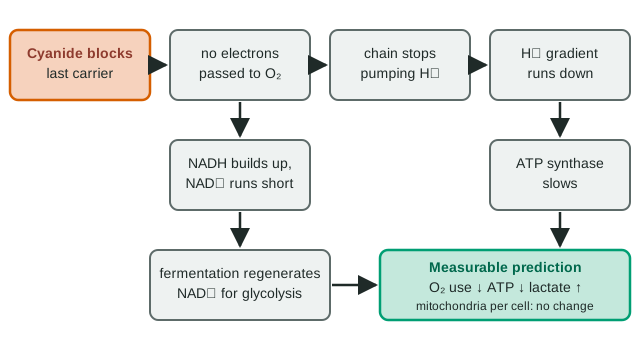
- A poison (cyanide) binds the last protein of the electron transport chain.Electrons can no longer be passed to O₂, so O₂ use falls.
- Electrons back up along the chain.The chain stops pumping H⁺, and the H⁺ gradient across the inner membrane runs down.
- ATP synthase is driven by H⁺ flowing down that gradient.ATP production by oxidative phosphorylation falls sharply.
- NADH can no longer hand its electrons to the chain, so NAD⁺ runs short.The Krebs cycle stalls, and cells that can ferment make more lactate to regenerate NAD⁺ for glycolysis.
- Each step has a measurable result.You can predict: less O₂ used, less ATP, more lactate, and no change in parts the poison does not touch.
Part 6 · Key ideas
Key ideas
- Worked example. Prediction: ATP in cyanide-treated cells will fall. Mechanism: cyanide blocks the last carrier, so electrons cannot reach O₂; the chain stops pumping H⁺; the gradient runs down; ATP synthase, driven by H⁺ flow, makes less ATP.
- Three parts score: direction (up, down, no change), mechanism (each cause leads to the next) and a measurable variable at the end.
- Use the model you are given. Trace the change along its arrows: a compound that takes electrons before a block restores flow upstream of the block, not downstream.
- Some variables do not change. Saying "no change" with a reason (DCMU does not change how much light reaches the leaf) is part of a good prediction.
Part 7 · Misconception
A common mistake
The wrong idea: "Cyanide kills cells because they cannot get oxygen."
What actually happens: Oxygen still reaches the cells. Cyanide stops electrons being passed to oxygen, which stops proton pumping, collapses the gradient and starves ATP synthase. The mechanism is the electron transport chain, not oxygen supply.
Part 8 · Check yourself
Check yourself
Exam-style questions. Anything you miss goes into your review queue.
Experimental setup
A poison and the electron transport chain
In the inner mitochondrial membrane, NADH and FADH₂ hand electrons to a chain of proteins. As electrons pass along, the proteins pump H⁺ into the intermembrane space; at the end, electrons combine with O₂ and H⁺ to form water. H⁺ flowing back through ATP synthase drives ATP production.
Cyanide binds the last protein of the chain and stops it from passing electrons to O₂. A researcher treats cultured muscle cells, which can also carry out lactic acid fermentation, with a low dose of cyanide.
1. Predict how each variable changes in the cyanide-treated muscle cells within a few minutes, compared with untreated cells.
| Variable | Change |
|---|---|
| O₂ used by the cells per minute | — |
| H⁺ gradient across the inner mitochondrial membrane | — |
| ATP made by ATP synthase | — |
| Lactate released by the cells | — |
| Number of mitochondria per cell | — |
Show the answer
Trace the block: no electron transfer to O₂, no pumping, the gradient falls, ATP synthase slows; NADH builds up, so fermentation rises to regenerate NAD⁺. Structures such as mitochondria do not change in minutes.
- O₂ used by the cells per minute: decreases. Electrons can no longer be passed to O₂, so O₂ stops being reduced to water.
- H⁺ gradient across the inner mitochondrial membrane: decreases. With electrons stuck, the chain stops pumping H⁺, while H⁺ keeps flowing back through ATP synthase, so the gradient runs down.
- ATP made by ATP synthase: decreases. ATP synthase is driven by H⁺ flowing down its gradient; a shrinking gradient drives less synthesis.
- Lactate released by the cells: increases. NADH cannot unload electrons to the chain, so NAD⁺ runs short; fermentation regenerates NAD⁺ by reducing pyruvate to lactate, letting glycolysis continue.
- Number of mitochondria per cell: no change. Cyanide blocks a protein's function; in a few minutes it does not change how many mitochondria the cell has.
2. Which is the best prediction with mechanism for the Krebs cycle in the cyanide-treated cells?
- It slows, because NADH cannot pass its electrons to the blocked chain, so NAD⁺ runs short and the cycle's oxidation steps cannot continue.
- It speeds up, because the cells need more ATP, so they send more pyruvate into the mitochondria to make up the lost ATP.
- It stays the same, because the Krebs cycle does not use oxygen directly, so a block at the end of the chain has no route to reach it in the mitochondrion.
- It stops at once, because cyanide binds the enzymes of the Krebs cycle as well as the last protein of the chain.
Show the answer
The Krebs cycle needs NAD⁺ (and FAD) to accept electrons. With the chain blocked, NADH cannot be oxidized back to NAD⁺, so the cycle stalls even though it uses no O₂ itself.
- Correct: It slows, because NADH cannot pass its electrons to the blocked chain, so NAD⁺ runs short and the cycle's oxidation steps cannot continue.: Correct: a mechanism that links the block to the cycle through NAD⁺.
- It speeds up, because the cells need more ATP, so they send more pyruvate into the mitochondria to make up the lost ATP.: Need does not drive a pathway; without NAD⁺ the cycle cannot run faster.
- It stays the same, because the Krebs cycle does not use oxygen directly, so a block at the end of the chain has no route to reach it in the mitochondrion.: It does not use O₂ directly, but it depends on NAD⁺ that only the chain regenerates in mitochondria.
- It stops at once, because cyanide binds the enzymes of the Krebs cycle as well as the last protein of the chain.: The description says cyanide binds the last protein of the chain; the cycle slows indirectly.
3. A student predicts, "The cells will die because they cannot get oxygen." What is the main weakness of this prediction?
- Oxygen still reaches the cells; the problem is that electrons cannot be passed to it, and no steps link the block to the outcome.
- It is too detailed, because a prediction should name just the variable that changes and leave out the cause and any other explanation.
- It is wrong, because muscle cells use fermentation for their ATP and are not affected by cyanide in any way.
- It uses the word "because", which belongs in reasoning rather than in a prediction about an experiment.
Show the answer
Cyanide does not keep O₂ out; it blocks its use. A full prediction names a measurable change (ATP falls, lactate rises) and the chain of causes from the block.
- Correct: Oxygen still reaches the cells; the problem is that electrons cannot be passed to it, and no steps link the block to the outcome.: Correct: wrong mechanism, and no causal steps.
- It is too detailed, because a prediction should name just the variable that changes and leave out the cause and any other explanation.: Exam predictions earn more credit with a mechanism, not less.
- It is wrong, because muscle cells use fermentation for their ATP and are not affected by cyanide in any way.: Fermentation yields far less ATP; cyanide does affect these cells.
- It uses the word "because", which belongs in reasoning rather than in a prediction about an experiment.: A prediction with mechanism is expected to use "because".
Graph
A herbicide and leaf disks
Leaf disks floating in bicarbonate solution under bright light release O₂. The herbicide DCMU binds a protein in the electron transport chain just after photosystem II and stops electrons from moving on toward photosystem I. DCMU was added to one dish at 5 minutes.
ControlDCMU added at 5 min
Data table
| Time (min) | Control | DCMU added at 5 min |
|---|---|---|
| 0 | 0 | 0 |
| 5 | 0.9 | 0.9 |
| 10 | 1.8 | 1 |
| 15 | 2.7 | 1 |
4. Predict how each variable changes in the DCMU-treated disks after 10 minutes, compared with the control.
| Variable | Change |
|---|---|
| O₂ released by water splitting | — |
| NADPH produced | — |
| CO₂ fixed by the Calvin cycle | — |
| Light reaching the chloroplasts | — |
Show the answer
The block stops the flow of electrons from water through to NADP⁺, so O₂ release, NADPH and (through lost ATP and NADPH) carbon fixation all fall. The light supply is unchanged.
- O₂ released by water splitting: decreases. Electrons cannot leave photosystem II, so it cannot accept new electrons from water, and water splitting stops.
- NADPH produced: decreases. No electrons reach photosystem I and NADP⁺, so NADPH production stops.
- CO₂ fixed by the Calvin cycle: decreases. The Calvin cycle needs ATP and NADPH from the light reactions; with less of both, it slows.
- Light reaching the chloroplasts: no change. DCMU blocks electron flow; it does not change the lamp or how much light reaches the leaf.
5. Which explanation best accounts for the DCMU curve after 5 minutes?
- With electrons unable to leave photosystem II, it cannot replace them from water, so water splitting and O₂ release stop.
- DCMU destroys the chlorophyll in the disks, so they can no longer absorb any of the light energy that reaches them from the lamp.
- DCMU blocks the Calvin cycle directly, so O₂ is used up as fast as it is made.
- DCMU closes the leaf's stomata, so the O₂ that is made is trapped inside the leaf disk.
Show the answer
Photosystem II gives up electrons to the chain and refills them by splitting water, which releases O₂. If its electrons cannot move on, water splitting stops and O₂ release flattens.
- Correct: With electrons unable to leave photosystem II, it cannot replace them from water, so water splitting and O₂ release stop.: Correct.
- DCMU destroys the chlorophyll in the disks, so they can no longer absorb any of the light energy that reaches them from the lamp.: The description says DCMU binds a protein of the chain, not chlorophyll.
- DCMU blocks the Calvin cycle directly, so O₂ is used up as fast as it is made.: The Calvin cycle does not consume O₂, and DCMU acts on the chain.
- DCMU closes the leaf's stomata, so the O₂ that is made is trapped inside the leaf disk.: The curve shows O₂ release stopping; nothing in the setup involves stomata.
6. An artificial compound can take electrons directly from photosystem II, before the DCMU block. If it is added to DCMU-treated disks, what is the best prediction?
- O₂ release resumes, because photosystem II can again pass on electrons and refill them by splitting water.
- O₂ release stays at zero, because DCMU still blocks the chain and so no electrons can leave photosystem II.
- NADPH production resumes, because the compound carries the electrons on to photosystem I and NADP⁺.
- O₂ release rises above the control, because the compound adds extra electrons to photosystem II.
Show the answer
Trace the model: the compound gives electrons a new exit before the block, so photosystem II keeps working and water splitting, with O₂ release, resumes.
- Correct: O₂ release resumes, because photosystem II can again pass on electrons and refill them by splitting water.: Correct: a model-based prediction.
- O₂ release stays at zero, because DCMU still blocks the chain and so no electrons can leave photosystem II.: The compound takes electrons before the block, so they no longer need to pass DCMU.
- NADPH production resumes, because the compound carries the electrons on to photosystem I and NADP⁺.: Nothing says the compound passes electrons to photosystem I; NADPH stays low.
- O₂ release rises above the control, because the compound adds extra electrons to photosystem II.: The compound accepts electrons; it does not supply them, and O₂ comes from water.
7. Which statement is a prediction with mechanism rather than a prediction alone?
- "If a cell is given an uncoupler, its ATP production will fall, because H⁺ leaks back without passing through ATP synthase."
- "If a cell is given an uncoupler, its ATP production will fall, and the cell will also release more heat than before."
- "Uncouplers are dangerous because they lower ATP and raise body temperature."
- "ATP production depends on many factors inside the mitochondrion, and an uncoupler is one of the factors that can change it."
Show the answer
It names the change (ATP falls) and the cause in steps (H⁺ bypasses ATP synthase).
- Correct: "If a cell is given an uncoupler, its ATP production will fall, because H⁺ leaks back without passing through ATP synthase.": Correct.
- "If a cell is given an uncoupler, its ATP production will fall, and the cell will also release more heat than before.": A prediction with no mechanism.
- "Uncouplers are dangerous because they lower ATP and raise body temperature.": A judgment with effects, but no mechanism linking them.
- "ATP production depends on many factors inside the mitochondrion, and an uncoupler is one of the factors that can change it.": Too vague to test, and no mechanism.
Part 9 · Summary
Summary
A prediction with mechanism names the variable that will change, the direction, and the chain of causes from the disruption to that result. Trace perturbations through the model you are given, step by step; say "no change" where a part is unaffected; and propose next experiments that isolate where a disruption acts, for example by using isolated mitochondria to bypass glycolysis.
Part 10 · Up next
What comes next
Part 11 · Connections