Claim, evidence and reasoning
A scientific argument has three parts.
Part 1 · Hook
Why this matters
On free-response questions, students who understand the biology still lose points by writing "the data show the enzyme works best at pH 7 because it was highest at pH 7." That sentence has a claim and a vague nod to evidence, but no reasoning. Claim, evidence, reasoning is the shape of almost every "justify" and "support" question on the exam.
Part 2 · Before you start
What this builds on
Part 3 · Prerequisite check
Quick check before you start
1. Why does an enzyme slow down at a pH far from its optimum?
- Changed charges on R groups alter the active site's shape, so substrate binds poorly.
- The enzyme is used up faster at extreme pH.
- The substrate gains activation energy at extreme pH.
Show the answer
pH changes ionization of R groups, disrupting the bonds that shape the active site.
- Correct: Changed charges on R groups alter the active site's shape, so substrate binds poorly.:
- The enzyme is used up faster at extreme pH.:
- The substrate gains activation energy at extreme pH.:
2. A competitive inhibitor…
- binds the active site, so extra substrate can outcompete it
- binds elsewhere and lowers the maximum rate whatever the substrate level
- denatures the enzyme permanently
Show the answer
It competes with the substrate for the active site; at high substrate its effect shrinks.
- Correct: binds the active site, so extra substrate can outcompete it:
- binds elsewhere and lowers the maximum rate whatever the substrate level:
- denatures the enzyme permanently:
Part 4 · See it
See it first
Part 5 · Step by step
How it works, step by step
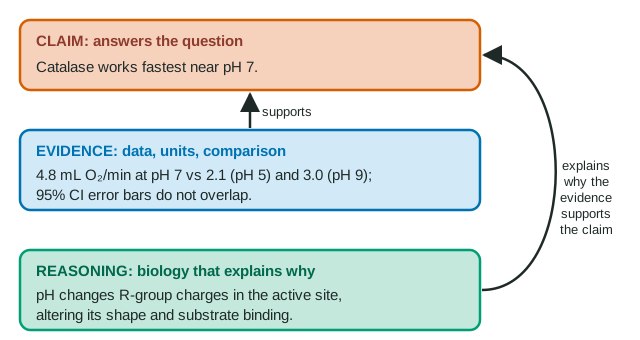
- A question asks you to support or justify a conclusion from data.You write a claim: one sentence that answers it ("catalase works fastest near pH 7").
- A grader needs to see that the data back your claim.You quote evidence: values with units and the comparison that matters (4.8 mL/min at pH 7 against 2.1 at pH 5 and 3.0 at pH 9, with non-overlapping error bars).
- Numbers alone do not say why the pattern exists.You give reasoning: pH changes the charges on R groups in the active site, altering its shape and substrate binding.
- Every study has gaps (pH tested only every 2 units).You name a limitation, which keeps your claim from going further than the data allow.
Part 6 · Key ideas
Key ideas
- Worked example. Claim: potato catalase works fastest near pH 7. Evidence: 4.8 mL O₂/min at pH 7, versus 2.1 at pH 5 and 3.0 at pH 9; the 95% CIs do not overlap. Reasoning: pH alters R-group charges in the active site, changing its shape and substrate binding. Limitation: pH was tested every 2 units, so the optimum lies between about 6 and 8.
- Evidence = data (numbers, units, a comparison). Reasoning = biology (a mechanism). Restating the data as the "reason" earns no reasoning point.
- Fit the claim to the evidence: overlapping error bars support "no difference shown", not "faster".
- A source of error is a measurement problem (inconsistent timing). A limitation is a boundary on the conclusion (only one species, wide spacing of values).
Part 7 · Misconception
A common mistake
The wrong idea: Reasoning means explaining the data again in more detail: "the rate was highest at pH 7 because 4.8 is the largest number."
What actually happens: Reasoning brings in biology the data do not contain: a mechanism (here, how pH changes the active site) that explains why the evidence supports the claim.
Part 8 · Check yourself
Check yourself
Exam-style questions. Anything you miss goes into your review queue.
Graph
Catalase activity across pH
Catalase speeds the breakdown of hydrogen peroxide into water and oxygen gas. Students added potato extract to hydrogen peroxide in buffers of five pH values at 25 °C and measured the oxygen released per minute. Bars show means of five trials; error bars show 95% confidence intervals.
Data table
| pH of buffer | Mean rate (± error) |
|---|---|
| 3 | 0.4 ± 0.2 |
| 5 | 2.1 ± 0.3 |
| 7 | 4.8 ± 0.4 |
| 9 | 3 ± 0.4 |
| 11 | 0.6 ± 0.3 |
1. Which is the best claim based on these data?
- Potato catalase works fastest near pH 7, and its activity falls as the pH moves away in either direction.
- Potato catalase works best in acidic conditions, because pH 3 and pH 5 are both below neutral.
- Potato catalase is destroyed at each pH other than pH 7, because the rates measured at the other four pH values are lower.
- Potato catalase activity rises steadily with pH, because pH 11 is higher than pH 3.
Show the answer
A claim answers the question in one sentence that the data can support: the highest rate is at pH 7, with lower rates on both sides.
- Correct: Potato catalase works fastest near pH 7, and its activity falls as the pH moves away in either direction.: Correct.
- Potato catalase works best in acidic conditions, because pH 3 and pH 5 are both below neutral.: The acidic rates (0.4 and 2.1) are among the lowest.
- Potato catalase is destroyed at each pH other than pH 7, because the rates measured at the other four pH values are lower.: Lower activity is not destruction; the rates at pH 5 and 9 are still well above zero.
- Potato catalase activity rises steadily with pH, because pH 11 is higher than pH 3.: Activity rises to pH 7 and then falls; it does not rise steadily.
2. Which sentence is the best evidence for the claim that catalase works fastest near pH 7?
- The mean rate at pH 7 (4.8 mL/min) is higher than at pH 5 (2.1) and pH 9 (3.0), and its error bar overlaps neither of theirs.
- Catalase is an enzyme, and enzymes have an optimal pH at which their active sites have the right shape.
- The graph shows that pH affects catalase, because the bars are different heights at different pH values.
- The students did five trials at each pH, so their results are reliable, and a claim based on five trials per group is certainly right.
Show the answer
Evidence quotes specific data with units and makes the comparison the claim depends on, including whether the difference is likely real.
- Correct: The mean rate at pH 7 (4.8 mL/min) is higher than at pH 5 (2.1) and pH 9 (3.0), and its error bar overlaps neither of theirs.: Correct: numbers, units, comparison, uncertainty.
- Catalase is an enzyme, and enzymes have an optimal pH at which their active sites have the right shape.: This is reasoning (a biological principle), not evidence from the data.
- The graph shows that pH affects catalase, because the bars are different heights at different pH values.: This is too vague: it names no values and does not show that pH 7 is highest.
- The students did five trials at each pH, so their results are reliable, and a claim based on five trials per group is certainly right.: Describing the method is not evidence, and repeats do not make a claim certain.
3. Which is the best reasoning to complete the argument?
- pH changes the charges on R groups in the active site; away from pH 7 this alters the site's shape and how well it binds substrate.
- The rate at pH 7 is 4.8 mL/min, which is more than twice the rate at pH 5 and about 1.6 times the rate measured at pH 9, as the graph shows.
- Enzymes speed up reactions by lowering the activation energy, so a faster rate means more oxygen gas is released per minute.
- Catalase prefers a neutral environment because the potato cells it comes from need to stay healthy and grow.
Show the answer
Reasoning explains why the evidence supports the claim with a biological mechanism: pH alters ionic and hydrogen bonds involving R groups, changing the active site's shape and substrate binding.
- Correct: pH changes the charges on R groups in the active site; away from pH 7 this alters the site's shape and how well it binds substrate.: Correct: a mechanism connecting pH to activity.
- The rate at pH 7 is 4.8 mL/min, which is more than twice the rate at pH 5 and about 1.6 times the rate measured at pH 9, as the graph shows.: This restates evidence; it does not explain it.
- Enzymes speed up reactions by lowering the activation energy, so a faster rate means more oxygen gas is released per minute.: True, but it does not explain why pH 7 gives the highest rate.
- Catalase prefers a neutral environment because the potato cells it comes from need to stay healthy and grow.: This is a purpose ("prefers", "needs"), not a mechanism.
Graph
An enzyme with and without compound X
A team measured the initial reaction rate of an enzyme at increasing substrate concentrations, with and without a fixed amount of compound X. Enzyme concentration, temperature and pH were the same in every tube.
No compound XWith compound X
Data table
| Substrate concentration (mM) | No compound X | With compound X |
|---|---|---|
| 0 | 0 | 0 |
| 1 | 3.3 | 1.4 |
| 2 | 5 | 2.5 |
| 5 | 7.1 | 4.5 |
| 10 | 8.3 | 6.3 |
| 20 | 9.1 | 7.7 |
| 40 | 9.5 | 8.7 |
4. Which claim do the data best support?
- Compound X acts as a competitive inhibitor of the enzyme.
- Compound X acts as a noncompetitive inhibitor of the enzyme.
- Compound X denatures the enzyme, so it can no longer bind substrate.
- Compound X increases the enzyme's maximum rate at high substrate levels.
Show the answer
With X, rates are lower at low substrate but approach the same maximum as substrate rises (8.7 vs 9.5 µmol/min at 40 mM and still climbing). That pattern fits an inhibitor that competes for the active site.
- Correct: Compound X acts as a competitive inhibitor of the enzyme.: Correct.
- Compound X acts as a noncompetitive inhibitor of the enzyme.: A noncompetitive inhibitor lowers the maximum rate however much substrate is added.
- Compound X denatures the enzyme, so it can no longer bind substrate.: A denatured enzyme would not reach nearly the normal rate at high substrate.
- Compound X increases the enzyme's maximum rate at high substrate levels.: X lowers the rate at every concentration tested.
5. Which evidence best supports the claim that compound X competes with the substrate?
- At 1 mM substrate X cuts the rate by about 58% (3.3 to 1.4), but at 40 mM by only about 8% (9.5 to 8.7).
- With compound X, the rate at 40 mM substrate (8.7 µmol/min) is lower than the rate without it (9.5 µmol/min).
- Both curves start at zero and rise as the substrate concentration increases from 0 to 40 mM in each tube.
- Compound X lowers the rate of the reaction at each of the six substrate concentrations that were tested.
Show the answer
Competition predicts that extra substrate outcompetes the inhibitor, so the inhibitor's effect should shrink as substrate rises. The percentages show exactly that.
- Correct: At 1 mM substrate X cuts the rate by about 58% (3.3 to 1.4), but at 40 mM by only about 8% (9.5 to 8.7).: Correct: a shrinking effect with more substrate.
- With compound X, the rate at 40 mM substrate (8.7 µmol/min) is lower than the rate without it (9.5 µmol/min).: A single point does not show how the effect changes, which is the key to the claim.
- Both curves start at zero and rise as the substrate concentration increases from 0 to 40 mM in each tube.: This describes both curves; it does not distinguish the inhibitor's type.
- Compound X lowers the rate of the reaction at each of the six substrate concentrations that were tested.: Lower rates show inhibition, but any inhibitor does that; it does not show competition.
6. Which reasoning best links the evidence to the claim?
- X binds the active site reversibly; as substrate rises, substrate molecules occupy most active sites first, so X's effect shrinks.
- X binds the enzyme away from its active site and changes the enzyme's shape, so fewer enzymes work at any substrate level.
- X raises the activation energy of the reaction, so more substrate is needed to supply the extra energy that X takes away.
- X is a substrate of the enzyme as well, so the enzyme makes product from both of them and the total rate stays the same.
Show the answer
A competitive inhibitor resembles the substrate and binds the active site. Binding is reversible, so the more substrate there is, the more often substrate rather than X occupies the site.
- Correct: X binds the active site reversibly; as substrate rises, substrate molecules occupy most active sites first, so X's effect shrinks.: Correct: competition for the active site explains the shrinking effect.
- X binds the enzyme away from its active site and changes the enzyme's shape, so fewer enzymes work at any substrate level.: This describes noncompetitive (allosteric) inhibition, which would lower the maximum rate.
- X raises the activation energy of the reaction, so more substrate is needed to supply the extra energy that X takes away.: Substrate does not supply energy to the reaction; inhibitors interfere with binding or shape.
- X is a substrate of the enzyme as well, so the enzyme makes product from both of them and the total rate stays the same.: If X were converted to product, the total rate would not fall.
7. Which is the weakness in this reasoning? "The enzyme works best at 37 °C because the rate was highest at 37 °C."
- It restates the evidence instead of explaining it with a biological mechanism.
- It uses a number, and reasoning should be written without any numbers.
- It is too long, because reasoning should be a single word such as "denaturation".
- It mentions temperature, which belongs in the evidence part of the answer instead.
Show the answer
The sentence is circular: it says the rate was highest because the rate was highest. Reasoning would explain, for example, how molecular motion and denaturation change the rate on either side of 37 °C.
- Correct: It restates the evidence instead of explaining it with a biological mechanism.: Correct.
- It uses a number, and reasoning should be written without any numbers.: Numbers can appear in reasoning; the problem is the lack of a mechanism.
- It is too long, because reasoning should be a single word such as "denaturation".: A single word does not explain anything.
- It mentions temperature, which belongs in the evidence part of the answer instead.: Reasoning can and usually must refer to the variable; it explains its effect.
Part 9 · Summary
Summary
A scientific argument has three parts. The claim answers the question in one sentence. The evidence quotes the specific data, with units and the comparison that matters. The reasoning explains with a biological mechanism why that evidence supports the claim. Keep the claim within what the data show, and name limitations and sources of error honestly.
Part 10 · Up next
What comes next
Part 11 · Connections