Cell Structure and Function
Every cell has a membrane, cytoplasm, DNA and ribosomes.
Part 1 · Hook
Why this matters
Cells in your pancreas spend most of their lives making one product: digestive enzymes that they ship out into your gut. In the 1960s, researchers fed these cells a short pulse of radioactive amino acids and took electron micrographs to see where the new protein went. Within minutes it sat in the rough ER, a few minutes later in the Golgi complex, and within about two hours in small sacs near the cell's edge, ready to be released. A cell is not a bag of chemicals. It is a factory with departments, and each department's shape fits its job.
Part 2 · Before you start
What this builds on
Part 3 · Prerequisite check
Quick check before you start
1. In a membrane made of phospholipids, which part of each phospholipid faces the watery surroundings?
- The hydrophilic head
- The hydrophobic tails
- The cholesterol rings
Show the answer
The heads are hydrophilic (water-loving), so they face the water on each side; the hydrophobic tails point inward, away from water.
- Correct: The hydrophilic head:
- The hydrophobic tails:
- The cholesterol rings:
2. What mostly decides what job a protein can do?
- How many copies of it the cell makes
- Its three-dimensional shape, set by its amino acid sequence
- Whether it contains any sugar
Show the answer
A protein's amino acid sequence decides how it folds, and its folded shape decides what it can bind and do.
- How many copies of it the cell makes:
- Correct: Its three-dimensional shape, set by its amino acid sequence:
- Whether it contains any sugar:
3. In hydrolysis, what happens to a large molecule?
- Water is removed to join two monomers
- Water is added to break it into smaller pieces
- It is joined to a phosphate group
Show the answer
Hydrolysis adds water to break the bond between monomers. Joining monomers by removing water is dehydration synthesis.
- Water is removed to join two monomers:
- Correct: Water is added to break it into smaller pieces:
- It is joined to a phosphate group:
Part 4 · See it
See it first
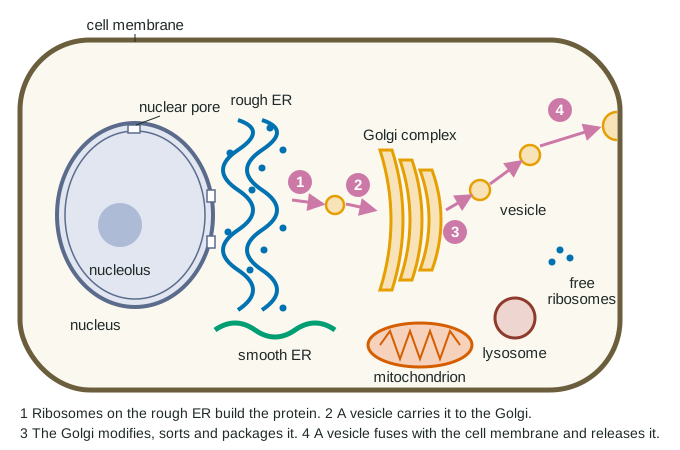
Part 5 · Step by step
How it works, step by step
- A gene in the DNA inside the nucleus carries the instructions for a protein the cell will export.The instructions are copied into mRNA, which leaves the nucleus through a nuclear pore.
- A ribosome starts reading the mRNA and attaches to the rough ER, because the new protein is bound for export.The ribosome threads the growing protein into the ER, where it folds and may have sugars added.
- A patch of ER membrane holding the finished protein pinches off.A vesicle carries the protein to the Golgi complex and merges with it.
- Enzymes in the Golgi trim and add sugars and sort proteins by their destination.The protein is packaged into a new vesicle bound for the cell membrane.
- Motor proteins carry the vesicle along microtubules, using ATP made mostly in mitochondria.The vesicle reaches the cell membrane, merges with it, and releases the protein outside the cell.
Part 6 · Key ideas
Key ideas
- Prokaryotes (bacteria and archaea) have DNA in the cytoplasm, ribosomes and a cell membrane, but no nucleus and no membrane-bound organelles. Eukaryotes keep their DNA in a nucleus and divide the cytoplasm into membrane-bound organelles.
- Ribosomes are in every cell. They are made of rRNA and protein, and they build proteins. Free ribosomes make proteins for the cytosol; ribosomes on the rough ER make proteins for membranes, lysosomes and export.
- The smooth ER makes lipids and, in liver cells, breaks down drugs and toxins. The Golgi complex modifies, sorts and packages proteins. Lysosomes digest worn-out parts and engulfed material with enzymes that work best in acid.
- Mitochondria and chloroplasts each have a double membrane and their own DNA and ribosomes. Their folded inner membranes (cristae, thylakoids) pack in more membrane for the proteins that capture energy.
- A plant cell's central vacuole stores water and presses the cytoplasm against the cell wall, keeping the cell firm. The cytoskeleton gives shape and carries vesicles along microtubule tracks.
Part 7 · Misconception
A common mistake
The wrong idea: Plant cells have chloroplasts instead of mitochondria, because they make their own food.
What actually happens: Plant cells have both. Chloroplasts capture the energy of sunlight to build sugar; mitochondria break sugar down by cellular respiration to make ATP, day and night.
Part 8 · Check yourself
Check yourself
Exam-style questions. Anything you miss goes into your review queue.
Graph
Following a newly made protein through a pancreas cell
Researchers gave pancreas cells a 3-minute pulse of amino acids carrying a radioactive label, then moved the cells into a medium with only unlabeled amino acids. At each time point they measured where the labeled protein was. The graph shows the share of all labeled protein found in each location (means of several dishes of cells).
Rough ERGolgi complexSecretory vesiclesOutside the cell
Data table
| Time after the pulse (min) | Rough ER | Golgi complex | Secretory vesicles | Outside the cell |
|---|---|---|---|---|
| 0 | 90 | 4 | 1 | 0 |
| 10 | 62 | 30 | 5 | 0 |
| 20 | 35 | 45 | 15 | 1 |
| 40 | 12 | 30 | 45 | 8 |
| 60 | 6 | 14 | 55 | 22 |
| 90 | 4 | 6 | 40 | 48 |
| 120 | 3 | 4 | 25 | 66 |
1. Which sequence of locations does the labeled protein most likely pass through, according to the graph?
- Rough ER, then Golgi complex, then secretory vesicles, then outside the cell
- Golgi complex, then rough ER, then secretory vesicles, then outside the cell
- Rough ER, then secretory vesicles, then Golgi complex, then outside the cell
- Rough ER, then outside the cell, with the Golgi and vesicles filling up afterward
Show the answer
Each location peaks in turn: rough ER at 0 min, Golgi at about 20 min, vesicles at about 60 min, and the outside keeps rising to the end. Label moves from one place to the next, so the order of the peaks is the order of the path.
- Correct: Rough ER, then Golgi complex, then secretory vesicles, then outside the cell: The peaks come in this order (0, 20, 60 and 120+ minutes), which is the path of a secreted protein.
- Golgi complex, then rough ER, then secretory vesicles, then outside the cell: At time 0 the rough ER already holds 90% of the label and the Golgi only 4%, so the protein cannot start in the Golgi.
- Rough ER, then secretory vesicles, then Golgi complex, then outside the cell: Vesicles peak at about 60 minutes, well after the Golgi peaks at about 20 minutes, so the vesicles come after the Golgi.
- Rough ER, then outside the cell, with the Golgi and vesicles filling up afterward: Almost no label is outside the cell until 40 minutes, after the Golgi has peaked, so the protein leaves last, not second.
2. The experiment is repeated with a drug that stops vesicles from budding off the Golgi complex. Which result at 90 minutes is most likely?
- Most label is still in the rough ER, because proteins pile up in the ER when the Golgi is blocked
- Most label is in the Golgi complex, and very little is outside the cell
- Most label is outside the cell, because proteins leak out of the Golgi
- Most label is in secretory vesicles, which pile up beside the membrane
Show the answer
Proteins still travel from the rough ER to the Golgi, but they cannot leave it in vesicles, so label piles up in the Golgi and few labeled proteins reach the vesicles or the outside.
- Most label is still in the rough ER, because proteins pile up in the ER when the Golgi is blocked: The drug acts on vesicles leaving the Golgi, not on those leaving the ER, so proteins still move on from the ER and reach the Golgi.
- Correct: Most label is in the Golgi complex, and very little is outside the cell: Label enters the Golgi as usual but cannot leave it, so it collects there instead of moving on.
- Most label is outside the cell, because proteins leak out of the Golgi: Secreted proteins leave a cell inside vesicles that fuse with the membrane; with no vesicles from the Golgi, they cannot get out.
- Most label is in secretory vesicles, which pile up beside the membrane: Secretory vesicles form from the Golgi, so blocking budding leaves fewer of them, not more.
3. Why does the labeled protein appear in the rough ER within minutes, instead of first collecting in the cytosol?
- The rough ER makes its own amino acids and builds proteins from them without ribosomes.
- Ribosomes in the nucleus build the protein and pass it straight into the ER.
- Ribosomes bound to the rough ER build it and thread it into the ER as it grows.
- Free ribosomes build the protein, and the finished protein later moves into the ER.
Show the answer
A protein bound for export is built by a ribosome attached to the rough ER. The growing chain goes straight into the ER, so the label is inside the ER almost as soon as it is built into protein.
- The rough ER makes its own amino acids and builds proteins from them without ribosomes.: Every protein is built by ribosomes; the ER does not link amino acids into proteins by itself.
- Ribosomes in the nucleus build the protein and pass it straight into the ER.: Ribosomes work in the cytoplasm and on the rough ER, not inside the nucleus; the nucleolus only assembles their pieces.
- Correct: Ribosomes bound to the rough ER build it and thread it into the ER as it grows.: This is how proteins for export are made: built on the rough ER and threaded into it as they grow.
- Free ribosomes build the protein, and the finished protein later moves into the ER.: Proteins made on free ribosomes mostly stay in the cytosol; if this protein were made there, label would first collect in the cytosol.
Data table
Organelle volumes in four cell types
A student used electron micrographs to estimate how much of each cell's volume four organelles take up, in four cell types (W, X, Y and Z) from the same mammal. Each value is the mean of 10 cells.
| Cell type | Rough ER (%) | Smooth ER (%) | Mitochondria (%) | Lysosomes (%) |
|---|---|---|---|---|
| W | 20 | 1 | 8 | 1 |
| X | 2 | 15 | 21 | 1 |
| Y | 1 | 1 | 36 | 0.5 |
| Z | 4 | 1 | 6 | 9 |
4. Which cell type is most likely to make and export large amounts of a digestive enzyme?
- Cell W
- Cell X
- Cell Y
- Cell Z
Show the answer
Enzymes are proteins, and proteins for export are made on the rough ER. Cell W has by far the most rough ER (20% of its volume).
- Correct: Cell W: Cell W's large rough ER fits a cell that builds and exports a lot of protein.
- Cell X: Cell X has little rough ER but much smooth ER, which makes lipids and breaks down toxins, not exported proteins.
- Cell Y: Cell Y is mostly mitochondria, which fits a cell that uses a lot of ATP, not one that exports protein.
- Cell Z: Cell Z's many lysosomes fit a cell that breaks material down inside itself, not one that exports enzymes.
5. Which claim about cell Y is best supported by the table, with correct reasoning?
- Cell Y makes most of the animal's exported proteins, because mitochondria build proteins for export.
- Cell Y uses ATP at a high, steady pace, because mitochondria make most of a cell's ATP.
- Cell Y stores most of the animal's lipids, because mitochondria are where lipids are made.
- Cell Y breaks down large amounts of engulfed material, because mitochondria digest worn-out parts.
Show the answer
Mitochondria are where cellular respiration makes most of a cell's ATP. A cell that is 36% mitochondria, like a heart muscle cell, uses energy steadily and fast.
- Cell Y makes most of the animal's exported proteins, because mitochondria build proteins for export.: Exported proteins are built on the rough ER, and cell Y has almost none (1%).
- Correct: Cell Y uses ATP at a high, steady pace, because mitochondria make most of a cell's ATP.: This links the evidence (36% mitochondria) to the job of mitochondria (making ATP) correctly.
- Cell Y stores most of the animal's lipids, because mitochondria are where lipids are made.: Lipids are made in the smooth ER, and cell Y has very little smooth ER (1%).
- Cell Y breaks down large amounts of engulfed material, because mitochondria digest worn-out parts.: Digesting worn-out parts and engulfed material is the job of lysosomes, and cell Y has the fewest of the four.
6. Which structures are found in both prokaryotic and eukaryotic cells? Select all that apply.
- Ribosomes
- A cell membrane
- A nucleus
- Mitochondria
- Cytoplasm
- A Golgi complex
Show the answer
Every cell has a cell membrane, cytoplasm, DNA and ribosomes. A nucleus and other membrane-bound organelles, such as mitochondria and the Golgi, are found only in eukaryotes.
- Correct: Ribosomes: All cells build proteins on ribosomes, so prokaryotes and eukaryotes both have them.
- Correct: A cell membrane: Every cell is bounded by a cell membrane.
- A nucleus: A prokaryote's DNA sits in the cytoplasm with no membrane around it; only eukaryotes have a nucleus.
- Mitochondria: Mitochondria are membrane-bound organelles, found in eukaryotes but not prokaryotes.
- Correct: Cytoplasm: All cells are filled with cytoplasm, the region inside the membrane.
- A Golgi complex: The Golgi is part of the endomembrane system, which prokaryotes lack.
7. Two mitochondria are the same size, but the inner membrane of one has many more cristae. Which prediction is best?
- The one with fewer cristae makes ATP faster, because its matrix has more room for the reactions that need space.
- Both make ATP at the same pace, because they are the same size.
- The one with more cristae makes ATP faster: more inner membrane holds more ATP-making proteins.
- The one with more cristae makes more DNA, because the DNA is stored in the folds.
Show the answer
Much of a cell's ATP is made by proteins set in the inner membrane. More folds pack more of that membrane, and so more of those proteins, into the same space.
- The one with fewer cristae makes ATP faster, because its matrix has more room for the reactions that need space.: The ATP-making proteins sit in the inner membrane, so less membrane means less ATP-making machinery, not more.
- Both make ATP at the same pace, because they are the same size.: Outer size is the same, but the amount of inner membrane differs, and that membrane holds the ATP-making proteins.
- Correct: The one with more cristae makes ATP faster: more inner membrane holds more ATP-making proteins.: This links the folds to their function: more inner membrane, more ATP-making proteins.
- The one with more cristae makes more DNA, because the DNA is stored in the folds.: Mitochondrial DNA sits in the matrix; cristae are about membrane for making ATP, not DNA storage.
8. A potted plant is not watered for a week, and its leaves droop. Predict how each quantity in a leaf cell changes compared with a well-watered plant.
| Variable | Change |
|---|---|
| Volume of the central vacuole | — |
| Outward push of the cell contents against the cell wall | — |
| Number of chloroplasts in the cell | — |
Show the answer
The central vacuole stores water. When it shrinks, it presses less on the cytoplasm and cell wall, the cells go limp and the leaf droops. Organelle numbers do not change in a week.
- Volume of the central vacuole: decreases. The central vacuole is mostly water; with too little water coming in from the roots, the cell loses water and the vacuole shrinks.
- Outward push of the cell contents against the cell wall: decreases. A full central vacuole presses the cytoplasm against the wall and keeps the cell firm; a shrunken vacuole presses less, so the cell goes limp and the leaf droops.
- Number of chloroplasts in the cell: no change. A week of dry soil changes the cell's water content, not the number of chloroplasts it holds; the chloroplasts are still there.
Part 9 · Summary
Summary
Every cell has a membrane, cytoplasm, DNA and ribosomes. Eukaryotic cells add a nucleus and membrane-bound organelles that split the work: the rough ER builds proteins for export, the smooth ER makes lipids and detoxifies, the Golgi modifies and packages, lysosomes digest, vacuoles store, mitochondria make ATP and chloroplasts capture the energy of sunlight. Each structure's shape fits its job, from the folded inner membranes of mitochondria to the ribosome-studded surface of the rough ER.
Part 10 · Up next
What comes next
Part 11 · Connections