Cell Size
As an object grows, its volume grows faster than its surface, so its surface area-to-volume ratio falls.
Part 1 · Hook
Why this matters
A blue whale and a shrew are built from cells of about the same size. The whale simply has trillions more of them. Why don't big animals just have bigger cells? And why does a shrew, which weighs less than a coin, have to eat almost its own body weight in food every day while an elephant eats a few percent of its weight? Both answers come from one piece of geometry: as an object gets bigger, its inside grows faster than its outside.
Part 2 · Before you start
What this builds on
Part 3 · Prerequisite check
Quick check before you start
1. Through which structure must every material pass to enter or leave a cell?
- The nucleus
- The cell membrane
- The Golgi complex
Show the answer
The cell membrane surrounds the whole cell, so everything that enters or leaves crosses it.
- The nucleus:
- Correct: The cell membrane:
- The Golgi complex:
2. In which organelle does cellular respiration make most of a eukaryotic cell's ATP, using oxygen?
- The chloroplast
- The lysosome
- The mitochondrion
Show the answer
Mitochondria carry out most of cellular respiration, which uses oxygen to break down fuel, makes ATP and releases heat.
- The chloroplast:
- The lysosome:
- Correct: The mitochondrion:
Part 4 · See it
See it first
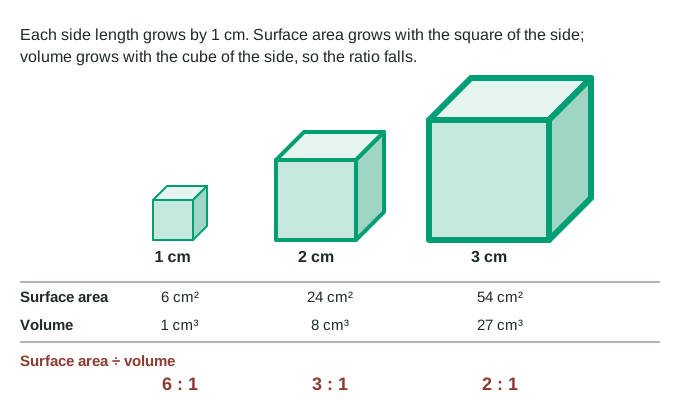
Part 5 · Step by step
How it works, step by step
- A cell gets bigger.Its surface area grows with the square of its size, but its volume grows with the cube, so its surface area-to-volume ratio falls.
- Every part of the volume uses materials and makes wastes, but exchange happens only across the surface.Each unit of surface must serve more volume, and exchange per unit of volume slows.
- Diffusion is fast over short distances and slow over long ones, and the center of a big cell is far from its surface.Materials reach the center too slowly, which limits how large a cell can grow.
- Tissues that exchange a lot have thin projections and folds, such as microvilli, root hairs and alveoli.They add surface without adding much volume, raising the surface area-to-volume ratio.
- In a small endotherm, a high surface area-to-volume ratio lets heat escape quickly for its mass.Each gram must burn more fuel to replace the heat, so small endotherms have higher metabolic rates per gram than large ones.
Part 6 · Key ideas
Key ideas
- For a cube with side s, surface area = 6s² and volume = s³. For a sphere, surface area = 4πr² and volume = 4/3 πr³. Doubling the size multiplies surface by 4 but volume by 8, so the ratio halves.
- Diffusion is the net spreading of particles down their concentration gradient, from more crowded to less crowded, powered by their own motion. It is quick across a few micrometers and very slow across centimeters.
- Small cells and thin, folded exchange surfaces (microvilli, root hairs, alveoli) keep the surface area-to-volume ratio high. Flattening a shape raises the ratio too: a thin slab exchanges far faster than a cube of the same volume.
- Endotherms keep warm with heat from their own cellular respiration; ectotherms rely on outside heat. Small endotherms lose heat fast for their size, so their metabolic rate per gram is much higher than that of large endotherms.
Part 7 · Misconception
A common mistake
The wrong idea: A bigger cell has more surface area, so it can exchange materials with its surroundings better than a small cell.
What actually happens: A bigger cell does have more total surface, but it has even more volume to supply. Per unit of volume it has less surface, so it exchanges materials more slowly for its size.
Part 8 · Check yourself
Check yourself
Exam-style questions. Anything you miss goes into your review queue.
Data table
Acid soaking into agar cubes
Students made agar containing an indicator that is pink when basic and turns clear in acid. They cut cubes with sides of 1, 2 and 3 cm and soaked them together in the same beaker of dilute vinegar for 10 minutes at room temperature. Then they cut each cube in half and measured how far the clear zone reached in from each face. Each depth is the mean ± SD of four cubes; the pink volume is calculated from the mean depth.
| Side (cm) | Surface area (cm²) | Volume (cm³) | Surface area ÷ volume (per cm) | Depth of clear zone (cm) | Volume still pink (cm³) |
|---|---|---|---|---|---|
| 1 | 6 | 1 | 6.0 | 0.40 ± 0.03 | 0.008 |
| 2 | 24 | 8 | 3.0 | 0.40 ± 0.04 | 1.73 |
| 3 | 54 | 27 | ? | 0.40 ± 0.02 | 10.6 |
1. Calculate the missing surface area ÷ volume value for the 3 cm cube. Give your answer to one decimal place.
Type a number in per cm.
Show the answer
Surface area = 6 × 3² = 54 cm²; volume = 3³ = 27 cm³. 54 ÷ 27 = 2.0 per cm.
- Answer: 2.0 per cm
2. Which conclusion is best supported by the data?
- Acid moves faster into large cubes, because they have more surface through which acid can enter.
- Acid reaches the same depth in each cube, so it reaches a smaller share of a larger cube.
- Acid reaches a smaller depth in large cubes, because their surface area ÷ volume is lower.
- Acid reaches the whole volume of each cube, but large cubes take longer to turn clear.
Show the answer
The depth is about 0.4 cm in every cube (the SDs overlap), but 0.4 cm covers nearly all of a 1 cm cube and much less of a 3 cm cube, whose center is 1.5 cm from any face.
- Acid moves faster into large cubes, because they have more surface through which acid can enter.: The depths are all about 0.4 cm, so acid did not move faster into the larger cubes.
- Correct: Acid reaches the same depth in each cube, so it reaches a smaller share of a larger cube.: This is what the table shows: equal depth, so the reached share falls as the cube grows.
- Acid reaches a smaller depth in large cubes, because their surface area ÷ volume is lower.: The depth is the same in all three cubes; what changes is the share of the volume that depth covers.
- Acid reaches the whole volume of each cube, but large cubes take longer to turn clear.: The 2 and 3 cm cubes still have pink volume left (1.73 and 10.6 cm³), so the acid did not reach all of them.
3. A student also soaks a flat slab of the same agar, 4 cm × 4 cm × 0.5 cm, which has the same volume as the 2 cm cube. Predict the result after 10 minutes in the same vinegar.
- About 78% of the slab turns clear, the same share as the 2 cm cube, because the volumes are equal.
- Nearly the whole slab turns clear, because no point in it is more than 0.25 cm from a face.
- Less of the slab turns clear than of the 2 cm cube, because the slab has a lower surface area ÷ volume.
- Little of the slab turns clear, because acid enters mainly through the narrow edges of a flat shape.
Show the answer
Acid reaches about 0.4 cm from each face in 10 minutes. The slab is only 0.5 cm thick, so acid entering from the top and bottom meets in the middle. Its surface area ÷ volume is 40 cm² ÷ 8 cm³ = 5 per cm, higher than the cube's 3.
- About 78% of the slab turns clear, the same share as the 2 cm cube, because the volumes are equal.: Equal volume does not mean equal exposure: the slab has more surface (40 cm² against 24 cm²) for the same volume.
- Correct: Nearly the whole slab turns clear, because no point in it is more than 0.25 cm from a face.: Being thin puts every point close to a face, so the 0.4 cm the acid travels reaches the whole slab.
- Less of the slab turns clear than of the 2 cm cube, because the slab has a lower surface area ÷ volume.: The slab's surface area ÷ volume is 5 per cm, higher than the cube's 3 per cm, not lower.
- Little of the slab turns clear, because acid enters mainly through the narrow edges of a flat shape.: Acid enters through every face, and the large top and bottom faces are the slab's biggest surfaces.
Graph
Oxygen use per gram in mammals of different sizes
The graph shows the oxygen each mammal uses per gram of body mass per hour while resting, a measure of its metabolic rate. Typical body masses: shrew 4 g, mouse 25 g, rat 290 g, dog 12 kg, human 70 kg, horse 650 kg, elephant 3,800 kg. All are endotherms.
Data table
| Mammal (smallest to largest) | Resting oxygen use |
|---|---|
| Shrew | 7.4 |
| Mouse | 1.65 |
| Rat | 0.87 |
| Dog | 0.33 |
| Human | 0.21 |
| Horse | 0.11 |
| Elephant | 0.07 |
4. Which explanation best accounts for the shrew's high oxygen use per gram?
- Its body has a high surface area ÷ volume, so it loses heat fast for its mass and releases more heat per gram by respiration.
- Its cells are much larger than an elephant's cells, so oxygen has to travel much farther inside each one to reach the mitochondria.
- Its small body holds less heat, so it needs less oxygen to keep warm than a large animal does.
- Its small lungs take in oxygen slowly, so it has to breathe in more of it per gram of body mass to catch up with demand.
Show the answer
Endotherms keep warm with heat released by their own cellular respiration. A small body has a lot of surface for its volume, so heat escapes fast relative to mass, and each gram must burn more fuel, using more oxygen, to replace it.
- Correct: Its body has a high surface area ÷ volume, so it loses heat fast for its mass and releases more heat per gram by respiration.: This links small size to a high surface area ÷ volume, fast heat loss, and more respiration per gram to replace the heat.
- Its cells are much larger than an elephant's cells, so oxygen has to travel much farther inside each one to reach the mitochondria.: Shrew and elephant cells are about the same size; the difference is in the whole body's surface and volume.
- Its small body holds less heat, so it needs less oxygen to keep warm than a large animal does.: Holding less heat means losing it faster for its mass, so a small endotherm needs more oxygen per gram to stay warm, not less.
- Its small lungs take in oxygen slowly, so it has to breathe in more of it per gram of body mass to catch up with demand.: Taking in oxygen slowly would limit its oxygen use, not raise it; the high use reflects high demand.
5. A student says the graph shows that an elephant uses less oxygen each hour than a mouse. Which response is correct?
- The student is right: the elephant's bar is about one twenty-fifth as tall as the bar for the mouse.
- The student is right, because larger animals have a lower surface area ÷ volume and so need less oxygen in total.
- Wrong: the graph gives use per gram, and the elephant's far greater mass makes its total far larger.
- The student is wrong, because the graph shows the elephant uses more oxygen per gram than the mouse.
Show the answer
Total use = per-gram use × mass. Elephant: 0.07 × 3,800,000 g ≈ 266,000 mL per hour. Mouse: 1.65 × 25 g ≈ 41 mL per hour. Each gram of elephant uses less, but the whole elephant uses thousands of times more.
- The student is right: the elephant's bar is about one twenty-fifth as tall as the bar for the mouse.: The bars compare use per gram, not per animal, so their heights do not show total use.
- The student is right, because larger animals have a lower surface area ÷ volume and so need less oxygen in total.: A lower surface area ÷ volume lowers the need per gram; total need still grows with body mass.
- Correct: Wrong: the graph gives use per gram, and the elephant's far greater mass makes its total far larger.: Per-gram values must be multiplied by mass to compare whole animals, and the elephant's total is far larger.
- The student is wrong, because the graph shows the elephant uses more oxygen per gram than the mouse.: The elephant's per-gram value (0.07) is lower than the mouse's (1.65), so this reason is false.
6. A spherical cell grows until its radius has doubled, keeping the same shape. What happens to its surface area ÷ volume?
- It doubles, because both surface area and volume grow with size.
- It stays the same, because the cell keeps its shape.
- It halves, because surface area rises 4 times and volume rises 8 times.
- It falls to a quarter, because volume rises 4 times faster than surface area.
Show the answer
Surface area = 4πr², so doubling r multiplies it by 2² = 4. Volume = 4/3 πr³, so it is multiplied by 2³ = 8. The ratio is multiplied by 4 ÷ 8 = ½.
- It doubles, because both surface area and volume grow with size.: Both grow, but volume grows faster, so the ratio falls, not rises.
- It stays the same, because the cell keeps its shape.: Keeping the shape keeps proportions, but surface area and volume still scale differently with size.
- Correct: It halves, because surface area rises 4 times and volume rises 8 times.: 4 times the surface over 8 times the volume gives half the ratio.
- It falls to a quarter, because volume rises 4 times faster than surface area.: Volume rises 8 times and surface 4 times, so the ratio halves; it does not drop to a quarter.
7. Which of these features increase the surface area available for exchange relative to the volume it serves? Select all that apply.
- Root hairs growing out from cells at the surface of a root
- Cells becoming rounder and larger as a tissue grows
- Microvilli on the cells lining the small intestine
- A thicker layer of cells between the air in the lungs and the blood
- A few large air sacs in the lungs replacing many small ones
Show the answer
Root hairs and microvilli are thin projections that add a lot of membrane without adding much volume. The other changes lower the surface for exchange or make the path longer.
- Correct: Root hairs growing out from cells at the surface of a root: Each root hair is a long, thin outgrowth of one cell, adding surface for taking in water and minerals.
- Cells becoming rounder and larger as a tissue grows: Larger, rounder cells have a lower surface area ÷ volume, so they exchange less per unit of volume.
- Correct: Microvilli on the cells lining the small intestine: Microvilli are tiny finger-like folds of the cell membrane that multiply the surface for absorbing food molecules.
- A thicker layer of cells between the air in the lungs and the blood: A thicker layer does not add surface; it lengthens the distance gases must travel, slowing exchange.
- A few large air sacs in the lungs replacing many small ones: Merging many small alveoli into fewer large ones lowers the total surface for gas exchange.
8. A cube-shaped cell grows from 10 µm to 20 µm along each side. Predict how each quantity changes.
| Variable | Change |
|---|---|
| Surface area of the cell | — |
| Surface area ÷ volume | — |
| Time for oxygen to cross the membrane itself | — |
Show the answer
Doubling each side multiplies surface by 4 and volume by 8, so the ratio halves. The membrane itself is no thicker, so crossing it takes the same time.
- Surface area of the cell: increases. Surface area is 6 × side², so it rises from 600 µm² to 2,400 µm², four times as much.
- Surface area ÷ volume: decreases. Volume rises eightfold (1,000 to 8,000 µm³) while surface rises fourfold, so the ratio halves, from 0.6 to 0.3 per µm.
- Time for oxygen to cross the membrane itself: no change. The membrane is the same thickness in a large cell as in a small one, so crossing it takes the same time; what changes is the distance to the cell's center and the surface per unit of volume.
Part 9 · Summary
Summary
As an object grows, its volume grows faster than its surface, so its surface area-to-volume ratio falls. Cells exchange materials and heat across their surface, and diffusion is slow over long distances, so a high ratio is needed for fast exchange. That limits cell size and explains the thin, folded shapes of exchange surfaces such as microvilli, root hairs and alveoli. In endotherms the same geometry means small animals lose heat fast for their mass and have a higher metabolic rate per gram than large animals.
Part 10 · Up next