Rates and percent change
A rate is change ÷ time (the slope); the average rate over an interval can hide a rate that changes within it.
Part 1 · Hook
Why this matters
Drop a cube of agar into colored solution and the color races in at first, then crawls. "How fast?" is a rate, and "how much did it change?" is often a percent. Both sound easy, both appear on the formula sheet, and both are where careful students lose easy points: wrong interval, wrong starting value, wrong units.
Part 2 · Before you start
What this builds on
Part 3 · Prerequisite check
Quick check before you start
1. Diffusion is the net movement of particles…
- from higher to lower concentration, down a concentration gradient
- from lower to higher concentration, using energy
- only through water, from colder to warmer regions
Show the answer
Random motion produces net movement from where particles are more concentrated to where they are less concentrated.
- Correct: from higher to lower concentration, down a concentration gradient:
- from lower to higher concentration, using energy:
- only through water, from colder to warmer regions:
2. A cube with 2 cm sides has what surface area : volume ratio?
- 3 cm⁻¹ (24 cm² ÷ 8 cm³)
- 6 cm⁻¹ (6 cm² ÷ 1 cm³)
- 0.33 cm⁻¹ (8 cm³ ÷ 24 cm²)
Show the answer
SA = 6 × 2² = 24 cm²; V = 2³ = 8 cm³; 24 ÷ 8 = 3 cm⁻¹.
- Correct: 3 cm⁻¹ (24 cm² ÷ 8 cm³):
- 6 cm⁻¹ (6 cm² ÷ 1 cm³):
- 0.33 cm⁻¹ (8 cm³ ÷ 24 cm²):
Part 4 · See it
See it first
Part 5 · Step by step
How it works, step by step
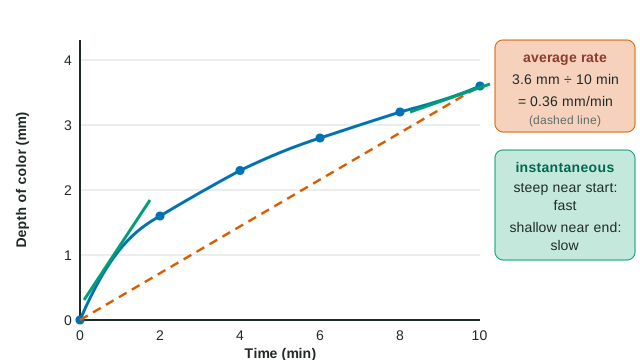
- A quantity changes over time (color moves 3.6 mm into the agar in 10 minutes).Its average rate is the change divided by the time: 3.6 mm ÷ 10 min = 0.36 mm/min.
- The curve is steeper at the start than at the end.The rate over a short interval differs from the average: 0.8 mm/min in the first 2 minutes, 0.2 mm/min in the last 2.
- You want to compare a change with where it started.You calculate percent change = (final − initial) ÷ initial × 100; from 0.8 to 0.2 mm/min is −75%.
- Your values come in different units (µm, mm, cm).You convert with metric prefixes before calculating: 1 mm = 1,000 µm, so 1 mm³ = 10⁹ µm³.
- You finish the calculation.You report the answer with its units (mm/min, %, cm⁻¹) and the sign, and round as the question asks.
Part 6 · Key ideas
Key ideas
- Worked example. Depth 1.6 mm at 2 min, 3.2 mm at 8 min, 3.6 mm at 10 min. Rate 0-10 min = 3.6 ÷ 10 = 0.36 mm/min. Rate 8-10 min = (3.6 − 3.2) ÷ 2 = 0.20 mm/min. Percent change from 0.8 to 0.2 mm/min = (0.2 − 0.8) ÷ 0.8 × 100 = −75%.
- Formula sheet: rate = change in y ÷ change in x; percent change = (final − initial) ÷ initial × 100. Always divide by the initial value.
- The difference between two percentages (97.8% and 56.1%) is 41.7 percentage points; the percent change is (56.1 − 97.8) ÷ 97.8 × 100 = −42.6%.
- Prefixes: kilo 10³, centi 10⁻², milli 10⁻³, micro 10⁻⁶, nano 10⁻⁹. Areas convert by the factor squared, volumes by the factor cubed.
Part 7 · Misconception
A common mistake
The wrong idea: A 50% decrease followed by a 50% increase brings you back to where you started.
What actually happens: Each percent is taken of the value at the start of that step: 400 falls 50% to 200, then rises 50% to 300. Percent changes do not simply add.
Part 8 · Check yourself
Check yourself
Exam-style questions. Anything you miss goes into your review queue.
Graph
Dye moving into an agar cube
A 3 cm cube of clear agar was placed in a colored solution. Every 2 minutes a student cut a matching cube in half and measured how far the color had moved in from the surface.
Data table
| Time (min) | Depth from surface |
|---|---|
| 0 | 0 |
| 2 | 1.6 |
| 4 | 2.3 |
| 6 | 2.8 |
| 8 | 3.2 |
| 10 | 3.6 |
1. Calculate the average rate at which the color moved into the cube over the whole 10 minutes, in mm per minute, to two decimal places.
Type a number in mm/min.
Show the answer
Average rate = total change ÷ total time = (3.6 − 0) mm ÷ (10 − 0) min = 0.36 mm/min.
- Answer: 0.36 mm/min
2. Calculate the average rate between 8 and 10 minutes, in mm per minute, to two decimal places.
Type a number in mm/min.
Show the answer
(3.6 − 3.2) mm ÷ (10 − 8) min = 0.4 ÷ 2 = 0.20 mm/min.
- Answer: 0.20 mm/min
3. Which statement best describes how the rate of color movement changed during the experiment?
- The rate was highest in the first 2 minutes (0.8 mm/min) and then fell, to 0.2 mm/min in each of the last two intervals.
- The rate stayed at 0.36 mm/min throughout, because that is the average rate for the whole run of the experiment.
- The rate increased over time, because the depth of color was greatest at 10 minutes, the end of the run.
- The rate fell to zero after 8 minutes, because the curve flattened out and the color stopped moving into the agar.
Show the answer
Interval rates: 0-2 min, 1.6 ÷ 2 = 0.8; 2-4 min, 0.35; 4-6 min, 0.25; 6-8 min, 0.2; 8-10 min, 0.2 mm/min. The curve gets less steep, so the rate falls.
- Correct: The rate was highest in the first 2 minutes (0.8 mm/min) and then fell, to 0.2 mm/min in each of the last two intervals.: Correct: the slope is steepest at the start.
- The rate stayed at 0.36 mm/min throughout, because that is the average rate for the whole run of the experiment.: An average over the whole run hides how the rate changed within it.
- The rate increased over time, because the depth of color was greatest at 10 minutes, the end of the run.: A large depth at 10 min shows the total distance moved, not the rate at that time.
- The rate fell to zero after 8 minutes, because the curve flattened out and the color stopped moving into the agar.: The depth still rose from 3.2 to 3.6 mm between 8 and 10 minutes, so the rate was 0.2 mm/min, not zero.
4. Which explanation best accounts for the falling rate?
- As the color moves deeper, the concentration difference is spread over a longer distance, so the gradient driving diffusion is less steep.
- The colored molecules get larger as they move into the agar, so each one moves more slowly than it did when it first entered at the surface.
- The agar cube grows larger as it absorbs the solution, so the color has a bigger volume to fill as time goes on.
- The solution outside the cube runs out of colored molecules after 2 minutes, so diffusion slows to a steady trickle.
Show the answer
Diffusion is net movement down a concentration gradient. Near the surface early on, high concentration outside sits right next to zero inside: a steep gradient. As the colored zone thickens, the same drop in concentration is spread over more distance, so net movement at the front slows.
- Correct: As the color moves deeper, the concentration difference is spread over a longer distance, so the gradient driving diffusion is less steep.: Correct: a shallower gradient gives slower net diffusion.
- The colored molecules get larger as they move into the agar, so each one moves more slowly than it did when it first entered at the surface.: Molecules do not change size as they diffuse.
- The agar cube grows larger as it absorbs the solution, so the color has a bigger volume to fill as time goes on.: The cube's size is fixed in this setup; the data describe depth, not swelling.
- The solution outside the cube runs out of colored molecules after 2 minutes, so diffusion slows to a steady trickle.: A large volume of solution holds far more dye than a small cube absorbs; the outside concentration stays about the same.
5. Calculate the percent change in the rate of color movement from the 0-2 minute interval to the 8-10 minute interval. Give your answer to the nearest whole percent (use a minus sign for a decrease).
Type a number in %.
Show the answer
Rates: 0-2 min, 1.6 ÷ 2 = 0.8 mm/min; 8-10 min, 0.2 mm/min. Percent change = (0.2 − 0.8) ÷ 0.8 × 100 = −75%.
- Answer: -75 %
Data table
How much of each cube colored in 10 minutes
Cubes of three sizes sat in the same colored solution for 10 minutes. The color moved in about 3.6 mm from every face in each cube. The student then calculated how much of each cube's volume had colored.
| Side (cm) | Surface area (cm²) | Volume (cm³) | Surface area : volume (cm⁻¹) | Volume colored (%) |
|---|---|---|---|---|
| 1 | 6 | 1 | 6.0 | 97.8 |
| 2 | 24 | 8 | 3.0 | 73.8 |
| 3 | 54 | 27 | ? | 56.1 |
6. Calculate the surface area : volume ratio of the 3 cm cube, in cm⁻¹, to one decimal place.
Type a number in cm⁻¹.
Show the answer
SA = 6 × 3² = 54 cm². V = 3³ = 27 cm³. SA : V = 54 ÷ 27 = 2.0 cm⁻¹.
- Answer: 2.0 cm⁻¹
7. From the 1 cm cube to the 3 cm cube, the volume colored fell from 97.8% to 56.1%. Which description is correct?
- A fall of 41.7 percentage points, which is a 42.6% decrease relative to the 1 cm cube.
- A fall of 41.7 percentage points, which is the same thing as a 41.7% decrease.
- A 42.6% decrease, which is the same thing as a fall of 42.6 percentage points.
- A 74.3% decrease, because 41.7 is 74.3% of the 3 cm cube's value of 56.1.
Show the answer
The difference between two percentages is 97.8 − 56.1 = 41.7 percentage points. The percent change divides by the starting value: (56.1 − 97.8) ÷ 97.8 × 100 = −42.6%.
- Correct: A fall of 41.7 percentage points, which is a 42.6% decrease relative to the 1 cm cube.: Correct: points for the difference, percent change relative to the start.
- A fall of 41.7 percentage points, which is the same thing as a 41.7% decrease.: Percentage points and percent change differ unless the starting value is 100.
- A 42.6% decrease, which is the same thing as a fall of 42.6 percentage points.: The difference between the two values is 41.7 points, not 42.6.
- A 74.3% decrease, because 41.7 is 74.3% of the 3 cm cube's value of 56.1.: Percent change divides by the starting value (97.8), not the final one.
Part 9 · Summary
Summary
A rate is change ÷ time (the slope); the average rate over an interval can hide a rate that changes within it. Percent change is (final − initial) ÷ initial × 100, with a sign. Convert units with metric prefixes before calculating, remembering that areas and volumes convert by the squared and cubed factors. Report every answer with units.
Part 10 · Up next
What comes next
Part 11 · Connections