Plasma Membrane
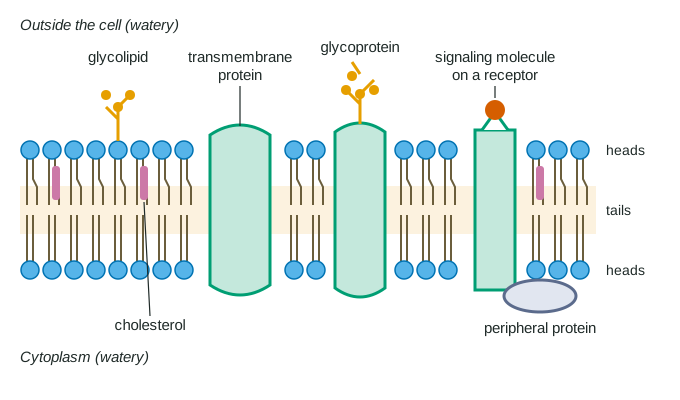
The plasma membrane is a phospholipid bilayer: hydrophilic heads face the water on each side and hydrophobic tails meet in the middle.
Part 1 · Hook
Why this matters
Fish that live in icy Antarctic water and bacteria that live in hot springs both have cell membranes that work. If you moved the fish's membrane into the hot spring, it would turn floppy and leaky; the hot-spring bacterium's membrane in ice water would stiffen like cold butter. A membrane is not a solid wall. It is a thin film of oily molecules that must stay just fluid enough, studded with proteins that do almost everything the membrane does.
Part 2 · Before you start
What this builds on
Part 3 · Prerequisite check
Quick check before you start
1. What makes a phospholipid amphipathic?
- It has a hydrophilic head and hydrophobic tails
- It dissolves completely in water
- It is made only of carbon and hydrogen
Show the answer
A phospholipid has a charged, water-loving head and two water-avoiding fatty acid tails, so it has both a hydrophilic and a hydrophobic part.
- Correct: It has a hydrophilic head and hydrophobic tails:
- It dissolves completely in water:
- It is made only of carbon and hydrogen:
2. How do unsaturated fatty acids differ from saturated ones?
- They have no carbon-carbon double bonds
- They have one or more double bonds that put kinks in the tail
- They are hydrophilic instead of hydrophobic
Show the answer
Unsaturated fatty acids have one or more carbon-carbon double bonds, which bend the tail, so the tails cannot pack tightly.
- They have no carbon-carbon double bonds:
- Correct: They have one or more double bonds that put kinks in the tail:
- They are hydrophilic instead of hydrophobic:
3. Where are proteins that end up in the plasma membrane made?
- On free ribosomes in the cytosol
- On ribosomes bound to the rough ER
- In the nucleolus
Show the answer
Proteins for membranes, lysosomes and export are built on ribosomes attached to the rough ER, then sent on through the Golgi in vesicles.
- On free ribosomes in the cytosol:
- Correct: On ribosomes bound to the rough ER:
- In the nucleolus:
Part 4 · See it
See it first
Part 5 · Step by step
How it works, step by step
- Phospholipids have hydrophilic heads and hydrophobic tails, and both sides of the membrane are watery.They form a bilayer, heads facing the water on each side and tails hidden in the middle.
- The molecules in the bilayer are held together by hydrophobic interactions, not covalent bonds.Lipids and many proteins can slide sideways, so the membrane behaves like a fluid.
- Integral proteins have nonpolar stretches that sit among the tails and polar parts that face the water.They stay embedded in the bilayer, and many cross it to touch both sides.
- Carbohydrate chains are attached to proteins and lipids inside the ER and Golgi, on the side that will face out.Glycoproteins and glycolipids carry them on the outer surface, where other cells can recognize them.
- Temperature, the share of kinked unsaturated tails and cholesterol all change how tightly the tails pack.The membrane's fluidity changes, and with it how well its proteins can move and work.
Part 6 · Key ideas
Key ideas
- The fluid mosaic model: a fluid phospholipid bilayer with a patchwork of proteins in it. "Fluid" because lipids and proteins slide sideways; "mosaic" because many kinds of proteins are scattered through it.
- Membrane proteins are integral (embedded, often crossing the whole bilayer) or peripheral (loosely attached to one surface). They move substances across, act as receptors for signaling molecules, join cells, and act as enzymes.
- Glycoproteins and glycolipids carry carbohydrate chains on the outside of the cell. These chains are identity tags used in cell recognition.
- Fluidity rises with temperature and with the share of unsaturated (kinked) tails. Cholesterol buffers it: it restrains movement when warm and prevents tight packing when cold.
Part 7 · Misconception
A common mistake
The wrong idea: The plasma membrane is a rigid wall with fixed holes in it, like a sieve.
What actually happens: It is a fluid film only two molecules thick. Its lipids and many of its proteins move sideways constantly, and which substances cross depends mostly on the chemistry of the bilayer and its proteins, not on fixed holes.
Part 8 · Check yourself
Check yourself
Exam-style questions. Anything you miss goes into your review queue.
Graph
Membrane proteins mixing in fused cells
Researchers labeled a membrane protein of mouse cells with a green fluorescent tag and the matching protein of human cells with a red tag. They fused one mouse cell with one human cell to make a single cell whose plasma membrane is green on one half and red on the other. They kept the fused cells at 37 °C or at 15 °C and, at each time, counted the percentage of fused cells in which green and red were fully intermixed over the whole surface (200 fused cells per point).
37 °C15 °C
Data table
| Time after fusion (min) | 37 °C | 15 °C |
|---|---|---|
| 0 | 0 | 0 |
| 5 | 8 | 0 |
| 10 | 24 | 1 |
| 20 | 52 | 2 |
| 30 | 78 | 3 |
| 40 | 92 | 4 |
1. Which statement best describes the results?
- Mixing reached 92% of cells by 40 minutes at 37 °C but stayed near zero at 15 °C.
- Labels mixed at about the same pace at both temperatures, each reaching roughly 50% of cells by 20 minutes.
- Labels mixed faster at 15 °C than at 37 °C over the first 10 minutes.
- Labels mixed in about half of the fused cells at each temperature by 40 minutes.
Show the answer
At 37 °C the share of mixed cells climbs to 92% by 40 minutes; at 15 °C it never passes 4%.
- Correct: Mixing reached 92% of cells by 40 minutes at 37 °C but stayed near zero at 15 °C.: This matches both curves: a steep rise at 37 °C and almost none at 15 °C.
- Labels mixed at about the same pace at both temperatures, each reaching roughly 50% of cells by 20 minutes.: Only the 37 °C curve reaches about 50% at 20 minutes; at 15 °C the value is 2%.
- Labels mixed faster at 15 °C than at 37 °C over the first 10 minutes.: At 10 minutes, 24% of cells are mixed at 37 °C and 1% at 15 °C, so mixing is slower in the cold.
- Labels mixed in about half of the fused cells at each temperature by 40 minutes.: By 40 minutes, 92% are mixed at 37 °C and 4% at 15 °C, nowhere near half in either case.
2. Which explanation best accounts for the difference between the two temperatures?
- At 15 °C the cold denatures the labeled proteins, so their fluorescent tags fade and are no longer counted as mixed.
- At 37 °C the bilayer is fluid and proteins slide sideways; at 15 °C tightly packed lipids hold them.
- At 37 °C the fused cell builds new copies of each protein over its whole surface, and this looks like mixing.
- At 15 °C the two halves of the fused membrane fail to join, so the two labels stay on separate sides.
Show the answer
Phospholipids and many proteins move sideways within a fluid bilayer. Cooling slows the molecules and lets the tails pack closer, so the membrane becomes less fluid and proteins barely move.
- At 15 °C the cold denatures the labeled proteins, so their fluorescent tags fade and are no longer counted as mixed.: Moderate cold slows molecules but does not denature proteins, and the labels are still visible at 15 °C.
- Correct: At 37 °C the bilayer is fluid and proteins slide sideways; at 15 °C tightly packed lipids hold them.: This links temperature to fluidity and fluidity to sideways movement of proteins.
- At 37 °C the fused cell builds new copies of each protein over its whole surface, and this looks like mixing.: Making new protein is not needed to explain the mixing, and newly made protein would not carry the labels added before fusion.
- At 15 °C the two halves of the fused membrane fail to join, so the two labels stay on separate sides.: The cells were already fused before they were cooled; the halves form one continuous membrane at both temperatures.
3. The 15 °C experiment is repeated with cells whose membranes have been loaded with extra cholesterol. Predict the result compared with the original 15 °C curve.
- Less mixing, because cholesterol makes membranes stiffer whatever the temperature is.
- Somewhat more, because cholesterol keeps the tails from packing tightly in the cold.
- Hardly any mixing, because the extra cholesterol binds to the labeled proteins and holds them still.
- Mixing at the 37 °C pace, because cholesterol warms the membrane.
Show the answer
Cholesterol is a buffer for fluidity. In the cold, its rigid rings wedge between the phospholipid tails and stop them packing tightly, so the membrane stays more fluid than it would otherwise. (In the heat, it does the opposite, restraining movement.)
- Less mixing, because cholesterol makes membranes stiffer whatever the temperature is.: Cholesterol stiffens the membrane at high temperatures but keeps it more fluid at low temperatures.
- Correct: Somewhat more, because cholesterol keeps the tails from packing tightly in the cold.: In the cold, cholesterol prevents tight packing, so proteins can move a little more.
- Hardly any mixing, because the extra cholesterol binds to the labeled proteins and holds them still.: Cholesterol sits among the tails; it does not bind or block the labeled proteins.
- Mixing at the 37 °C pace, because cholesterol warms the membrane.: Cholesterol does not produce heat; it changes how tightly the lipids pack.
Data table
Membrane lipids of bacteria grown at different temperatures
A species of bacterium was grown at four temperatures. For each culture, researchers measured the percentage of unsaturated fatty acids in the membrane phospholipids, and the fluidity of the membrane measured at that same growth temperature (a fluidity index: higher means more fluid). Values are mean ± SD of three cultures.
| Growth temperature (°C) | Unsaturated fatty acids (% of total) | Fluidity index at growth temperature |
|---|---|---|
| 15 | 68 ± 2 | 0.52 ± 0.03 |
| 25 | 58 ± 3 | 0.51 ± 0.02 |
| 37 | 45 ± 2 | 0.53 ± 0.03 |
| 43 | 38 ± 3 | 0.50 ± 0.04 |
4. Why does a membrane with more unsaturated fatty acids stay fluid at 15 °C?
- Unsaturated tails are more hydrophilic, so they attract water into the bilayer and loosen it.
- Double bonds put kinks in the tails, so the tails do not pack tightly.
- Unsaturated tails are longer than saturated ones, so they wave about more and push the heads apart.
- Unsaturated tails form hydrogen bonds with each other, which hold the bilayer loosely.
Show the answer
A double bond puts a bend in a fatty acid tail. Bent tails cannot line up as closely as straight saturated tails, so they stay loosely packed and free to move even in the cold.
- Unsaturated tails are more hydrophilic, so they attract water into the bilayer and loosen it.: Unsaturated tails are still hydrocarbon chains and still hydrophobic; water stays out of the bilayer's core.
- Correct: Double bonds put kinks in the tails, so the tails do not pack tightly.: Kinked tails pack loosely, which keeps the membrane fluid at low temperature.
- Unsaturated tails are longer than saturated ones, so they wave about more and push the heads apart.: The difference is the kinks, not the length; longer tails would actually pack more tightly.
- Unsaturated tails form hydrogen bonds with each other, which hold the bilayer loosely.: Hydrocarbon tails are nonpolar and do not form hydrogen bonds with each other.
5. A laboratory strain of this bacterium has lost the ability to change its fatty acid mix: its membranes stay at about 45% unsaturated fatty acids, the 37 °C value, at any growth temperature. Predict what happens when it is moved from 37 °C to 15 °C.
- Its membrane stays as fluid as the normal strain's, because temperature has little effect on fatty acid tails.
- Its membrane becomes much more fluid, because saturated tails spread apart in the cold.
- Its membrane stiffens, so its membrane proteins work poorly and growth slows.
- Its membrane gains unsaturated fatty acids from the cold, so nothing changes.
Show the answer
Normal cells keep their membranes fluid in the cold by raising their share of kinked, unsaturated tails (68% at 15 °C in the table). This strain stays at 45%, so its tails pack more tightly at 15 °C, the membrane stiffens, and the proteins that do the membrane's jobs cannot work properly.
- Its membrane stays as fluid as the normal strain's, because temperature has little effect on fatty acid tails.: Cold slows all tails and lets them pack closer; the normal strain makes up for this by adding unsaturated tails, which this strain cannot do.
- Its membrane becomes much more fluid, because saturated tails spread apart in the cold.: Cold makes all tails move less; straight saturated tails pack closer, not farther apart.
- Correct: Its membrane stiffens, so its membrane proteins work poorly and growth slows.: Without the option of adding unsaturated tails, the membrane stiffens and its proteins suffer.
- Its membrane gains unsaturated fatty acids from the cold, so nothing changes.: Cold does not convert fatty acids, and this strain cannot change its fatty acid mix at any temperature.
6. A transmembrane protein crosses the bilayer once. Which amino acids are most likely in the stretch of the protein that lies inside the bilayer?
- Amino acids with charged side chains, which attract the phosphate heads
- Nonpolar amino acids, which sit well among the hydrophobic tails
- Amino acids with polar side chains, which form hydrogen bonds with the tails
- Any mix of amino acids, because the inside of the bilayer has little effect on which side chains fit there
Show the answer
The middle of the bilayer is made of hydrophobic tails. A stretch of protein there is stable only if its side chains are nonpolar, too; polar or charged side chains would be pushed toward water.
- Amino acids with charged side chains, which attract the phosphate heads: The heads are at the surfaces, not in the middle; charged side chains in the core would be unstable.
- Correct: Nonpolar amino acids, which sit well among the hydrophobic tails: Nonpolar side chains match the hydrophobic core, holding the protein in place.
- Amino acids with polar side chains, which form hydrogen bonds with the tails: Hydrocarbon tails cannot form hydrogen bonds, and polar side chains are unstable among them.
- Any mix of amino acids, because the inside of the bilayer has little effect on which side chains fit there: The hydrophobic core strongly favors nonpolar side chains, so the mix is far from random.
7. Sugar chains are added to a glycoprotein inside the ER and Golgi. Which side of the plasma membrane do those chains end up on, and why?
- The cytoplasm side, because the sugars are added in the cytoplasm.
- Outside, because a vesicle's inner face becomes the cell's outer face when it fuses.
- Both sides equally, because glycoproteins flip over freely in the bilayer.
- The outside, because sugar chains are hydrophobic, so the watery cytoplasm pushes them out of the cell.
Show the answer
The sugars are attached on the inner (lumen) side of the ER and Golgi membranes. When a vesicle fuses with the plasma membrane, its inner face turns outward, so the chains face outside the cell, where they act in recognition.
- The cytoplasm side, because the sugars are added in the cytoplasm.: The sugars are added inside the ER and Golgi, not in the cytosol.
- Correct: Outside, because a vesicle's inner face becomes the cell's outer face when it fuses.: Vesicle fusion turns the lumen-facing side of the membrane into the cell's outer surface.
- Both sides equally, because glycoproteins flip over freely in the bilayer.: Proteins move sideways freely but almost never flip from one face to the other.
- The outside, because sugar chains are hydrophobic, so the watery cytoplasm pushes them out of the cell.: Sugar chains are hydrophilic; they face the watery outside because of where they were added.
8. A culture of animal cells is warmed from 20 °C to 35 °C. Predict how each quantity changes.
| Variable | Change |
|---|---|
| Fluidity of the plasma membrane | — |
| Speed at which membrane proteins slide sideways | — |
| Number of phospholipid layers in the membrane | — |
Show the answer
Warming makes the lipids move faster, so the bilayer becomes more fluid and proteins slide faster, but it remains a bilayer.
- Fluidity of the plasma membrane: increases. Warmer phospholipids move faster and pack less tightly, so the bilayer becomes more fluid.
- Speed at which membrane proteins slide sideways: increases. In a more fluid bilayer, proteins meet less resistance and slide sideways faster.
- Number of phospholipid layers in the membrane: no change. The membrane stays a bilayer; warming changes how freely its molecules move, not how many layers there are.
Part 9 · Summary
Summary
The plasma membrane is a phospholipid bilayer: hydrophilic heads face the water on each side and hydrophobic tails meet in the middle. Proteins sit in or on it and do most of its jobs: moving substances, receiving signals as receptors, and, with carbohydrate chains attached, letting cells recognize each other. Its lipids and proteins slide sideways, which is why it is called a fluid mosaic. Temperature, unsaturated fatty acids and cholesterol together keep it fluid enough to work.
Part 10 · Up next
What comes next
Part 11 · Connections