Lines: Slope and Intercept
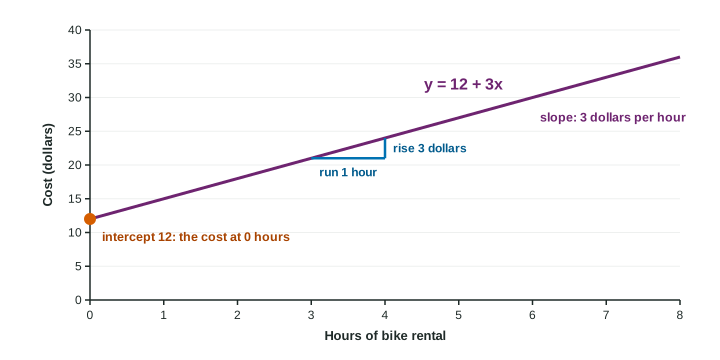
A line y = a + bx has slope b , the change in y for each one-unit increase in x (rise over run), and y-intercept a , the value of y when x = 0 .
Part 1 · Hook
Why this matters
Part 2 · Prerequisite check
Quick check before you start
1. What is ?
- 27
- 75
- 20
- 15
Show the answer
Multiply first: 15, then add 12.
- Correct: 27:
- 75:
- 20:
- 15:
2. Evaluate .
- 3
- 12
- 4
- 0.33
Show the answer
12/4 = 3.
- Correct: 3:
- 12:
- 4:
- 0.33:
Part 3 · See it
See it first
Part 4 · Step by step
How it works, step by step
- A line can be written is the y-intercept and is the slope
- Move one unit to the right on xy changes by : up if , down if
- Set y equals , which has meaning only if makes sense in context
- Know two points, or one point and the slopeslope = rise over run, then solve for from one point
Part 5 · Key ideas
Key ideas
- A line is . The slope is the change in y for each one-unit increase in x; its units are y units per x unit.
- Slope from two points:
, rise over run, subtracting in the same order on top and bottom. - The y-intercept is the value of y when . Interpret it only when makes sense.
- In context: "For each additional hour, the cost increases by 3 dollars."
Part 6 · Misconception
A common mistake
The wrong idea: The line through with slope 4 is .
What actually happens: 20 is the value of y at , not at . Solve to get : .
Part 7 · Check yourself
Check yourself
Exam-style questions. Anything you miss goes into your review queue.
1. A line passes through the points and . What is its slope?
Type a number. A table answer and a calculator answer are both accepted.
Show the answer
Slope =
- Answer: 3
2. For the same line through and , what is the y-intercept?
Type a number. A table answer and a calculator answer are both accepted.
Show the answer
With slope 3, . Using : , so .
- Answer: 1
3. A bike rental costs dollars for hours. What does the slope 3 tell you?
- The rental costs 3 dollars before any time is used
- The cost goes up 3 dollars for each additional hour
- The bike can be rented for at most 3 hours
- The total cost of the rental is 3 times the hours
Show the answer
Slope = change in y per one-unit increase in x: 3 dollars more for each extra hour.
- The rental costs 3 dollars before any time is used: That would be the intercept, which here is 12 dollars.
- Correct: The cost goes up 3 dollars for each additional hour: Right: the slope is the change in y for each one-unit increase in x.
- The bike can be rented for at most 3 hours: The slope is a rate, not a limit on x.
- The total cost of the rental is 3 times the hours: That ignores the 12 dollar start; the cost is 12 plus 3 per hour.
4. For the rental cost , what does the y-intercept 12 tell you?
- The cost goes up 12 dollars for each hour
- The rental lasts 12 hours
- The cost is 12 dollars per hour after the first hour
- The cost is 12 dollars at 0 hours, a fixed fee
Show the answer
The y-intercept is the value of y when : a 12 dollar fee before any hours.
- The cost goes up 12 dollars for each hour: That would be a slope of 12; the slope here is 3.
- The rental lasts 12 hours: The intercept is a value of y (dollars), not of x.
- The cost is 12 dollars per hour after the first hour: After the start, each hour adds 3 dollars.
- Correct: The cost is 12 dollars at 0 hours, a fixed fee: Right: the intercept is the value of y when x = 0.
5. A cooling drink’s temperature is degrees after minutes. What does the slope tell you?
- The temperature rises 2.5 degrees for each minute
- The drink starts at 2.5 degrees
- The temperature falls 2.5 degrees for each minute
- The drink is 80 degrees colder after each minute
Show the answer
Slope : for each one-minute increase, the temperature decreases by 2.5 degrees.
- The temperature rises 2.5 degrees for each minute: The minus sign means the temperature falls.
- The drink starts at 2.5 degrees: The start, at , is 80 degrees.
- Correct: The temperature falls 2.5 degrees for each minute: Right: a negative slope means y goes down as x goes up.
- The drink is 80 degrees colder after each minute: 80 is the starting temperature, not a rate.
6. A line for adults gives height in centimeters from shoe length in centimeters: . Why does the intercept 95 have no sensible meaning here?
- A shoe length of 0 cm is impossible for an adult
- No adult is 95 centimeters tall
- The slope is positive, so the intercept is zero
- Intercepts are given in different units from y
Show the answer
Interpret an intercept only when makes sense in context; a shoe length of 0 does not.
- Correct: A shoe length of 0 cm is impossible for an adult: Right: the intercept is y at , far outside any real shoe length.
- No adult is 95 centimeters tall: Some people are 95 cm tall; the problem is the x-value, 0.
- The slope is positive, so the intercept is zero: A positive slope says nothing about the intercept’s value.
- Intercepts are given in different units from y: The intercept is in y’s units, centimeters of height.
Part 8 · Summary
Summary
Part 9 · Up next
What comes next
Part 10 · Connections