Inequalities in Words
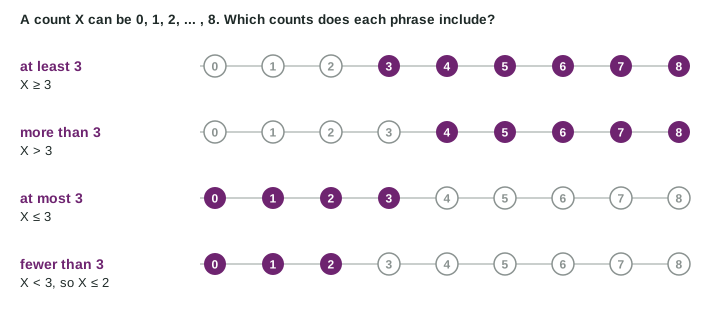
Translate words into inequalities before computing: at least is ≥ , at most and no more than are ≤ , more than is > , fewer than is < .
Part 1 · Hook
Why this matters
Part 2 · Prerequisite check
Quick check before you start
1. Which variable is discrete?
- Number of shots made
- Time to run a mile
- Height
- Weight
Show the answer
A count takes separate whole-number values.
- Correct: Number of shots made:
- Time to run a mile:
- Height:
- Weight:
2. What proportion of 10 students is 3 students?
- 0.3
- 3
- 0.03
- 0.7
Show the answer
3/10 = 0.3.
- Correct: 0.3:
- 3:
- 0.03:
- 0.7:
Part 3 · See it
See it first
Part 4 · Step by step
How it works, step by step
- Write the phrase as an inequality"at least 3" is , "fewer than 3" is
- Decide whether the boundary is included"at least", "at most", "no more than" and "inclusive" include it; "more than" and "fewer than" do not
- For a count, turn a strict inequality into one with an equals sign becomes , and becomes
- List the included values to checkthe slip "fewer than 3 is 3 or fewer" shows up at once
Part 5 · Key ideas
Key ideas
- At least : . At most and no more than : . More than : . Fewer than : . No fewer than : .
- For counts, is and is : "fewer than 3" is 0, 1 or 2.
- "At least one" is every count except 0.
- For continuous measurements, whether the exact boundary is included makes almost no difference.
Part 6 · Misconception
A common mistake
The wrong idea: "Fewer than 3" means .
What actually happens: "Fewer than 3" leaves out 3: it is , which for counts is , the values 0, 1 and 2.
Part 7 · Check yourself
Check yourself
Exam-style questions. Anything you miss goes into your review queue.
1. A count X can be 0, 1, 2, and so on. Which inequality says "X is at least 3"?
Show the answer
"At least 3" is 3 or more: .
- : That is "more than 3", which leaves out 3.
- Correct: : Right: "at least 3" means 3 or more, so 3 itself is included.
- : That is "at most 3", 3 or fewer.
- : That is "fewer than 3".
2. For a count X, which is the same as "fewer than 3"?
Show the answer
"Fewer than 3" means . For counts, the largest such value is 2, so it is . Reading it as is a classic slip.
- : That includes 3. "Fewer than 3" stops before 3.
- : That is "at least 3", the opposite group of counts.
- : That leaves out 2, which is fewer than 3.
- Correct: : Right: fewer than 3 is , and for whole-number counts that is 0, 1 or 2, so .
3. A count X can be 0 to 6. Which values are included in "at most 2"? Select all that apply.
- 0
- 1
- 2
- 3
- 4
- 6
Show the answer
"At most 2" means 2 or fewer: 0, 1 and 2.
- Correct: 0: Right: at most 2 includes every count up to and including 2.
- Correct: 1: Right: 1 is fewer than 2.
- Correct: 2: Right: "at most" includes the boundary.
- 3: 3 is more than 2.
- 4: 4 is more than 2.
- 6: 6 is more than 2.
4. Out of 10 free throws, a player makes "more than 4". For the count X of free throws made, which inequality fits?
Show the answer
"More than 4" is , which for counts is .
- Correct: : Right: more than 4 is , which for whole numbers is 5 or more.
- : That includes 4, but "more than 4" does not.
- : That is "at most 4".
- : That leaves out 5, which is more than 4.
5. A count X can be 0, 1, 2, ... , 8. Which counts make up "at least one"?
- 0 and 1
- 1 alone
- 1 through 8
- 2 through 8
Show the answer
"At least one" is : every value except 0. It is often easiest to find by starting with all the values and removing 0.
- 0 and 1: Those are "at most one".
- 1 alone: That is "exactly one".
- Correct: 1 through 8: Right: "at least one" is every count except 0.
- 2 through 8: That is "more than one", which leaves out 1.
6. Ten students read 0, 1, 1, 2, 3, 3, 4, 5, 6 and 9 books. How many students read at least 5 books?
- 2
- 3
- 4
- 5
Show the answer
"At least 5" includes 5: the students with 5, 6 and 9 books, so 3 students.
- 2: That counts only 6 and 9, leaving out the student who read exactly 5.
- Correct: 3: Right: the counts 5, 6 and 9 are 5 or more.
- 4: That also counts the student who read 4, which is fewer than 5.
- 5: 5 is the boundary value, not the number of students.
Part 8 · Summary
Summary
Part 9 · Up next
What comes next
Part 10 · Connections