Linear Momentum
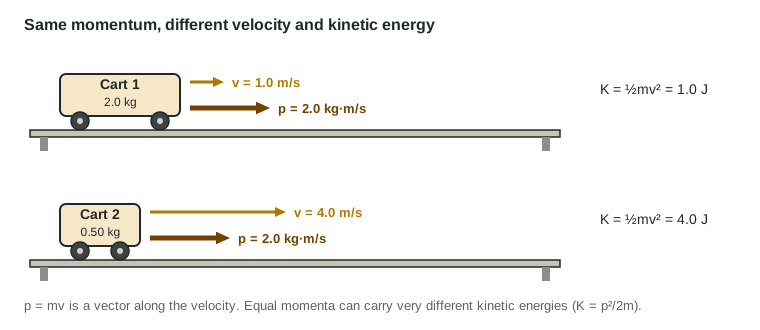
Momentum p = mv is a vector along the velocity.
Part 1 · Hook
Why this matters
Part 2 · Before you start
What this builds on
Part 3 · Prerequisite check
Quick check before you start
1. Velocity is
- a vector with size and direction
- a scalar
- always positive
- the same as speed
Show the answer
Velocity has a direction, carried by its sign in one dimension.
- Correct: a vector with size and direction:
- a scalar:
- always positive:
- the same as speed:
2. The center of mass of a system is
- the mass-weighted average position
- the midpoint between objects
- the heaviest object
- where gravity is zero
Show the answer
x_cm = Σmᵢxᵢ/Σmᵢ.
- Correct: the mass-weighted average position:
- the midpoint between objects:
- the heaviest object:
- where gravity is zero:
3. Forces between objects inside a system are
- internal forces
- external forces
- net forces
- contact forces only
Show the answer
Forces between parts of the system are internal; Newton's third law makes them cancel in pairs.
- Correct: internal forces:
- external forces:
- net forces:
- contact forces only:
Part 4 · See it
See it first
Part 5 · Step by step
How it works, step by step
- An object of mass m moves with velocity vit has momentum p = mv, a vector along v, in kg·m/s
- Several objects form a systemthe system's momentum is the vector sum, and momenta in opposite directions cancel
- The system's momentum is divided by its total massthe result is the velocity of the center of mass, v_cm = Σp/Σm
- Objects push on each other briefly and hard (a collision or explosion)the internal forces dominate, so the system's momentum is the same just before and just after
Part 6 · Key ideas
Key ideas
- Momentum p = mv is a vector in the direction of the velocity, in kg·m/s.
- A system's momentum is the vector sum of its parts. Opposite momenta cancel; kinetic energies never do.
- Same momentum does not mean same kinetic energy: K = p²/(2m), so the lighter object has more K.
- The velocity of the center of mass is v_cm = Σp/Σm.
- The collision model: forces between colliding objects are internal and much larger than outside forces, so the system's momentum is the same just before and just after. An explosion is the same model in reverse.
Part 7 · Misconception
A common mistake
The wrong idea: A heavy truck always has more momentum than a light ball.
What actually happens: Momentum is mass times velocity. A fast, light object can have as much momentum as a slow, heavy one, and two momenta in opposite directions can cancel.
Part 8 · Check yourself
Check yourself
Exam-style questions. Anything you miss goes into your review queue.
Diagram
Two carts on level tracks
Positive is to the right.
1. What is cart 1's momentum? Give the value and its unit.
Type a number and its unit.
Show the answer
p = mv = (2.0 kg)(+1.0 m/s) = +2.0 kg·m/s, to the right. Momentum's unit is kg·m/s (the same as N·s).
- Answer: 2.0 kg·m/s
2. How do the momenta and kinetic energies of the two carts compare?
- Equal momenta; cart 2 has 4 times the kinetic energy
- Equal momenta and equal kinetic energies
- Cart 2 has 4 times the momentum and 4 times the kinetic energy
- Cart 1 has more momentum, because it is heavier
Show the answer
p₁ = (2.0)(1.0) = 2.0 kg·m/s; p₂ = (0.50)(4.0) = 2.0 kg·m/s. K₁ = ½(2.0)(1.0)² = 1.0 J; K₂ = ½(0.50)(4.0)² = 4.0 J.
- Correct: Equal momenta; cart 2 has 4 times the kinetic energy: Right: both p = 2.0 kg·m/s; K is 1.0 J and 4.0 J.
- Equal momenta and equal kinetic energies: Equal momenta do not mean equal K: K = p²/(2m) is larger for the smaller mass.
- Cart 2 has 4 times the momentum and 4 times the kinetic energy: Cart 2 is 4 times as fast but has one quarter the mass, so its momentum is the same.
- Cart 1 has more momentum, because it is heavier: Momentum depends on mass and velocity together: 2.0 × 1.0 = 0.50 × 4.0.
3. Cart 2 reverses and moves left at 4.0 m/s. What is the momentum of the two-cart system now?
- 4.0 kg·m/s to the right
- Zero
- 2.0 kg·m/s to the right
- 5.0 J
Show the answer
Total p = (2.0 kg)(+1.0 m/s) + (0.50 kg)(−4.0 m/s) = 0. Momenta are vectors and can cancel; kinetic energies cannot.
- 4.0 kg·m/s to the right: That adds the sizes. Cart 2 now moves left, so its momentum is negative.
- Correct: Zero: Right: (2.0)(+1.0) + (0.50)(−4.0) = 0. Opposite momenta cancel.
- 2.0 kg·m/s to the right: That is cart 1 alone. Add cart 2's −2.0 kg·m/s.
- 5.0 J: That is the kinetic energy, which does not cancel. Momentum is a vector, in kg·m/s.
4. What is the velocity of the center of mass of the two carts, both moving right as shown?
- +2.5 m/s
- +5.0 m/s
- +1.6 m/s
- +4.0 m/s
Show the answer
v_cm = Σp/Σm = (2.0 + 2.0) kg·m/s / (2.0 + 0.50) kg = +1.6 m/s.
- +2.5 m/s: This averages the two speeds. The center of mass weights each velocity by its mass.
- +5.0 m/s: This adds the velocities. Divide the sum of the momenta by the total mass.
- Correct: +1.6 m/s: Right: v_cm = (sum of momenta)/(total mass) = 4.0/2.5.
- +4.0 m/s: That is the sum of the momenta; it still needs dividing by the total mass, 2.5 kg.
5. If an object's speed doubles, by what factor does its momentum change, and by what factor does its kinetic energy change?
- Both ×2
- Both ×4
- Momentum ×4, kinetic energy ×2
- Momentum ×2, kinetic energy ×4
Show the answer
p = mv doubles with v; K = ½mv² quadruples. This difference is why momentum and energy behave differently in collisions.
- Both ×2: K depends on v², so it grows by 4.
- Both ×4: p = mv is proportional to v, so it only doubles.
- Momentum ×4, kinetic energy ×2: That swaps the two: p is linear in v, K quadratic.
- Correct: Momentum ×2, kinetic energy ×4: Right: p ∝ v, K ∝ v².
6. A two-object system has a center of mass that moves at constant velocity. What can you conclude?
- Both objects move at constant velocity
- The net external force on the system is zero
- The two objects exert no forces on each other
- The system has no kinetic energy
Show the answer
The system's momentum, and so v_cm, changes only when there is a net external force. Internal forces move the parts, not the center of mass.
- Both objects move at constant velocity: The objects can speed up and slow down as they push each other; only their combined momentum is fixed.
- Correct: The net external force on the system is zero: Right: v_cm = Σp/Σm is constant only when the system's momentum is constant.
- The two objects exert no forces on each other: They may interact strongly; internal forces cancel in the total.
- The system has no kinetic energy: A moving center of mass means the system does have kinetic energy.
Part 9 · Summary
Summary
Part 10 · Up next
What comes next
Part 11 · Connections