Work and energy tell you how much energy moves. They say nothing about how quickly. A crane and a person with a rope can both lift a crate to the roof, doing the same work, but the crane does it in seconds. The rate of energy transfer is power, and it is what motors, engines and athletes are rated by.
Average power
When a force does work W over a time interval Δt, or a system's energy changes by ΔE over Δt, the average power is
P_avg = W/Δt = ΔE/Δt
The SI unit is the watt: 1 W = 1 J/s = 1 kg·m²/s³. A bright LED uses about 10 W; a person climbing stairs briskly delivers a few hundred watts; a car engine tens of thousands.
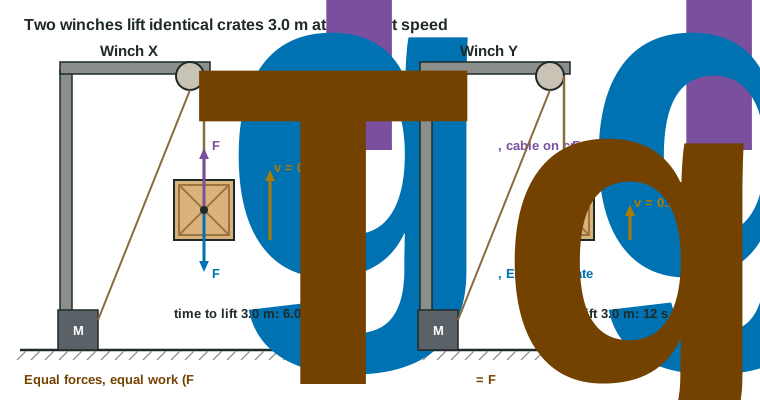
Worked example 1. A winch lifts a 50.0 kg crate 4.00 m at constant speed in 8.00 s. Find the work done by the cable and the average power. Use g = 9.8 m/s².
At constant speed the net force is zero, so the cable's force equals the crate's weight: F_T = mg = (50.0 kg)(9.8 m/s²) = 490 N.
Work: W = F_T d = (490 N)(4.00 m) = 1.96 × 10³ J.
Power: P = W/Δt = 1960 J / 8.00 s = 245 W.
A second winch doing the same lift in 4.00 s does the same work at 490 W.
Power is a functional-dependence favorite: for the same work, P ∝ 1/Δt, so a third of the time means three times the power. And doing more work does not guarantee more power: a heavy student walking up the stairs can do more work than a light one running, with less power.
Instantaneous power: P = Fv
Over a very short interval, a force F along the motion does work F Δx, so the power is F Δx/Δt = Fv. In general only the part of the force along the velocity counts:
P = F_∥ v = Fv cos θ
For the winch above, the crate rises at 4.00 m ÷ 8.00 s = 0.500 m/s, so P = (490 N)(0.500 m/s) = 245 W, the same as W/Δt, because the speed was constant.
Worked example 2. A 60. W motor lifts a 3.0 kg load at constant speed. How fast does the load rise?
At constant speed, the lifting force is mg = (3.0 kg)(9.8 m/s²) = 29.4 N.
P = Fv, so v = P/F = 60. W / 29.4 N = 2.0 m/s.
P = Fv also explains a familiar fact: an engine working at its full power can push hard at low speed (large F = P/v) but only gently at high speed. That is why a car speeds up less and less quickly as it goes faster.
Power and changes in kinetic energy
Power can feed any energy form, not just U_g. A 1500 kg car that goes from rest to 12 m/s in 6.0 s gains ΔK = ½(1500 kg)(12 m/s)² = 1.08 × 10⁵ J, so at least 1.8 × 10⁴ W was delivered to its kinetic energy, on average. Find the energy change first, then divide by the time.
Energy, not power, on your bill
Power companies charge for energy, in kilowatt-hours: one kilowatt for one hour, (1000 J/s)(3600 s) = 3.6 × 10⁶ J. A kilowatt-hour is power times time, which is energy.
Common slips
| Slip | Fix |
|---|---|
| Multiplying work by time | Power is work divided by time |
| Using the mass instead of the force in P = Fv | F is a force in newtons; for lifting at constant speed, mg |
| "More work means more power" | Compare W/Δt, not W |
| Using mv/t for power | mv/t is a force; power needs an energy change over time |