Kinetic and Static Friction
Friction acts along a surface.
Part 1 · Hook
Why this matters
Part 2 · Before you start
What this builds on
Part 3 · Prerequisite check
Quick check before you start
1. On a level floor with no other vertical forces, the normal force on a box of mass m is
- mg
- zero
- less than mg
- greater than mg
Show the answer
Up and down balance, so F_N = mg. On a ramp or with a tilted pull, it is different.
- Correct: mg:
- zero:
- less than mg:
- greater than mg:
2. A box slides at constant velocity. The net force on it is
- zero
- in the direction of motion
- opposite the motion
- equal to its weight
Show the answer
Constant velocity means translational equilibrium.
- Correct: zero:
- in the direction of motion:
- opposite the motion:
- equal to its weight:
3. On a ramp tilted at θ, the part of a vector pointing along the ramp from a vertical force F is
- F sin θ
- F cos θ
- F tan θ
- F
Show the answer
The angle between the vertical and the ramp's perpendicular is θ, so the along-ramp part is F sin θ.
- Correct: F sin θ:
- F cos θ:
- F tan θ:
- F:
Part 4 · See it
See it first
Part 5 · Step by step
How it works, step by step
- Two surfaces press together with a normal force F_Nthey can exert friction on each other along the surface
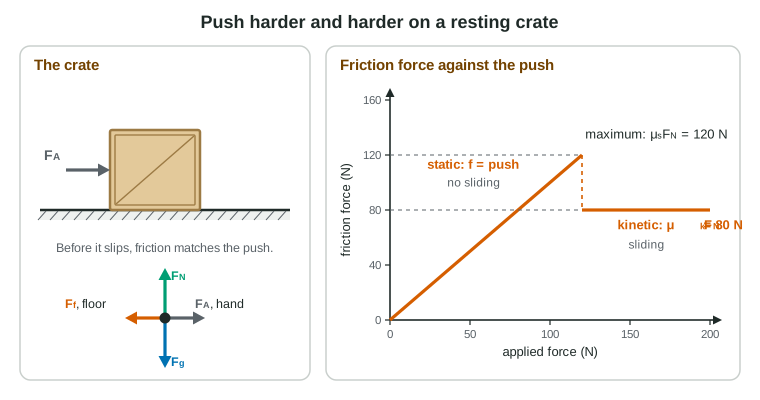
- The surfaces do not slide but something tries to slide themstatic friction takes whatever value prevents slipping, up to μ_s F_N
- The needed friction would exceed μ_s F_Nthe surfaces slip and friction drops to kinetic friction, μ_k F_N, opposing the sliding
- The normal force changes (a ramp, a tilted pull, a load)both the maximum static friction and the kinetic friction change in proportion
Part 6 · Key ideas
Key ideas
- Kinetic friction (sliding): fk = μkFN, opposing the sliding of the surfaces; independent of contact area and speed.
- Static friction (gripping): fs ≤ μsFN. It equals whatever prevents slipping; it reaches μsFN only at the point of slipping.
- Usually μs > μk, so a stuck object lurches once it breaks free.
- Find FN from the perpendicular direction first: on a ramp it is mg cos θ, not mg. The equations sheet writes |Ff| ≤ |μFN|.
Part 7 · Misconception
A common mistake
The wrong idea: Static friction on a resting object is always μ_s F_N.
What actually happens: Static friction is only as large as it needs to be. A crate pushed with 60 N that does not move has 60 N of friction, even if μ_s F_N is 206 N.
Part 8 · Check yourself
Check yourself
Exam-style questions. Anything you miss goes into your review queue.
Data table
Pushing a crate that starts at rest
A 25 kg crate rests on a level warehouse floor. A worker pushes it horizontally, slowly increasing the push, while a force sensor records the push and a motion detector reports whether the crate moves. Once it slides, the worker adjusts the push to keep the crate sliding at a constant speed. Use g = 9.8 m/s².
| Push (N) | Crate |
|---|---|
| 50 | at rest |
| 75 | at rest |
| 140 | at rest |
| 147 | just starts to slide |
| 98 | sliding at constant speed |
1. When the push is 75 N, what is the size of the friction force on the crate, in newtons?
Type a number in N.
Show the answer
The crate stays at rest, so the net horizontal force is zero. Static friction matches the push: 75 N, opposite to it. It is not μ_s F_N; that is only the largest value static friction can reach.
- Answer: 75 N
2. What is the coefficient of static friction between the crate and the floor?
Type a number.
Show the answer
Sliding starts when the push reaches the maximum static friction: f_s,max = μ_s F_N. On a level floor with a horizontal push, F_N = mg = 25 kg × 9.8 m/s² = 245 N. μ_s = 147 N ÷ 245 N = 0.60.
- Answer: 0.60
3. What is the coefficient of kinetic friction between the crate and the floor?
Type a number.
Show the answer
At constant speed the push balances kinetic friction, so f_k = 98 N. μ_k = f_k ÷ F_N = 98 N ÷ 245 N = 0.40.
- Answer: 0.40
4. Right after the crate starts to slide, the worker keeps pushing with 147 N. What happens?
- It speeds up, as kinetic friction is 98 N
- The crate moves at a constant speed, since the push equals the friction
- The crate stops again, since friction rises to match
- The crate slows down, since friction grows once it moves
Show the answer
Once the crate slides, friction drops to the kinetic value, 98 N. A 147 N push gives a net force of 49 N forward, so the crate speeds up at 49 N ÷ 25 kg ≈ 2.0 m/s². That is why things lurch forward once they break free.
- Correct: It speeds up, as kinetic friction is 98 N: Right: kinetic friction is smaller than the maximum static friction.
- The crate moves at a constant speed, since the push equals the friction: The push equalled the maximum static friction, but kinetic friction is smaller.
- The crate stops again, since friction rises to match: Static friction stops acting once the surfaces slide; kinetic friction cannot exceed μ_k F_N.
- The crate slows down, since friction grows once it moves: Kinetic friction is smaller than maximum static friction, not larger.
5. A runner speeds up along a track. What is the direction of the friction from the track on her shoe while it is planted?
- Forward, the way she speeds up
- Backward, opposing her motion
- Straight up
- Zero, since the shoe does not slide
Show the answer
Her shoe pushes back on the track and does not slip, so static friction from the track pushes her forward. Friction opposes the sliding the surfaces would otherwise do, not the motion of the person.
- Correct: Forward, the way she speeds up: Right: static friction forward is what speeds her up.
- Backward, opposing her motion: Friction opposes slipping between surfaces; here that means it points forward on her shoe.
- Straight up: Friction acts along the surface, not perpendicular to it.
- Zero, since the shoe does not slide: Static friction acts without sliding; it is what keeps the shoe from slipping.
6. Which of these statements about static friction are correct? Select all that apply.
- It can be smaller than μ_s F_N
- It acts when surfaces do not slide relative to each other
- Its size equals μ_s F_N whenever it acts
- It points opposite the object's velocity
Show the answer
Static friction adjusts to whatever value prevents slipping, up to a maximum of μ_s F_N. Its direction opposes the sliding that would otherwise happen, which need not be opposite the velocity.
- Correct: It can be smaller than μ_s F_N: Right: it is often less than its maximum.
- Correct: It acts when surfaces do not slide relative to each other: Right: no relative sliding at the contact.
- Its size equals μ_s F_N whenever it acts: μ_s F_N is the maximum, reached only when slipping is about to begin.
- It points opposite the object's velocity: A crate riding on an accelerating truck bed has static friction along its velocity.
Part 9 · Summary
Summary
Part 10 · Up next
What comes next
Part 11 · Connections