Price Elasticity of Demand
Price elasticity of demand measures how strongly the quantity demanded responds to a price change: the percent change in quantity over the percent change in price, read as an absolute value.
Part 1 · Hook
Why this matters
Part 2 · Before you start
What this builds on
Part 3 · Prerequisite check
Quick check before you start
1. By the law of demand, when a good's price rises the quantity demanded
- falls
- rises
- stays the same
- shifts the curve right
Show the answer
Price and quantity demanded move in opposite directions.
- Correct: falls:
- rises:
- stays the same:
- shifts the curve right:
2. Goods used in place of each other, such as two brands of water, are
- substitutes
- complements
- inferior goods
- factors of production
Show the answer
Substitutes can replace each other.
- Correct: substitutes:
- complements:
- inferior goods:
- factors of production:
3. The slope of a straight line is
- the rise over the run, the same at each point
- largest at its middle
- the area under the line
- the point where it meets an axis
Show the answer
A straight line has one constant slope.
- Correct: the rise over the run, the same at each point:
- largest at its middle:
- the area under the line:
- the point where it meets an axis:
Part 4 · See it
See it first
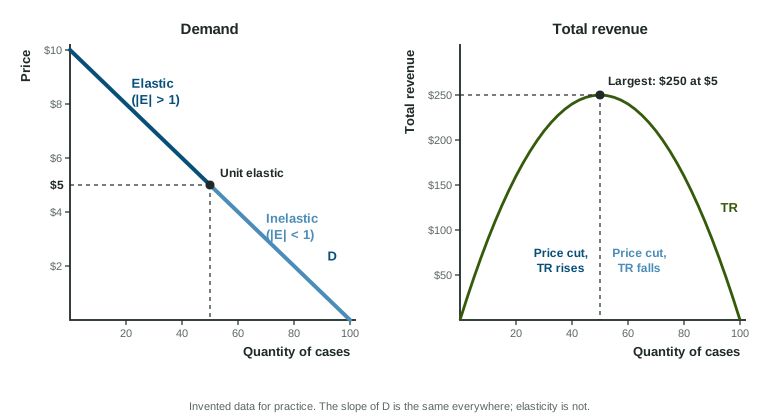
Part 5 · Step by step
How it works, step by step
- A good has many close substitutesbuyers switch away when its price rises
- Buyers switch awaythe quantity demanded falls by a larger percent than the price rose: demand is elastic
- Demand is elasticthe lost sales outweigh the higher price, so total revenue falls
Part 6 · Key ideas
Key ideas
- Price elasticity of demand = percent change in quantity demanded divided by percent change in price. Read the absolute value.
- Greater than 1: elastic. Less than 1: inelastic. Exactly 1: unit elastic. Zero: perfectly inelastic (vertical). Infinite: perfectly elastic (horizontal).
- Total revenue test: elastic demand, price and TR move opposite; inelastic demand, they move together; unit elastic, TR does not change.
- Along a straight-line demand curve the slope is constant but elasticity is not: elastic at the top, unit elastic at the midpoint, inelastic at the bottom.
- Demand is more elastic with close substitutes, a large budget share, a narrowly defined good and more time to adjust.
Part 7 · Misconception
A common mistake
The wrong idea: An elasticity of is negative, so demand is elastic; a steeper curve is always the less elastic one.
What actually happens: Judge elasticity by the absolute value: 0.4 is less than 1, so demand is inelastic. And slope is not elasticity: one straight-line demand curve has the same slope everywhere but is elastic at high prices and inelastic at low ones.
Part 8 · Check yourself
Check yourself
Exam-style questions. Anything you miss goes into your review queue.
Data
A demand schedule for phone cases at Juno Cases
| Price | Quantity demanded |
|---|---|
| $8 | 20 |
| $6 | 40 |
| $5 | 50 |
| $4 | 60 |
| $2 | 80 |
1. Using the starting values, calculate the price elasticity of demand for phone cases when the price falls from $8 to $6. Give the absolute value.
Type a number. A four-function calculator is allowed, as on the exam.
Show the answer
Percent change in quantity: . Percent change in price: . Elasticity: , so demand is elastic in this range.
- Answer: 4
2. By how many dollars does Juno's weekly total revenue change when it cuts the price from $8 to $6?
Type a number. A four-function calculator is allowed, as on the exam.
Show the answer
Total revenue is price times quantity. At $8: . At $6: . The change is dollars, a rise, as the total revenue test predicts for elastic demand.
- Answer: 80
Scenario
Three goods at an island general store
The only store on Tallis Island, an invented place reached by a weekly ferry, sells three goods among many others:
- Insulin, which some islanders need every day and which has no substitute on the island.
- Fizzle, one of six brands of sparkling water on the shelf, all of which taste much the same.
- Table salt, which costs about $1 a box and lasts a family a month.
The store manager raises the price of Fizzle by 10% and sees the quantity of Fizzle sold fall by 30%.
3. Which good in the store most likely has the most elastic demand?
- Insulin
- Table salt
- They are equally elastic
- Fizzle sparkling water
Show the answer
Fizzle has close substitutes on the same shelf, so buyers switch brands when its price rises. Many close substitutes make demand elastic.
- Insulin: Insulin is a necessity with no substitute, so demand is very inelastic.
- Table salt: Salt is a tiny share of a budget, so buyers barely react to its price.
- They are equally elastic: Substitutes, necessity and budget share differ across the three.
- Correct: Fizzle sparkling water: Right: five other brands are close substitutes.
4. Calculate the price elasticity of demand for Fizzle from the manager's results. Give the absolute value.
Type a number. A four-function calculator is allowed, as on the exam.
Show the answer
Elasticity is the percent change in quantity demanded over the percent change in price: . Demand for Fizzle is elastic.
- Answer: 3
5. Demand for a concert band's T-shirts is elastic at the current price. The band wants to raise its total revenue from shirts. What should it do to the price, according to the total revenue test?
- Lower the price
- Raise the price
- Keep the price, since revenue will not change
- Raise the price until demand turns elastic
Show the answer
With elastic demand, price and total revenue move in opposite directions, so a lower price raises total revenue: the quantity rises by a larger percent than the price falls.
- Correct: Lower the price: Right: with elastic demand, a price cut raises total revenue.
- Raise the price: With elastic demand, a price rise loses more sales than it gains per shirt.
- Keep the price, since revenue will not change: Revenue changes with price unless demand is unit elastic.
- Raise the price until demand turns elastic: Demand is already elastic; higher prices make it more so.
Part 9 · Summary
Summary
Part 10 · Up next
What comes next
Part 11 · Connections