Price Elasticity of Supply
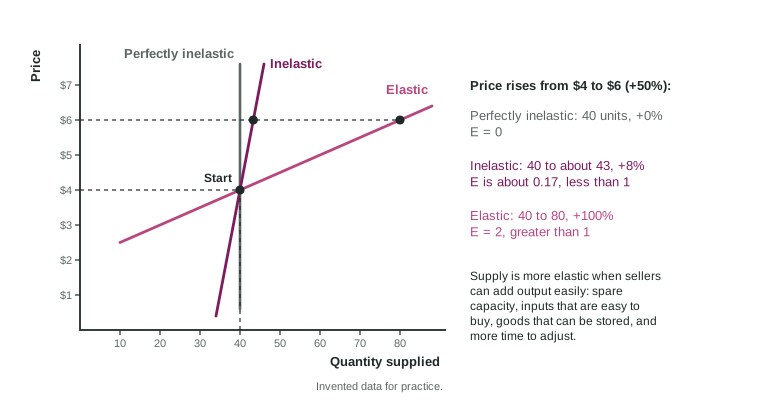
The price elasticity of supply is the percent change in quantity supplied divided by the percent change in price.
Part 1 · Hook
Why this matters
Part 2 · Before you start
What this builds on
Part 3 · Prerequisite check
Quick check before you start
1. By the law of supply, a higher price
- raises the quantity supplied
- lowers the quantity supplied
- shifts supply left
- leaves the quantity supplied the same
Show the answer
Price and quantity supplied move together.
- Correct: raises the quantity supplied:
- lowers the quantity supplied:
- shifts supply left:
- leaves the quantity supplied the same:
2. The price elasticity of demand is
- the percent change in quantity demanded over the percent change in price
- the change in price over the change in quantity
- price times quantity
- the slope of the demand curve
Show the answer
Percent changes, quantity on top.
- Correct: the percent change in quantity demanded over the percent change in price:
- the change in price over the change in quantity:
- price times quantity:
- the slope of the demand curve:
Part 4 · See it
See it first
Part 5 · Step by step
How it works, step by step
Part 6 · Key ideas
Key ideas
- Price elasticity of supply = percent change in quantity supplied divided by percent change in price. It is positive.
- Same benchmarks as demand: greater than 1 elastic, less than 1 inelastic, 1 unit elastic; vertical supply is perfectly inelastic, horizontal supply perfectly elastic.
- Supply is more elastic with spare capacity, inputs that are easy to buy, goods that can be stored, and more time to adjust.
- Perishable goods and fixed capacity (seats, land) make supply inelastic.
Part 7 · Misconception
A common mistake
The wrong idea: Supply elasticity depends on how many substitutes buyers have.
What actually happens: Substitutes drive demand elasticity. Supply elasticity is about sellers: how easily they can add output when the price rises, through spare capacity, available inputs, storage and time.
Part 8 · Check yourself
Check yourself
Exam-style questions. Anything you miss goes into your review queue.
Data
Two sellers respond to a higher price
| Seller | Good | Quantity at $20 | Quantity at $25 |
|---|---|---|---|
| Wren Studio | Hand-knit scarves | 100 | 105 |
| Copperleaf Print | Printed posters | 100 | 150 |
1. Calculate the price elasticity of supply of Copperleaf's posters when the price rises from $20 to $25.
Type a number. A four-function calculator is allowed, as on the exam.
Show the answer
Percent change in quantity supplied:
- Answer: 2
2. Calculate the price elasticity of supply of Wren Studio's scarves for the same price rise.
Type a number. A four-function calculator is allowed, as on the exam.
Show the answer
Quantity:
- Answer: 0.2
Scenario
The Bellweather Amphitheater on a summer night
The Bellweather Amphitheater, an invented outdoor venue, has exactly 8,000 seats and no standing room. For a Saturday concert, tickets sold for $50 last year. This year the band is more popular, and the venue can sell all 8,000 tickets at $90.
A developer plans to build a second, larger venue across the river, which will take about three years.
3. How would you describe the supply of seats for a Saturday concert at the amphitheater?
- Perfectly elastic: a horizontal supply curve
- Elastic, because the price rose so much
- Unit elastic, because the venue sells out
- Perfectly inelastic: a vertical supply curve
Show the answer
The number of seats is fixed at 8,000 whatever the price, so supply is perfectly inelastic: a vertical supply curve with elasticity 0.
- Perfectly elastic: a horizontal supply curve: A horizontal curve would add seats at the same price without limit.
- Elastic, because the price rose so much: A large price change with no quantity change marks inelastic supply.
- Unit elastic, because the venue sells out: Unit elastic means quantity rises by the same percent as price.
- Correct: Perfectly inelastic: a vertical supply curve: Right: the quantity is 8,000 at each price.
4. The price elasticity of supply of a good is 1.5. What does this mean?
- Elastic: a 10% price rise brings a 15% rise
- Inelastic: a 10% price rise brings a 1.5% rise
- Supply is unit elastic
- A 10% price rise lowers quantity supplied by 15%
Show the answer
1.5 is greater than 1: supply is elastic. A 10% rise in price raises the quantity supplied by 15%.
- Correct: Elastic: a 10% price rise brings a 15% rise: Right: 1.5 times 10%.
- Inelastic: a 10% price rise brings a 1.5% rise: An elasticity above 1 is elastic, and 1.5 times 10% is 15%.
- Supply is unit elastic: Unit elastic is exactly 1.
- A 10% price rise lowers quantity supplied by 15%: Quantity supplied rises with price.
5. Supply of a toy is elastic. Demand for the toy rises. Compared with a toy whose supply is inelastic, what happens?
- The price rises more, quantity less
- Neither price nor quantity changes
- Quantity rises more, the price less
- The price falls because supply is elastic
Show the answer
With elastic supply, sellers respond to the higher demand mostly by producing more, so quantity rises a lot and the price rises a little. With inelastic supply, the price rises more and the quantity less.
- The price rises more, quantity less: That happens when supply is inelastic.
- Neither price nor quantity changes: A rise in demand changes both unless a curve is flat or vertical.
- Correct: Quantity rises more, the price less: Right: elastic supply absorbs the demand increase with more output.
- The price falls because supply is elastic: Higher demand raises the price; elastic supply only limits how much.
Part 9 · Summary
Summary
Part 10 · Up next
What comes next
Part 11 · Connections