Marginal Analysis and Consumer Choice
Marginal analysis compares the extra benefit of one more unit with its extra cost: keep going while the marginal benefit is at least the marginal cost.
Part 1 · Hook
Why this matters
Part 2 · Before you start
What this builds on
Part 3 · Prerequisite check
Quick check before you start
1. Net benefit is
- total benefit minus the total cost
- total benefit plus the total cost
- the largest total benefit
- explicit costs plus implicit costs
Show the answer
Subtract every cost from the benefit.
- Correct: total benefit minus the total cost:
- total benefit plus the total cost:
- the largest total benefit:
- explicit costs plus implicit costs:
2. Jamal's net benefit is $45 at 3 lessons and $40 at 4. Taking the fourth lesson
- adds more to cost than to benefit
- adds more to benefit than to cost
- leaves net benefit unchanged
- has no cost
Show the answer
Net benefit falls, so the extra cost is larger.
- Correct: adds more to cost than to benefit:
- adds more to benefit than to cost:
- leaves net benefit unchanged:
- has no cost:
Part 4 · See it
See it first
Part 5 · Step by step
How it works, step by step
- A consumer eats more units of a goodeach extra unit adds less satisfaction than the one before (diminishing marginal utility)
- Goods have different pricesthe consumer compares marginal utility per dollar, MU ÷ P, not marginal utility alone
- One good gives more utility per dollar than anothermoving a dollar toward it raises total utility
- The budget is spent and MU per dollar is equal across goodsno move can raise total utility: the consumer has the utility-maximizing bundle
Part 6 · Key ideas
Key ideas
- Marginal analysis: decide one more unit at a time. Do one more unit when its marginal benefit is at least its marginal cost (MC), the extra cost of that unit; stop when it is less.
- Utility is satisfaction. Marginal utility (MU) is the extra utility from one more unit, and it usually falls as you consume more: diminishing marginal utility.
- Utility-maximizing rule: spend the whole budget so that
. Buy each next unit where MU per dollar is highest. - The budget constraint limits the bundles a consumer can afford: spending on all goods cannot exceed income.
- A sunk cost is already spent and cannot be recovered. It is the same whatever you choose next, so it never changes the best choice.
Part 7 · Misconception
A common mistake
The wrong idea: Leo should buy smoothies first and keep buying them, because each smoothie gives more utility than any taco.
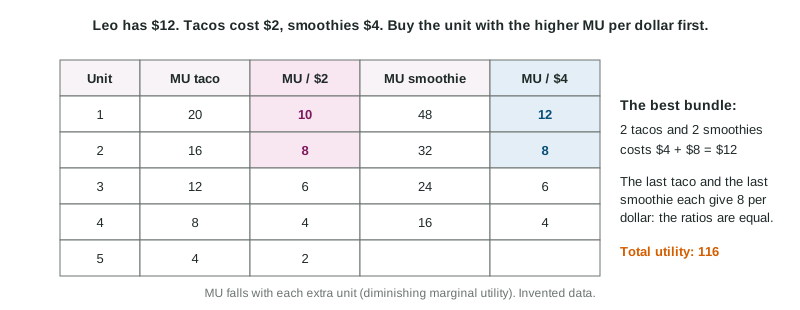
What actually happens: Smoothies cost twice as much. Compare MU per dollar: the first smoothie gives 12 per dollar, but the second gives 8, the same as the second taco. With $12 the best bundle is 2 tacos and 2 smoothies (total utility 116), not 3 smoothies (104).
Part 8 · Check yourself
Check yourself
Exam-style questions. Anything you miss goes into your review queue.
1. What is marginal utility?
- The total satisfaction from the units consumed so far
- The price of one more unit
- The extra satisfaction from one more unit
- The satisfaction per dollar of income
Show the answer
Marginal means one more. Marginal utility is the change in total utility from one more unit.
- The total satisfaction from the units consumed so far: That is total utility.
- The price of one more unit: Price is a cost, not a utility.
- Correct: The extra satisfaction from one more unit: Right: the extra utility of one more unit.
- The satisfaction per dollar of income: Utility per dollar is MU divided by the price of the good.
Data
A student choosing between two goods with a budget: marginal utility per dollar
| Unit | MU of tacos | MU of smoothies |
|---|---|---|
| 1st | 20 | 48 |
| 2nd | 16 | 32 |
| 3rd | 12 | 24 |
| 4th | 8 | 16 |
| 5th | 4 |
2. What is Leo's marginal utility per dollar from his second smoothie?
Type a number. A four-function calculator is allowed, as on the exam.
Show the answer
utils per dollar.
- Answer: 8
3. Leo spends his whole $12. Which bundle maximizes his total utility?
- 3 smoothies
- 6 tacos
- 4 tacos and 1 smoothie
- 2 tacos, 2 smoothies
Show the answer
At 2 tacos and 2 smoothies he spends dollars and the last of each gives 8 per dollar. Total utility is .
- 3 smoothies: 3 smoothies give 104 utils; the third gives only 6 per dollar while a taco gives 10.
- 6 tacos: The table stops at 5 tacos, and tacos alone give at most 60 utils.
- 4 tacos and 1 smoothie: This gives 104 utils; the 4th taco gives 4 per dollar while the 2nd smoothie gives 8.
- Correct: 2 tacos, 2 smoothies: Right: equal MU per dollar, budget spent, 116 utils.
Data
How many pizza slices?
| Slice | Marginal benefit ($) |
|---|---|
| 1st | 5.00 |
| 2nd | 4.00 |
| 3rd | 3.00 |
| 4th | 2.00 |
| 5th | 1.00 |
4. A slice costs $2.50. How many slices should Nadia buy?
- 5
- 3
- 4
- 2
Show the answer
Buy a slice while its marginal benefit is at least its $2.50 cost. The 3rd slice is worth $3.00; the 4th only $2.00.
- 5: The 4th and 5th slices are worth less than $2.50.
- Correct: 3: Right: the 4th slice is worth less than it costs.
- 4: The 4th slice is worth $2.00, less than its $2.50 cost.
- 2: The 3rd slice is still worth $3.00, more than it costs.
Scenario
Pellham Games and its unfinished game
Pellham Games, an invented studio, has already spent $200,000 building a new game, money it cannot get back. Finishing the game would cost another $50,000. The studio expects to take in $80,000 from sales once the game is finished. A manager says, "We have spent so much that we cannot quit now," and another says, "We will never earn back the $200,000, so we should stop."
5. Should Pellham Games finish the game, and why?
- No: it will not earn back the $200,000
- Yes: it has spent $200,000 and has to finish
- Yes: $80,000 more sales for $50,000 more cost
- No: $80,000 is less than $250,000
Show the answer
Only the costs and benefits still ahead matter. Finishing brings $80,000 and costs $50,000, so it adds $30,000. The $200,000 is sunk either way.
- No: it will not earn back the $200,000: The $200,000 is gone whether or not the game is finished, so it does not count.
- Yes: it has spent $200,000 and has to finish: The right answer, but for the wrong reason: past spending is not a reason to continue.
- Correct: Yes: $80,000 more sales for $50,000 more cost: Right: $80,000 more benefit against $50,000 more cost.
- No: $80,000 is less than $250,000: $250,000 adds the sunk $200,000 to the cost still ahead.
Part 9 · Summary
Summary
Part 10 · Up next
What comes next
Part 11 · Connections