The Circular Flow and GDP
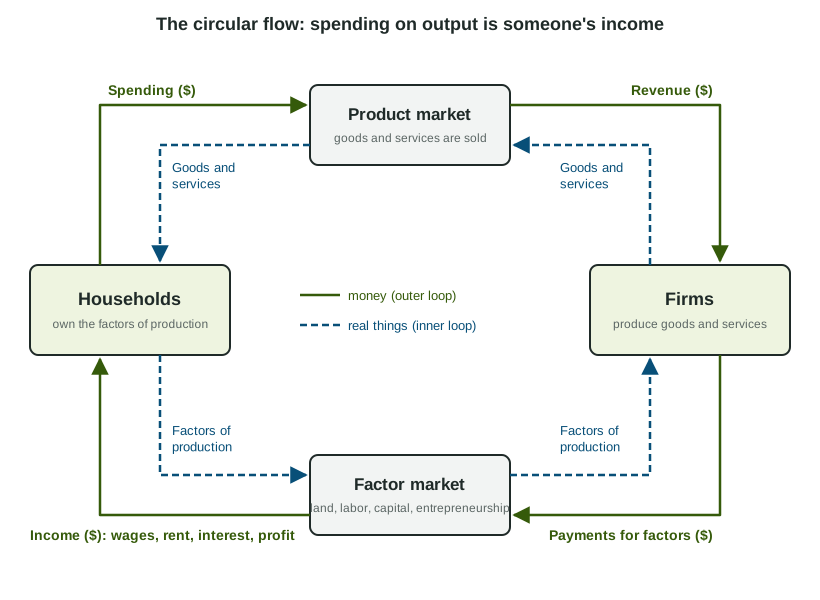
The circular flow shows households selling factors of production to firms and buying their output, so spending on final goods equals income.
Part 1 · Hook
Why this matters
Part 2 · Before you start
What this builds on
Part 3 · Prerequisite check
Quick check before you start
1. Which of these is a factor of production?
- Labor
- Money in a savings account
- A share of stock
- A finished bicycle
Show the answer
The factors of production are land, labor, capital and entrepreneurship. Households own them and sell their services to firms.
- Correct: Labor:
- Money in a savings account:
- A share of stock:
- A finished bicycle:
2. In a market, the price buyers pay times the quantity sold is
- the total spending on that good
- the shortage at that price
- the opportunity cost of the good
- the quantity demanded
Show the answer
Price times quantity is total spending, which is also the sellers' revenue. GDP adds this up for final goods and services.
- Correct: the total spending on that good:
- the shortage at that price:
- the opportunity cost of the good:
- the quantity demanded:
Part 4 · See it
See it first
Part 5 · Step by step
How it works, step by step
- Households spend on goods and services in the product marketfirms receive that spending as revenue
- Firms receive revenuethey pay wages, rent, interest and profit to households in the factor market
- Households receive factor incomethey spend it again, so total spending on final output equals total income
- GDP adds up spending on final goods onlyintermediate goods, used goods, financial trades and transfer payments are left out
Part 6 · Key ideas
Key ideas
- GDP is the market value of all final goods and services produced within a country in a year.
- The expenditure approach:
. Imports are subtracted because they are already inside C, I and G but were made abroad. - In GDP, investment means new capital, new homes and added inventory, not buying stocks.
- Left out: intermediate goods (double counting), used goods, stocks and bonds, and transfer payments. Counting each stage's value added gives the same total as counting final goods.
Part 7 · Misconception
A common mistake
The wrong idea: Adding up every sale in the economy, including the flour and the wheat, gives GDP.
What actually happens: Only final goods count. The bread's price already includes the flour and wheat, so adding them counts the same production two or three times.
Part 8 · Check yourself
Check yourself
Exam-style questions. Anything you miss goes into your review queue.
Data
Spending in Country X for one year
| Category | Amount |
|---|---|
| Consumption spending by households | 600 |
| Investment spending by firms | 150 |
| Government purchases of goods and services | 200 |
| Exports | 80 |
| Imports | 100 |
| Transfer payments (pensions and other benefit checks) | 90 |
1. Use the table. What is GDP in Country X, in billions of dollars?
Type a number. A four-function calculator is allowed, as on the exam.
Show the answer
Use the expenditure approach and leave out transfer payments:
- Answer: 930
2. Use the table. What are net exports in Country X, in billions of dollars?
Type a number. A four-function calculator is allowed, as on the exam.
Show the answer
Net exports are exports minus imports: billion dollars. More was bought from abroad than sold abroad.
- Answer: -20
Scenario
From wheat to a loaf of bread
In Country X a farmer grows wheat and sells it to a mill for $50. The mill grinds it into flour and sells the flour to a bakery for $120. The bakery bakes bread and sells all of it to shoppers for $300. Nothing else is produced along this chain this year.
3. How much does this chain add to Country X's GDP, in dollars?
Type a number. A four-function calculator is allowed, as on the exam.
Show the answer
Count only the final good, the bread sold to shoppers: $300. The wheat and the flour are intermediate goods; their value is already inside the price of the bread.
- Answer: 300
4. Which of these are counted in this year's GDP of the United States? Select all that apply.
- A pension check mailed to a retiree
- A house built and sold this year
- A haircut bought at a local salon
- A car built in Ohio by a company based in Japan
- A ten-year-old car bought from a neighbor
- Shares of stock bought through an app
Show the answer
GDP is the market value of final goods and services produced within a country in a year. New production counts; used goods, financial trades and transfers do not.
- A pension check mailed to a retiree: A transfer payment: nothing is produced in exchange, so it is left out.
- Correct: A house built and sold this year: Right: a newly built home is counted, as residential investment.
- Correct: A haircut bought at a local salon: Right: a service produced this year and sold at market value.
- Correct: A car built in Ohio by a company based in Japan: Right: GDP counts what is produced inside the country's borders, whoever owns the factory.
- A ten-year-old car bought from a neighbor: A used good was counted in the year it was made; reselling it produces nothing new.
- Shares of stock bought through an app: A stock purchase is a financial exchange of ownership, not production of a good or service.
5. A bakery buys a new delivery truck made this year in the same country. In which part of GDP is the truck counted?
- It is an intermediate good and is not counted
- Investment
- Consumption
- Government purchases
Show the answer
Investment in GDP means spending on new capital (machines, tools, buildings), new homes and changes in inventories. Capital goods are final goods, not intermediate ones.
- It is an intermediate good and is not counted: The truck is not used up in making one loaf; it is a capital good used for years, so it is a final good counted as investment.
- Correct: Investment: Right: new capital goods bought by firms are investment spending.
- Consumption: Consumption is spending by households on goods and services for their own use, not a firm's capital.
- Government purchases: The bakery is a private firm, not the government.
Part 9 · Summary
Summary
Part 10 · Up next
What comes next
Part 11 · Connections