Introduction to Sustainability
Sustainability means meeting present needs without reducing future generations' ability to meet theirs.
Part 1 · Hook
Why this matters
Part 2 · Before you start
What this builds on
Part 3 · Prerequisite check
Quick check before you start
1. In logistic growth, when does a population grow fastest?
- At about half of its carrying capacity
- When it is very small
- When it is at its carrying capacity
- When it is above its carrying capacity
Show the answer
Growth is slow when few individuals breed and slow again near K; it is fastest in the middle.
- Correct: At about half of its carrying capacity:
- When it is very small:
- When it is at its carrying capacity:
- When it is above its carrying capacity:
2. What is the tragedy of the commons?
- Overuse of a shared resource because each user keeps the gain while costs are shared
- The extinction of a species by natural causes
- The loss of soil by wind erosion on farms
- The growth of cities onto farmland
Show the answer
Each user gains fully from taking more but pays only a share of the cost.
- Correct: Overuse of a shared resource because each user keeps the gain while costs are shared:
- The extinction of a species by natural causes:
- The loss of soil by wind erosion on farms:
- The growth of cities onto farmland:
Part 4 · See it
See it first
Part 5 · Step by step
How it works, step by step
- A population is far below its carrying capacityresources are plentiful, so each fish leaves many young
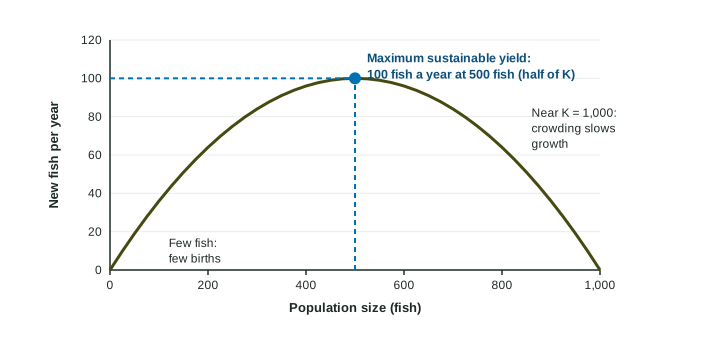
- The population is near half of its carrying capacityit adds the most new fish per year
- People harvest exactly the yearly growth at that sizethe population stays the same year after year: the maximum sustainable yield
- People harvest more than the yearly growththe population shrinks and adds fewer fish each year, so a steady harvest drives it down further
Part 6 · Key ideas
Key ideas
- Sustainability: meeting today's needs without reducing the ability of future generations to meet theirs. Living resources used no faster than they regrow; wastes released no faster than they are absorbed.
- Maximum sustainable yield (MSY) is the largest harvest a population can replace each year. For logistic growth it is at about half of the carrying capacity (K/2).
- Harvesting right at MSY is risky: estimates are uncertain and bad years happen, so managers usually harvest less.
- Environmental indicators track sustainability: biodiversity, food production, atmospheric carbon dioxide and temperature, human population, and resource depletion.
Part 7 · Misconception
A common mistake
The wrong idea: A population grows fastest, and so can be harvested most, when it is at its carrying capacity.
What actually happens: At carrying capacity, births just balance deaths, so the population adds almost nothing each year. It adds the most when it is near half of its carrying capacity.
Part 8 · Check yourself
Check yourself
Exam-style questions. Anything you miss goes into your review queue.
1. Which statement best defines sustainability?
- Meeting present needs while protecting future generations' needs
- Using each resource as fast as possible while it lasts
- Stopping the use of natural resources to protect them
- Growing the economy as fast as possible each year
Show the answer
Sustainability balances use today with what is left for the future.
- Correct: Meeting present needs while protecting future generations' needs: Right: present needs, protected future.
- Using each resource as fast as possible while it lasts: Using resources as fast as possible runs them down.
- Stopping the use of natural resources to protect them: Sustainable use still uses resources, at a rate they can renew.
- Growing the economy as fast as possible each year: Economic growth alone says nothing about resources.
2. A forest grows about 2,000 cubic meters of new wood a year. Which harvest is sustainable?
- Cutting about 1,500 cubic meters a year
- Cutting about 2,500 cubic meters a year
- Cutting about 5,000 cubic meters each year
- Cutting the whole forest in one year, then waiting
Show the answer
Taking less than the yearly growth leaves the forest at least as large each year.
- Correct: Cutting about 1,500 cubic meters a year: Right: less than the 2,000 m³ the forest adds.
- Cutting about 2,500 cubic meters a year: 2,500 is more than the forest replaces, so it shrinks.
- Cutting about 5,000 cubic meters each year: 5,000 a year runs the forest down quickly.
- Cutting the whole forest in one year, then waiting: Cutting the whole forest is not a steady harvest.
Model or diagram
New fish added each year at each population size
3. Why does the curve fall to zero at 1,000 fish?
- At carrying capacity, crowding and limited food stop growth
- At 1,000 fish, the anglers catch each new fish that is born
- At 1,000 fish, the fish stop reproducing because they are too old
- At 1,000 fish, the lake freezes over and no young survive
Show the answer
At K, density-dependent factors (food, space) balance births and deaths, so no new fish are added.
- Correct: At carrying capacity, crowding and limited food stop growth: Right: limited resources stop growth at K.
- At 1,000 fish, the anglers catch each new fish that is born: The curve shows growth, not catch.
- At 1,000 fish, the fish stop reproducing because they are too old: Age is not what sets K.
- At 1,000 fish, the lake freezes over and no young survive: Freezing is not shown; K reflects limited resources.
4. An agency allows a yearly catch of 80 fish from this lake. Write the setup for that catch as a percent of the maximum sustainable yield, then give the answer.
Type the setup as on the exam, with brackets and units, then the answer.
Show the answer
of the maximum sustainable yield, leaving a safety margin.
- Setup: ; answer 80 %
5. The lake's population falls to 200 fish after years of overfishing. Using the graph, why is a ban better than a smaller catch while it recovers?
- At 200 fish the lake adds about 64 fish a year, so any catch slows recovery
- At 200 fish the lake adds about 100 fish a year, the most it ever can
- At 200 fish the population is above its carrying capacity and will shrink
- At 200 fish the population will grow fastest if a few fish are removed
Show the answer
Reading the curve at 200 fish gives about 64 new fish a year; letting all of them survive rebuilds the stock fastest.
- Correct: At 200 fish the lake adds about 64 fish a year, so any catch slows recovery: Right: growth is small, so every fish left helps.
- At 200 fish the lake adds about 100 fish a year, the most it ever can: The peak of 100 is at 500 fish, not 200.
- At 200 fish the population is above its carrying capacity and will shrink: 200 is far below K = 1,000.
- At 200 fish the population will grow fastest if a few fish are removed: Removing fish from a small population slows growth.
Data
Environmental indicators for one region
| Indicator | 2000 | 2020 |
|---|---|---|
| Bird species counted in surveys | 140 | 112 |
| Grain harvested (million metric tons) | 4.0 | 4.6 |
| Forest cover (% of land) | 38 | 31 |
| Groundwater depth below surface (m) | 20 | 34 |
| Population (millions) | 6.0 | 7.5 |
6. Which indicators in the table changed in a direction that suggests the region is becoming less sustainable?
- Bird species, forest and groundwater
- Grain harvested and the population
- Bird species and grain harvested
- Forest cover and grain harvested
Show the answer
Fewer bird species, less forest and a deeper water table (groundwater being used up) all point away from sustainability.
- Correct: Bird species, forest and groundwater: Right: biodiversity, forest and groundwater all worsened.
- Grain harvested and the population: Grain rose, and population is a driver; the clearest warnings are birds, forest and water.
- Bird species and grain harvested: Grain harvested rose, which on its own is not a warning.
- Forest cover and grain harvested: Grain rose; bird species and groundwater are the missing warnings.
7. Explain why harvesting more than the maximum sustainable yield every year leads to a falling population.
Build the answer part by part, then write it in your own words.
Show the answer
Each link: the harvest is larger than the yearly growth, so the population shrinks; a smaller population (below K/2) adds even fewer young; so the same harvest takes a bigger share each year and the decline speeds up.
- An answer that earns the point: Because the harvest is larger than the number of fish added each year, the population shrinks; a smaller population adds even fewer young each year, which leads to the decline speeding up until the stock collapses.
Part 9 · Summary
Summary
Part 10 · Up next
What comes next
Part 11 · Connections