Primary Productivity
Primary productivity is the rate at which producers capture energy by photosynthesis.
Part 1 · Hook
Why this matters
Part 2 · Before you start
What this builds on
Part 3 · Prerequisite check
Quick check before you start
1. Which process releases CO2 as living things break down sugar for energy?
- Cellular respiration
- Photosynthesis
- Sedimentation
- Nitrogen fixation
Show the answer
Respiration breaks down sugar and releases CO2.
- Correct: Cellular respiration:
- Photosynthesis:
- Sedimentation:
- Nitrogen fixation:
2. A rate in "kcal per m² per year" means...
- energy divided by area and by time
- energy multiplied by area
- area divided by energy
- time divided by energy
Show the answer
Each "per" divides.
- Correct: energy divided by area and by time:
- energy multiplied by area:
- area divided by energy:
- time divided by energy:
3. What is a limiting nutrient?
- The nutrient in shortest supply compared with need
- The nutrient used the most
- A poison
- A gas
Show the answer
Adding it raises growth.
- Correct: The nutrient in shortest supply compared with need:
- The nutrient used the most:
- A poison:
- A gas:
Part 4 · See it
See it first
Part 5 · Step by step
How it works, step by step
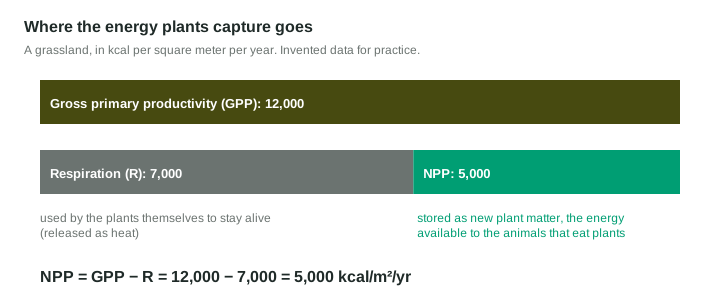
- Producers capture light energy by photosynthesisthat total rate is gross primary productivity (GPP)
- Producers use part of it for their own cellular respirationthat energy is lost as heat
- What is left is net primary productivity: NPP = GPP - RNPP is the energy available to the animals that eat plants
Part 6 · Key ideas
Key ideas
- Producers (autotrophs) make their own food by photosynthesis.
- Primary productivity is the rate producers capture energy, in units such as kcal/m²/yr or g/m²/yr.
- , so .
- Productivity is highest where light, water, warmth and nutrients are all plentiful (rainforests, wetlands, estuaries, reefs) and lowest in deserts, tundra and the open ocean.
Part 7 · Misconception
A common mistake
The wrong idea: NPP is the energy plants capture, and GPP is what animals eat.
What actually happens: GPP is the total captured (gross, like a paycheck before costs). NPP is what is left after the plants’ own respiration (net, like take-home pay); animals can eat only from NPP.
Part 8 · Check yourself
Check yourself
Exam-style questions. Anything you miss goes into your review queue.
1. A salt marsh has a GPP of 9,000 kcal/m²/yr, and its plants use 5,500 kcal/m²/yr in respiration. What is its NPP?
Type a number, then its unit (kcal/m^2/yr). Scale words (2.5 million) and powers of ten (2.5 × 10^6) are read.
Show the answer
- Answer: 3500 kcal/m^2/yr
2. A forest’s NPP is 2,000 kcal/m²/yr, and its plants use 4,000 kcal/m²/yr in respiration. Write the setup for its GPP, then give the answer.
Type the setup as on the exam, with brackets and units, then the answer.
Show the answer
- Setup: ; answer 6000 kcal/m^2/yr
Data
Gross productivity and respiration in five ecosystems
| Ecosystem | GPP (kcal/m²/yr) | Respiration R (kcal/m²/yr) |
|---|---|---|
| Tropical rainforest | 7,600 | 4,400 |
| Temperate deciduous forest | 5,000 | 3,000 |
| Temperate grassland | 2,400 | 1,200 |
| Desert scrub | 400 | 250 |
| Open ocean | 1,000 | 600 |
3. What is the NPP of the temperate grassland?
Type a number, then its unit (kcal/m^2/yr). Scale words (2.5 million) and powers of ten (2.5 × 10^6) are read.
Show the answer
- Answer: 1200 kcal/m^2/yr
4. Which ecosystem has the highest NPP?
- Tropical rainforest
- Temperate deciduous forest
- Temperate grassland
- Open ocean
Show the answer
NPP: rainforest 3,200; deciduous forest 2,000; grassland 1,200; desert scrub 150; open ocean 400 kcal/m²/yr.
- Correct: Tropical rainforest: Right: 7,600 - 4,400 = 3,200.
- Temperate deciduous forest: 5,000 - 3,000 = 2,000.
- Temperate grassland: 2,400 - 1,200 = 1,200.
- Open ocean: 1,000 - 600 = 400.
5. What percent of its GPP does the tropical rainforest use in respiration?
Type a number, then its unit (%). Scale words (2.5 million) and powers of ten (2.5 × 10^6) are read.
Show the answer
- Answer: 57.89 %
6. Which ecosystem has the largest share of its GPP left as NPP?
- Temperate grassland
- Tropical rainforest
- Desert scrub
- Open ocean
Show the answer
NPP as a share of GPP: grassland ; rainforest 42%; deciduous forest 40%; desert scrub 37.5%; open ocean 40%.
- Correct: Temperate grassland: Right: half of its GPP is left.
- Tropical rainforest: Highest NPP, but only about 42% of its GPP is left.
- Desert scrub: About 37.5% of its GPP is left.
- Open ocean: 40% of its GPP is left.
Model or diagram
Light and oxygen bottles in a lake
7. Oxygen fell from 8.0 to 7.4 mg/L in the dark bottle in 24 hours. What was the rate of respiration, in mg/L of oxygen per day?
Type a number, then its unit (mg/L/day). Scale words (2.5 million) and powers of ten (2.5 × 10^6) are read.
Show the answer
In the dark there is no photosynthesis, so the drop is respiration alone: mg/L per day.
- Answer: 0.6 mg/L/day
Part 9 · Summary
Summary
Part 10 · Up next
What comes next
Part 11 · Connections