Endocrine Disruptors
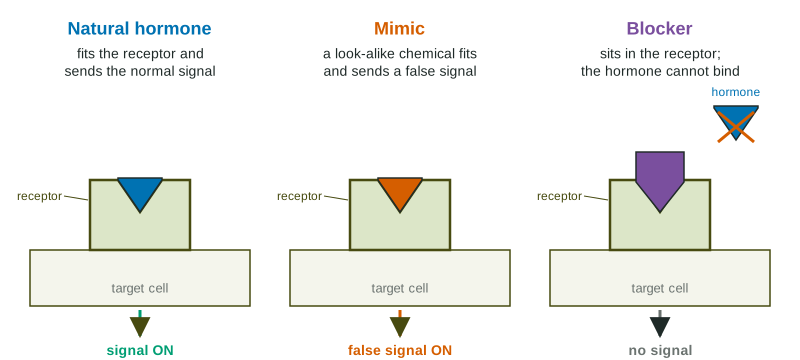
Endocrine disruptors are chemicals that interfere with hormones by mimicking them, blocking their receptors or changing how much is made.
Part 1 · Hook
Why this matters
Part 2 · Prerequisite check
Quick check before you start
1. Which kind of pollution comes from one identifiable place, such as a pipe?
- A point source
- A nonpoint source
- A natural source
- A secondary pollutant
Show the answer
A pipe is a single outlet, so it is a point source.
- Correct: A point source:
- A nonpoint source:
- A natural source:
- A secondary pollutant:
2. What are pesticides designed to do?
- Kill or control pests such as insects and weeds
- Add nitrogen to soil
- Raise the pH of soil
- Make crops grow taller
Show the answer
Pesticides (insecticides, herbicides and others) kill or control pests.
- Correct: Kill or control pests such as insects and weeds:
- Add nitrogen to soil:
- Raise the pH of soil:
- Make crops grow taller:
Part 3 · See it
See it first
Part 4 · Step by step
How it works, step by step
- Hormones from glands travel in the blood and bind to receptors on cellsthe cells switch on growth, development or reproduction
- An endocrine disruptor has a shape similar to a hormoneit binds the receptor and sends a false signal, or blocks the real hormone
- Exposure happens during development, even at very low dosesreproductive organs, growth and behavior develop abnormally
- Many such chemicals pass through city wastewater plants and persistfish, frogs and other wildlife downstream show intersex and reproductive effects
Part 5 · Key ideas
Key ideas
- An endocrine disruptor interferes with hormones: it mimics a hormone, blocks its receptor, or changes how much is made.
- Examples: the herbicide atrazine, BPA and phthalates in some plastics, and synthetic estrogen from birth control pills that passes into wastewater.
- Effects: intersex fish, frogs with abnormal sex organs, thinner eggshells, and in people reproductive, developmental and some cancer risks. Effects can appear at very low doses.
- Reduce them by limiting their use, extra cleaning steps at wastewater plants, proper disposal of medicines, and safer substitutes.
Part 6 · Misconception
A common mistake
The wrong idea: A chemical at a few parts per billion is too dilute to matter.
What actually happens: Hormones themselves work at tiny concentrations, so chemicals that mimic them can change development at very low doses.
Part 7 · Check yourself
Check yourself
Exam-style questions. Anything you miss goes into your review queue.
1. What is an endocrine disruptor?
- A germ that infects the glands that make hormones
- A gas that blocks oxygen from reaching the blood
- A chemical that breaks down quickly in water
- A chemical that interferes with hormones
Show the answer
An endocrine disruptor is a chemical that interferes with the body's hormones, by mimicking them, blocking them or changing how much is made.
- A germ that infects the glands that make hormones: Endocrine disruptors are chemicals, not germs.
- A gas that blocks oxygen from reaching the blood: That describes carbon monoxide.
- A chemical that breaks down quickly in water: Many endocrine disruptors are persistent, not quick to break down.
- Correct: A chemical that interferes with hormones: Right: it interferes with the endocrine (hormone) system.
Data
Intersex fish above and below a wastewater outfall
| Site | Distance from outfall | Estrogen-like chemicals (ng/L) | Males examined | Males with egg cells |
|---|---|---|---|---|
| 1 | 5 km upstream | 0.4 | 40 | 2 |
| 2 | at outfall | 6.0 | 40 | 26 |
| 3 | 3 km downstream | 3.1 | 40 | 15 |
| 4 | 10 km downstream | 1.0 | 40 | 6 |
2. What percent of the male bass at the outfall (site 2) had egg cells in their testes?
Type a number, then its unit (%). Scale words (2.5 million) and powers of ten (2.5 × 10^6) are read.
Show the answer
.
- Answer: 65 %
3. What relationship do the data show?
- More estrogen-like chemicals go with fewer intersex males
- More estrogen-like chemicals go with more intersex males
- Intersex males are found mostly upstream of the outfall
- The number of males examined explains the pattern
Show the answer
Sites with more estrogen-like chemicals have more intersex males: 2 of 40 at 0.4 ng/L up to 26 of 40 at 6.0 ng/L.
- More estrogen-like chemicals go with fewer intersex males: Site 2 has both the most chemicals and the most intersex males.
- Correct: More estrogen-like chemicals go with more intersex males: Right: the two rise and fall together across the sites.
- Intersex males are found mostly upstream of the outfall: Site 1, upstream, has the fewest.
- The number of males examined explains the pattern: Forty males were examined at every site.
4. Which claim is best supported by these data alone?
- The outfall is linked to more intersex fish downstream
- Estrogen-like chemicals have no effect on fish
- The intersex fish will recover once they swim upstream
- People drinking river water will become intersex
Show the answer
The data show a strong relationship along one river. They support that the outfall is linked to intersex fish; a controlled experiment would be needed to show that the chemicals cause it.
- Correct: The outfall is linked to more intersex fish downstream: Right: a strong pattern, but these field data show a link, not proof of cause.
- Estrogen-like chemicals have no effect on fish: The pattern points to an effect, not to no effect.
- The intersex fish will recover once they swim upstream: Nothing in the data shows recovery of individual fish.
- People drinking river water will become intersex: The data are about fish, not people, and give no human doses.
Model or diagram
Frog development at increasing doses of a herbicide in a lab study
5. Describe the shape of the dose-response pattern in the graph.
- There is no effect until the highest dose
- The effect rises by the same amount at each dose
- A big jump at the lowest dose, then small rises
- The effect falls as the dose increases
Show the answer
The biggest jump comes from 0 to 0.1 ppb (2 to 16 percent); higher doses add only a little more (up to 26 percent). Effects appear at very low doses.
- There is no effect until the highest dose: Abnormal males rise sharply at the lowest dose tested.
- The effect rises by the same amount at each dose: The first step is much larger than the later steps.
- Correct: A big jump at the lowest dose, then small rises: Right: 2 to 16 percent at 0.1 ppb, then small increases.
- The effect falls as the dose increases: The percent rises with dose.
6. Why are low-dose effects like these a special concern for endocrine disruptors?
- Endocrine disruptors are harmless at high doses
- Hormones act at tiny levels, and so do mimics
- Low doses make the chemical turn into a hormone
- Frogs absorb less of a chemical at high doses
Show the answer
Hormones work at tiny concentrations, so chemicals that mimic or block them can change development at very low doses, below levels once assumed safe.
- Endocrine disruptors are harmless at high doses: The graph shows effects rising with dose, not vanishing.
- Correct: Hormones act at tiny levels, and so do mimics: Right: the body's signals are naturally very dilute.
- Low doses make the chemical turn into a hormone: The chemical mimics or blocks a hormone; it does not turn into one.
- Frogs absorb less of a chemical at high doses: Nothing in the data suggests less absorption at high doses.
7. How can a chemical that mimics estrogen cause male fish to develop egg cells?
- It kills the male cells so female cells grow in their place
- It binds estrogen receptors and turns on female development
- It lowers dissolved oxygen so males develop poorly
- It changes the fish's genes into female genes
Show the answer
The chemical binds to estrogen receptors and switches on female development signals, so males exposed while developing grow female tissue.
- It kills the male cells so female cells grow in their place: It acts as a signal, not as a poison that kills cells.
- Correct: It binds estrogen receptors and turns on female development: Right: the body reads it as an estrogen signal.
- It lowers dissolved oxygen so males develop poorly: Low oxygen does not turn males female.
- It changes the fish's genes into female genes: It changes hormone signals, not the fish's sex genes.
Part 8 · Summary
Summary
Part 9 · Up next
What comes next
Part 10 · Connections