Atmospheric CO2 and Particulates
Carbon dioxide and particulate matter have natural sources as well as human ones.
Part 1 · Hook
Why this matters
Part 2 · Before you start
What this builds on
Part 3 · Prerequisite check
Quick check before you start
1. Which process releases CO2 as organisms break down food for energy?
- Cellular respiration
- Photosynthesis
- Nitrogen fixation
- Condensation
Show the answer
Respiration releases CO2; photosynthesis takes it in.
- Correct: Cellular respiration:
- Photosynthesis:
- Nitrogen fixation:
- Condensation:
2. Which particles reach deepest into the lungs?
- PM2.5
- PM10
- Sand grains
- Pollen grains
Show the answer
The smaller the particle, the deeper it goes; PM2.5 is the finest group.
- Correct: PM2.5:
- PM10:
- Sand grains:
- Pollen grains:
Part 4 · See it
See it first
Part 5 · Step by step
How it works, step by step
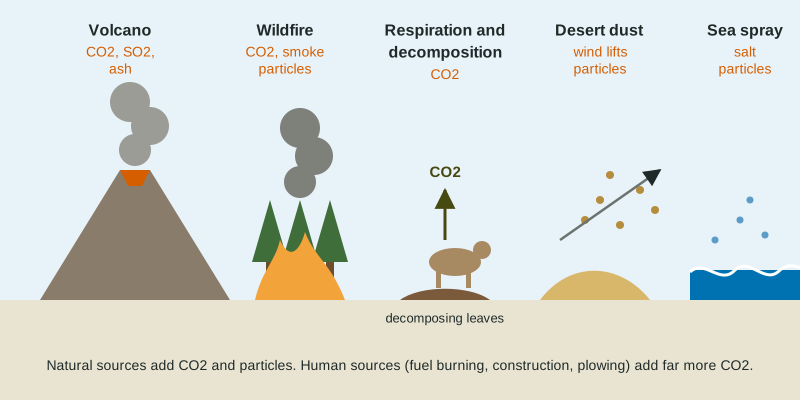
- Volcanoes erupt, wildfires burn, and organisms respire and decomposeCO2 enters the atmosphere without any human help
- Wind lifts desert dust and sea spray, and fires and volcanoes release smoke and ashnatural particulate matter enters the air
- Particles in the air scatter and absorb sunlightvisibility falls and the sky looks hazy
- People breathe air with more fine particleslung and heart problems rise, whether the particles are natural or human
Part 6 · Key ideas
Key ideas
- Natural emissions of CO2 come from volcanoes, wildfires, respiration and decomposition. Today human activities release roughly 100 times more CO2 each year than volcanoes.
- Natural particulate matter comes from volcanic ash, wildfire smoke, desert dust, sea salt spray and pollen. Human sources include burning fuel, construction and plowing.
- Particles scatter and absorb light, which makes haze and lowers visibility.
- PM2.5 harms the lungs and heart whatever its source, so smoke from a wildfire started by lightning is as dangerous as smoke from a fire people set.
Part 7 · Misconception
A common mistake
The wrong idea: Volcanoes put more CO2 into the air each year than all human activities.
What actually happens: All the world's volcanoes together release about one hundredth of the CO2 that humans release each year by burning fossil fuels and making cement.
Part 8 · Check yourself
Check yourself
Exam-style questions. Anything you miss goes into your review queue.
1. Which of these is a natural source of carbon dioxide in the atmosphere?
- Volcanic eruptions
- Burning gasoline in cars
- Making cement from limestone
- Photosynthesis by forest trees
Show the answer
Volcanoes release CO2 from deep in the Earth. Respiration, decomposition and wildfires are other natural sources.
- Correct: Volcanic eruptions: Right: volcanoes release CO2, sulfur dioxide and ash.
- Burning gasoline in cars: Burning gasoline releases CO2, but it is a human source.
- Making cement from limestone: Cement making releases CO2, but it is a human activity.
- Photosynthesis by forest trees: Photosynthesis takes CO2 out of the air; it is not a source.
2. Which pair lists a natural source of particulate matter and a human source of it?
- Diesel exhaust; volcanic ash
- Coal burning; construction dust
- Pollen; desert dust storms
- Sea salt spray; diesel exhaust
Show the answer
Volcanic ash, sea salt spray, pollen and desert dust are natural; diesel exhaust, coal burning and construction dust are human.
- Diesel exhaust; volcanic ash: The order is reversed: diesel is human and volcanic ash is natural.
- Coal burning; construction dust: Both of these are human sources.
- Pollen; desert dust storms: Both of these are natural sources.
- Correct: Sea salt spray; diesel exhaust: Right: sea spray is natural, diesel soot is human.
Model or diagram
Fine particles and visibility in a town during a wildfire smoke event
3. Describe the relationship between PM2.5 and visibility shown in the graph.
- As PM2.5 rises, visibility rises too
- As PM2.5 rises, visibility falls
- Visibility changes first, and PM2.5 follows two days later
- PM2.5 and visibility are unrelated on these days
Show the answer
As PM2.5 rises, visibility falls, and as PM2.5 clears, visibility returns: an inverse relationship. Particles scatter and absorb light, which makes haze.
- As PM2.5 rises, visibility rises too: On day 5, PM2.5 is highest and visibility is lowest, so they move oppositely.
- Correct: As PM2.5 rises, visibility falls: Right: the two lines move in opposite directions, an inverse relationship.
- Visibility changes first, and PM2.5 follows two days later: The two change on the same days, not two days apart.
- PM2.5 and visibility are unrelated on these days: They move in step, in opposite directions, across all ten days.
4. Why does visibility drop when PM2.5 rises?
- Particles scatter and absorb light, making the air hazy
- Particles are a gas that bends the light upward
- Particles cool the air and form thick rain clouds
- Particles lower the oxygen in the air people breathe
Show the answer
Particles scatter and absorb sunlight, so less light travels straight from distant objects to your eye, and the air looks hazy.
- Correct: Particles scatter and absorb light, making the air hazy: Right: that is what haze is.
- Particles are a gas that bends the light upward: Particles are tiny solids or droplets; they scatter light in many directions.
- Particles cool the air and form thick rain clouds: The haze comes from the particles themselves, not from rain clouds.
- Particles lower the oxygen in the air people breathe: Particles do not remove oxygen; they block and scatter light.
5. Find the percent change in visibility from day 1 to day 5.
Type a number, then its unit (%). Scale words (2.5 million) and powers of ten (2.5 × 10^6) are read.
Show the answer
- Answer: -95 %
6. Health officials told residents to stay indoors on days 4 to 6. Which reason best supports that advice?
- Visibility was too low for anyone to drive safely
- Smoke raises ozone in the stratosphere on those days
- CO2 from the fire was high enough to replace oxygen
- PM2.5 was highest, and fine particles reach deep in the lungs
Show the answer
PM2.5 reached 110 to 150 µg per m³ on those days. Particles that small reach deep into the lungs and the blood, so less time outdoors means less exposure.
- Visibility was too low for anyone to drive safely: Low visibility matters for driving, but the health advice is about breathing particles.
- Smoke raises ozone in the stratosphere on those days: Smoke does not raise stratospheric ozone; the risk here is particles.
- CO2 from the fire was high enough to replace oxygen: Outdoor CO2 from a distant fire does not get high enough to replace oxygen.
- Correct: PM2.5 was highest, and fine particles reach deep in the lungs: Right: the advice targets the days of highest exposure.
7. Volcanoes release CO2 every year. How do they compare with human activities as a source of atmospheric CO2 today?
- Volcanoes release far more CO2 each year than human activities
- Human activities release far more CO2 each year than volcanoes
- Volcanoes and human activities release about equal amounts
- Volcanoes take CO2 out of the air, so they offset human emissions
Show the answer
Human burning of fossil fuels and cement making release roughly 100 times more CO2 each year than all the world's volcanoes combined (USGS estimates).
- Volcanoes release far more CO2 each year than human activities: This common claim is wrong; human emissions are much larger.
- Correct: Human activities release far more CO2 each year than volcanoes: Right: estimates put human emissions at about 100 times volcanic emissions.
- Volcanoes and human activities release about equal amounts: They are not close; human emissions are about 100 times larger.
- Volcanoes take CO2 out of the air, so they offset human emissions: Volcanoes add CO2; they do not remove it.
Part 9 · Summary
Summary
Part 10 · Up next
What comes next
Part 11 · Connections