Indoor Air Pollutants
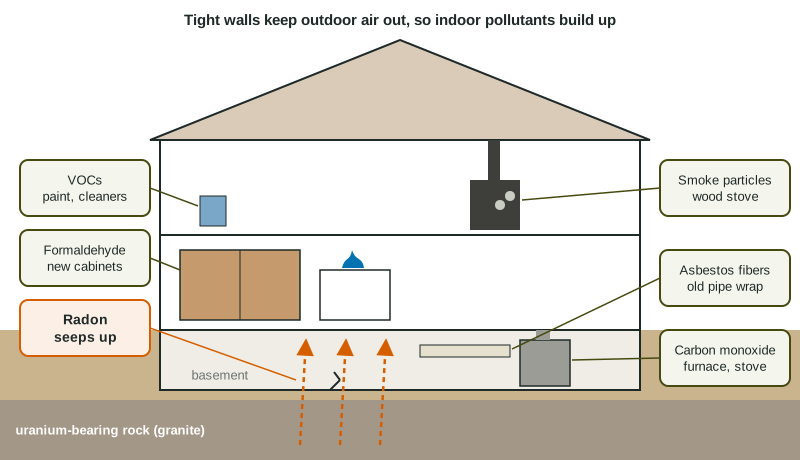
Indoor air pollutants include radon from uranium in rock, formaldehyde and other VOCs off-gassed by new materials, carbon monoxide from poorly burning stoves and furnaces, asbestos fibers from disturbed old insulation, and smoke from cooking over open fires.
Part 1 · Hook
Why this matters
Part 2 · Before you start
What this builds on
Part 3 · Prerequisite check
Quick check before you start
1. Which gas from incomplete burning keeps blood from carrying oxygen?
- Carbon monoxide
- Carbon dioxide
- Sulfur dioxide
- Ozone
Show the answer
CO binds hemoglobin, so the blood carries less oxygen.
- Correct: Carbon monoxide:
- Carbon dioxide:
- Sulfur dioxide:
- Ozone:
2. What happens to a radioactive element over time?
- It decays and gives off radiation
- It turns into water
- It grows heavier
- It stays exactly the same
Show the answer
Radioactive isotopes decay, giving off radiation and forming other elements.
- Correct: It decays and gives off radiation:
- It turns into water:
- It grows heavier:
- It stays exactly the same:
Part 4 · See it
See it first
Part 5 · Step by step
How it works, step by step
- Homes are sealed tightly to save energyless outdoor air comes in to dilute indoor pollutants
- Sources inside the home release pollutants: soil gas, new materials, stoves and old insulationradon, formaldehyde and other VOCs, carbon monoxide and asbestos fibers build up indoors
- People spend most of their time indoors breathing that airexposure is long and steady
- Each pollutant harms the body in its own waylung cancer from radon and asbestos, poisoning from CO, irritation and sick building syndrome from VOCs
Part 6 · Key ideas
Key ideas
- Radon is a radioactive gas from uranium decaying in rock and soil. It seeps through foundation cracks and is a leading cause of lung cancer. Test, then vent soil gas outside.
- Formaldehyde and other VOCs off-gas from pressed wood, glues, carpets and paints, most strongly when new. Asbestos is dangerous when old insulation or tiles are disturbed.
- Carbon monoxide comes from stoves, furnaces and generators that burn fuel incompletely; detectors save lives. Smoke from indoor cooking fires harms the most people worldwide.
- Sick building syndrome: symptoms that ease when people leave a poorly ventilated building. Ventilation and source control are the main fixes.
Part 7 · Misconception
A common mistake
The wrong idea: Air pollution is an outdoor problem, so staying indoors keeps you safe.
What actually happens: Indoor air can be more polluted than outdoor air. Radon, VOCs, CO and smoke from indoor stoves build up inside, especially in tight buildings with little ventilation.
Part 8 · Check yourself
Check yourself
Exam-style questions. Anything you miss goes into your review queue.
1. What is the source of radon in homes?
- Gas stoves that burn their fuel poorly and give off fumes
- Glues and resins in new pressed-wood furniture
- Old insulation that crumbles into fibers
- Uranium decaying in the rock and soil under the home
Show the answer
Radon is a radioactive gas made when uranium in rock and soil decays. It seeps up through cracks in foundations.
- Gas stoves that burn their fuel poorly and give off fumes: Poorly burning stoves make carbon monoxide, not radon.
- Glues and resins in new pressed-wood furniture: Pressed wood gives off formaldehyde, not radon.
- Old insulation that crumbles into fibers: Crumbling insulation can release asbestos fibers, not radon.
- Correct: Uranium decaying in the rock and soil under the home: Right: radon forms from uranium decay and seeps up.
2. Why is radon a health concern even though it cannot be seen or smelled?
- It binds to hemoglobin and blocks oxygen in the blood
- It reacts in sunlight to make ozone near the ground
- Its radiation damages lung cells and can cause cancer
- It dissolves in tap water and makes the water acidic
Show the answer
Radon and its decay products give off radiation inside the lungs when breathed in. Over years this damages lung cells, and radon is a leading cause of lung cancer after smoking.
- It binds to hemoglobin and blocks oxygen in the blood: That describes carbon monoxide, not radon.
- It reacts in sunlight to make ozone near the ground: Radon is unreactive; it does not form ozone.
- Correct: Its radiation damages lung cells and can cause cancer: Right: it is a leading cause of lung cancer after smoking.
- It dissolves in tap water and makes the water acidic: Radon does not make water acidic; it is a radioactive noble gas.
Data
Radon tests in the basements of five homes
| Home | Bedrock under the home | Radon before (pCi/L) | Radon after a fan system (pCi/L) |
|---|---|---|---|
| 1 | granite | 12.0 | 1.8 |
| 2 | granite | 8.5 | 1.2 |
| 3 | shale with uranium | 6.4 | 1.6 |
| 4 | limestone | 2.1 | no fix needed |
| 5 | sandstone | 1.3 | no fix needed |
3. Which homes in the table should be fixed according to the EPA's 4 pCi/L action level?
- Homes 1 and 2, on granite
- Homes 1, 2 and 3
- The homes on limestone and sandstone
- Home 1, with the highest radon
Show the answer
Homes 1 (12.0), 2 (8.5) and 3 (6.4) are at or above 4 pCi/L; the homes on limestone (2.1) and sandstone (1.3) are below it.
- Homes 1 and 2, on granite: Home 3, on uranium-bearing shale, is also above 4 pCi/L.
- Correct: Homes 1, 2 and 3: Right: all three are above 4 pCi/L before the fix.
- The homes on limestone and sandstone: Those two homes are below the action level, so they need no fix.
- Home 1, with the highest radon: Homes 2 and 3 are also above the action level.
4. What pattern links the bedrock to the radon level?
- Homes on uranium-rich rock have more radon
- Homes on limestone have the most radon in the table
- Radon is about the same whatever the bedrock
- Homes on sandstone have the most radon in the table
Show the answer
Radon comes from the decay of uranium in rock. Homes on granite and uranium-bearing shale have the most radon; limestone and sandstone, with little uranium, have the least.
- Correct: Homes on uranium-rich rock have more radon: Right: radon forms when uranium in rock decays.
- Homes on limestone have the most radon in the table: Home 4, on limestone, is second lowest at 2.1 pCi/L.
- Radon is about the same whatever the bedrock: Radon varies from 1.3 to 12.0 pCi/L, and it tracks the rock.
- Homes on sandstone have the most radon in the table: Home 5, on sandstone, has the least radon, 1.3 pCi/L.
5. Find the percent change in radon in home 1 after the fan system was installed.
Type a number, then its unit (%). Scale words (2.5 million) and powers of ten (2.5 × 10^6) are read.
Show the answer
- Answer: -85 %
6. The fan system pipes air from under the basement floor to above the roof. How does it lower radon indoors?
- It filters radioactive dust out of the air in each room
- It heats the basement so radon breaks down faster
- It traps radon in the water that comes out of the taps
- It vents soil gas outdoors before it can enter
Show the answer
Radon seeps up from the soil through cracks in the foundation. The fan pulls the soil gas out from under the slab and vents it outside before it can enter the house.
- It filters radioactive dust out of the air in each room: Radon is a gas; the system removes it from the soil, not with room filters.
- It heats the basement so radon breaks down faster: Heat does not speed radioactive decay.
- It traps radon in the water that comes out of the taps: The system works on soil gas under the floor, not on the water supply.
- Correct: It vents soil gas outdoors before it can enter: Right: the gas is removed at its source, under the floor.
7. In many developing countries, the indoor air pollutant that harms the most people comes from which source?
- Radon seeping from granite under modern homes
- Smoke from cooking over indoor fires
- Formaldehyde from new office furniture
- Asbestos in new insulation in suburban houses
Show the answer
Cooking and heating over open fires or simple stoves with wood, charcoal, dung or crop waste fills homes with smoke particles and carbon monoxide.
- Radon seeping from granite under modern homes: Radon matters, but smoke from indoor cooking fires harms far more people.
- Correct: Smoke from cooking over indoor fires: Right: the smoke gives high levels of particles and CO.
- Formaldehyde from new office furniture: Formaldehyde matters in new buildings but not on this scale.
- Asbestos in new insulation in suburban houses: Asbestos is mostly in old buildings and is not the largest global risk.
Part 9 · Summary
Summary
Part 10 · Up next
What comes next
Part 11 · Connections