Solids, Liquids, and Gases
Solids, liquids and gases differ in how close their particles are and how they move.
Part 1 · Hook
Why this matters
Part 2 · Before you start
What this builds on
Part 3 · Prerequisite check
Quick check before you start
1. Which attraction is overcome when liquid water boils?
- Hydrogen bonds between molecules
- O–H covalent bonds
- Ionic bonds
Show the answer
Boiling separates whole molecules; the covalent bonds inside them stay intact.
- Correct: Hydrogen bonds between molecules:
- O–H covalent bonds:
- Ionic bonds:
2. Ice is which kind of solid?
- Molecular
- Covalent network
- Ionic
Show the answer
Ice is separate H₂O molecules held by hydrogen bonds.
- Correct: Molecular:
- Covalent network:
- Ionic:
Part 4 · See it
See it first
Part 5 · Step by step
How it works, step by step
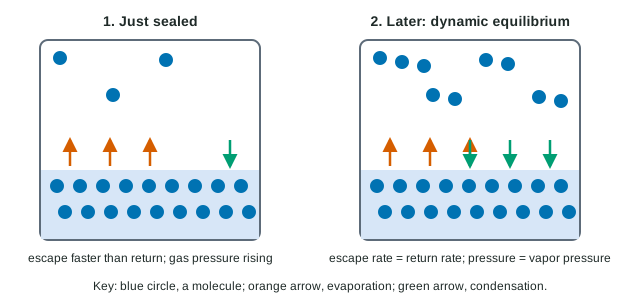
- Molecules in a liquid move at a range of speedssome at the surface escape their neighbors' attractions, at any temperature
- In a sealed container the escaped molecules stay and some returnescape and return reach equal rates: a dynamic equilibrium
- At equilibrium the number of gas molecules is constantthe vapor exerts a steady pressure, the vapor pressure
- Weaker attractions or a higher temperature let more molecules escapevapor pressure is higher
- Boiling happens when vapor pressure reaches the outside pressurelower air pressure means a lower boiling point
Part 6 · Key ideas
Key ideas
- Solid: touching, fixed, vibrating. Liquid: touching, sliding. Gas: far apart, flying freely.
- Phase changes overcome or form attractions between particles; molecules stay whole.
- 1 atm = 760 torr = 760 mm Hg = 101.325 kPa.
- Every liquid has a vapor pressure at every temperature. It rises with temperature and is higher when intermolecular forces are weaker.
Part 7 · Misconception
A common mistake
The wrong idea: A liquid has no vapor pressure until it reaches its boiling point.
What actually happens: Some molecules escape at any temperature, so a liquid always has a vapor pressure. At the boiling point the vapor pressure has risen to equal the outside pressure.
Part 8 · Check yourself
Check yourself
Exam-style questions. Anything you miss goes into your review queue.
Graph
Vapor pressure of three liquids
Measured vapor pressures of diethyl ether, ethanol and water at several temperatures. 760 torr is 1 atm.
Diethyl etherEthanolWater
Data table
| Temperature (°C) | Diethyl ether | Ethanol | Water |
|---|---|---|---|
| 0 | 185 | 12 | 4.6 |
| 10 | 292 | — | — |
| 20 | 442 | 44 | 17.5 |
| 30 | 647 | — | — |
| 34.6 | 760 | — | — |
| 40 | — | 134 | 55.3 |
| 60 | — | 353 | 149 |
| 78.4 | — | 760 | — |
| 80 | — | — | 355 |
| 100 | — | — | 760 |
1. Which liquid has the strongest intermolecular forces?
- Diethyl ether
- Ethanol
- Water
- The three are about equal
Show the answer
At every temperature water has the lowest vapor pressure, so the fewest molecules escape: its molecules attract each other most strongly.
- Diethyl ether: Ether has the highest vapor pressure, so its attractions are the weakest of the three.
- Ethanol: Ethanol's vapor pressure is higher than water's at every temperature shown, so its attractions are weaker.
- Correct: Water: Right: lowest vapor pressure at every temperature.
- The three are about equal: The three curves are far apart, so the attractions clearly differ.
2. On a mountain the air pressure is 355 torr. At about what temperature would water boil there?
- 60 °C
- 80 °C
- 100 °C
- 120 °C
Show the answer
A liquid boils when its vapor pressure equals the pressure above it. Water's vapor pressure reaches 355 torr at 80 °C.
- 60 °C: At 60 °C water's vapor pressure is 149 torr, still below 355 torr.
- Correct: 80 °C: Right: the vapor pressure equals the 355 torr air pressure at 80 °C.
- 100 °C: 100 °C is the boiling point at 760 torr, sea-level pressure.
- 120 °C: Lower air pressure lowers the boiling point; it does not raise it.
3. Which statement best explains why ethanol's vapor pressure is higher than water's at 40 °C?
- Ethanol molecules attract each other less strongly, so more of them escape the surface.
- Ethanol molecules are heavier than water molecules, so they move faster and escape.
- Ethanol has no hydrogen bonds, while water has strong ones between its molecules.
- Ethanol's covalent bonds break at a lower temperature, producing more gas particles.
Show the answer
Both liquids hydrogen-bond, but water forms more hydrogen bonds per molecule (two H on O and two lone pairs) than ethanol (one H on O). Weaker overall attractions let more ethanol molecules escape, so its vapor pressure is higher.
- Correct: Ethanol molecules attract each other less strongly, so more of them escape the surface.: Right: weaker attractions, more escape, higher vapor pressure.
- Ethanol molecules are heavier than water molecules, so they move faster and escape.: Heavier molecules at the same temperature move more slowly, not faster; and mass is not the cause here.
- Ethanol has no hydrogen bonds, while water has strong ones between its molecules.: Ethanol has an O–H group, so it does hydrogen-bond; it just forms fewer per molecule than water.
- Ethanol's covalent bonds break at a lower temperature, producing more gas particles.: Evaporation leaves molecules whole; no covalent bonds break.
4. A barometer reads 742 torr. What is this pressure in atmospheres?
Type a number and its unit.
Show the answer
742 torr × (1 atm / 760 torr) = 0.97632 atm, which is 0.976 atm to three significant figures.
- Answer: 0.976 atm
5. Water sits in a sealed flask at 25 °C with liquid and vapor at equilibrium. Predict how the vapor pressure changes after each change, once equilibrium is restored.
| Variable | Change |
|---|---|
| Raise the temperature to 40 °C | — |
| Add more liquid water at 25 °C | — |
| Move all of it, still at 25 °C, into a larger sealed flask with liquid left over | — |
Show the answer
Only temperature (and the identity of the liquid) changes a vapor pressure. The amount of liquid and the container size do not, as long as some liquid remains.
- Raise the temperature to 40 °C: increases. More molecules move fast enough to escape, so more are in the gas at equilibrium: 23.8 torr at 25 °C rises to 55.3 torr at 40 °C.
- Add more liquid water at 25 °C: no change. Vapor pressure depends on the liquid and the temperature, not on the amount of liquid. Escape and return balance at the same gas pressure.
- Move all of it, still at 25 °C, into a larger sealed flask with liquid left over: no change. More water evaporates to fill the larger space, but at equilibrium the pressure of the vapor returns to the same value at the same temperature.
6. A student says, "Water at 25 °C has no vapor pressure because it is below its boiling point." Which is the best correction?
- Some surface molecules escape at any temperature; water's vapor pressure at 25 °C is 23.8 torr.
- Water has a vapor pressure at 25 °C once it has first been heated to 100 °C and then cooled back down.
- The statement is correct; evaporation below the boiling point comes from dissolved air, not from water.
- Water at 25 °C has a vapor pressure of 760 torr, the same as at its boiling point.
Show the answer
Molecules in a liquid have a range of speeds. At any temperature, some at the surface can escape, so every liquid has a vapor pressure. Boiling only requires that this vapor pressure reach the outside pressure.
- Correct: Some surface molecules escape at any temperature; water's vapor pressure at 25 °C is 23.8 torr.: Right: liquids have a vapor pressure at every temperature.
- Water has a vapor pressure at 25 °C once it has first been heated to 100 °C and then cooled back down.: A liquid's vapor pressure depends only on its present temperature, not its history.
- The statement is correct; evaporation below the boiling point comes from dissolved air, not from water.: Puddles dry at room temperature because water molecules themselves escape.
- Water at 25 °C has a vapor pressure of 760 torr, the same as at its boiling point.: 760 torr is the vapor pressure only at the normal boiling point, 100 °C.
Part 9 · Summary
Summary
Part 10 · Up next
What comes next
Part 11 · Connections