Ideal Gas Law
The ideal gas law, PV = nRT, links pressure, volume, kelvin temperature and moles of a gas; R must match the units.
Part 1 · Hook
Why this matters
Part 2 · Before you start
What this builds on
Part 3 · Prerequisite check
Quick check before you start
1. What is 25 °C in kelvin?
- 298.15 K
- 248.15 K
- 25 K
Show the answer
K = °C + 273.15.
- Correct: 298.15 K:
- 248.15 K:
- 25 K:
2. How many torr are in 1 atm?
- 760
- 101.325
- 1,000
Show the answer
1 atm = 760 torr = 101.325 kPa.
- Correct: 760:
- 101.325:
- 1,000:
3. How many moles are in 8.00 g of O₂ (32.00 g/mol)?
- 0.250 mol
- 4.00 mol
- 256 mol
Show the answer
8.00 g ÷ 32.00 g/mol = 0.250 mol.
- Correct: 0.250 mol:
- 4.00 mol:
- 256 mol:
Part 4 · See it
See it first
Part 5 · Step by step
How it works, step by step
- Gas pressure comes from particles hitting the wallsmore particles (n) or faster particles (higher T) raise the pressure
- Squeezing the same particles into less volume makes them hit the walls more oftenpressure and volume are inversely proportional at fixed n and T
- These proportions combine into PV = nRTknowing three variables gives the fourth, with T in kelvin and R matched to the units
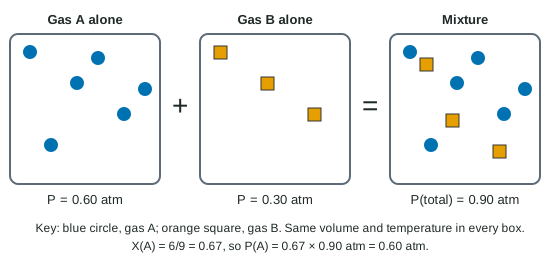
- Each gas in a mixture hits the walls independentlypartial pressures add, and each equals its mole fraction times the total
Part 6 · Key ideas
Key ideas
- PV = nRT. T in kelvin; with atm and L, R = 0.08206 L·atm/(mol·K).
- For one sample under new conditions: P₁V₁/T₁ = P₂V₂/T₂.
- At STP (0 °C, 1 atm) one mole of gas fills 22.4 L. Molar mass from gas data: M = mRT/PV = dRT/P.
- P(total) = P(A) + P(B) + …; P(A) = X(A) × P(total).
Part 7 · Misconception
A common mistake
The wrong idea: Doubling the temperature from 20 °C to 40 °C doubles the pressure of a sealed gas.
What actually happens: Pressure is proportional to kelvin temperature. 20 °C to 40 °C is 293.15 K to 313.15 K, a rise of only about 7%.
Part 8 · Check yourself
Check yourself
Exam-style questions. Anything you miss goes into your review queue.
Data table
Molar mass of a volatile liquid
A student puts a few milliliters of an unknown liquid in a flask, covers it with foil pierced by a pinhole, and heats it in boiling water until all the liquid has vaporized and the excess has escaped. The flask, now full of the vapor at the bath temperature and room pressure, is cooled and weighed. The vapor condenses, and its mass is found by difference.
| Quantity | Value |
|---|---|
| Volume of flask | 248.0 mL |
| Temperature of water bath | 98.6 °C |
| Barometric pressure | 742.0 torr |
| Mass of condensed vapor | 0.4625 g |
1. How many moles of vapor filled the flask?
Type a number and its unit.
Show the answer
T = 98.6 + 273.15 = 371.75 K; P = 742.0 torr × (1 atm / 760 torr) = 0.97632 atm; V = 0.2480 L. n = PV/RT = (0.97632 atm × 0.2480 L) / (0.08206 L·atm/(mol·K) × 371.75 K) = 0.0079371 mol, which is 0.007937 mol. (98.6 °C is known to the tenths place, so the sum is 371.8 K, four significant figures; report four.)
- Answer: 0.007937 mol
2. What is the molar mass of the unknown liquid, in g/mol?
Type a number in g/mol.
Show the answer
M = mass / moles = 0.4625 g / 0.007937 mol = 58.271 g/mol, which is 58.27 g/mol to four significant figures.
- Answer: 58.27 g/mol
Experimental setup
A three-gas mixture
A rigid 4.00 L container at 27.0 °C holds 0.150 mol N₂, 0.0400 mol O₂ and 0.0100 mol Ar. The gases do not react.
3. What is the total pressure in the container, in atm?
Type a number and its unit.
Show the answer
Total moles = 0.150 + 0.0400 + 0.0100 = 0.200 mol; T = 300.15 K. P = nRT/V = (0.200 mol × 0.08206 L·atm/(mol·K) × 300.15 K) / 4.00 L = 1.23152 atm, which is 1.23 atm.
- Answer: 1.23 atm
4. What is the partial pressure of O₂, in atm?
Type a number and its unit.
Show the answer
X(O₂) = 0.0400 / 0.200 = 0.200. P(O₂) = 0.200 × 1.2315 atm = 0.24630 atm, which is 0.246 atm. (Or P = nRT/V with 0.0400 mol.)
- Answer: 0.246 atm
5. A 2.50 L sample of gas at 1.00 atm and 25.0 °C is compressed and heated to 3.20 atm and 75.0 °C. What is its new volume?
Type a number and its unit.
Show the answer
V₂ = V₁ × (P₁/P₂) × (T₂/T₁) = 2.50 L × (1.00/3.20) × (348.15 K / 298.15 K) = 0.91227 L, which is 0.912 L.
- Answer: 0.912 L
6. A gas has a density of 1.96 g/L at 0.0 °C and 1.00 atm. What is its molar mass?
Type a number and its unit.
Show the answer
M = dRT/P = (1.96 g/L × 0.08206 L·atm/(mol·K) × 273.15 K) / 1.00 atm = 43.933 g/mol, which is 43.9 g/mol (CO₂ is 44.01 g/mol).
- Answer: 43.9 g/mol
7. Equal volumes of H₂ and CO₂ are at the same temperature and pressure. Which statement is true?
- They contain equal numbers of molecules, but the CO₂ sample has the greater mass.
- They have equal masses, but the H₂ sample contains more molecules.
- The CO₂ sample contains more molecules, because CO₂ molecules are larger.
- They contain equal masses and equal numbers of molecules.
Show the answer
With P, V and T equal, n = PV/RT is equal, so the numbers of molecules match. Each CO₂ molecule (44.01 g/mol) is heavier than each H₂ molecule (2.016 g/mol), so the CO₂ sample has more mass.
- Correct: They contain equal numbers of molecules, but the CO₂ sample has the greater mass.: Right: same n, different molar masses.
- They have equal masses, but the H₂ sample contains more molecules.: Equal n means equal numbers of molecules, and different molar masses mean different masses.
- The CO₂ sample contains more molecules, because CO₂ molecules are larger.: For an ideal gas the size of the molecules does not affect how many fit in a volume.
- They contain equal masses and equal numbers of molecules.: The numbers match, but the masses differ by a factor of about 22.
Part 9 · Summary
Summary
Part 10 · Up next
What comes next
Part 11 · Connections