Elementary Reactions
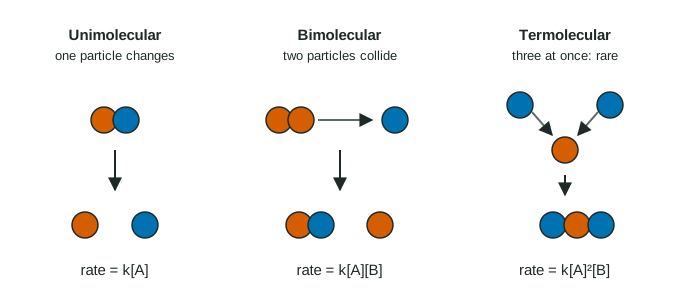
An elementary reaction happens in a single event, so its rate law follows from its coefficients and its molecularity is the number of particles in that event.
Part 1 · Hook
Why this matters
Part 2 · Before you start
What this builds on
Part 3 · Prerequisite check
Quick check before you start
1. A reaction has rate = k[A][B]. If [A] doubles and [B] is unchanged, the rate:
- doubles
- is unchanged
- quadruples
- halves
Show the answer
The rate is first order in A, so it changes by the same factor as [A].
- Correct: doubles:
- is unchanged:
- quadruples:
- halves:
2. Why do orders in a rate law have to be measured for an overall reaction?
- They need not match the coefficients of the balanced equation
- Concentrations cannot be calculated
- The rate constant changes with concentration
- Rates can only be measured for gases
Show the answer
The overall equation shows totals, not how the rate depends on each concentration.
- Correct: They need not match the coefficients of the balanced equation:
- Concentrations cannot be calculated:
- The rate constant changes with concentration:
- Rates can only be measured for gases:
Part 4 · See it
See it first
Part 5 · Step by step
How it works, step by step
- An elementary step happens in a single collision or eventits rate depends on how often those exact particles meet
- Doubling the number of one kind of particle doubles its collisionseach particle in the step contributes one power of its concentration
- So the coefficients of an elementary step are its ordersyou can write its rate law without an experiment
- An overall equation is usually several stepsits rate law must still come from data
Part 6 · Key ideas
Key ideas
- An elementary reaction is one event: a single collision or one particle breaking apart.
- The rate law of an elementary step uses its coefficients as orders: 2 A + B → products has rate = k[A]²[B].
- Molecularity: unimolecular (1), bimolecular (2, most common), termolecular (3, rare).
- Only elementary steps follow this rule. Overall rate laws are measured.
Part 7 · Misconception
A common mistake
The wrong idea: Any balanced equation's coefficients give its rate law.
What actually happens: Only an elementary step's coefficients give its rate law. Most overall equations happen in several steps, so their rate laws must be measured.
Part 8 · Check yourself
Check yourself
Exam-style questions. Anything you miss goes into your review queue.
Particle view
Three boxes of the same gas mixture
The elementary reaction A + B → AB happens in one collision between an A molecule and a B molecule. Three identical containers at the same temperature hold the mixtures shown.
Key: dark filled circle, a molecule of A; light ringed circle, a molecule of B.
1. What is the rate law for this elementary step?
- rate = k[A][B]
- rate = k[AB]
- rate = k[A]²
- rate = k[A] + k[B]
Show the answer
For an elementary step the rate law comes straight from the step: one A and one B collide, so rate = k[A][B].
- Correct: rate = k[A][B]: Right: first order in each of the two colliding reactants.
- rate = k[AB]: AB is the product; a rate law uses the reactants.
- rate = k[A]²: That would describe two A molecules colliding.
- rate = k[A] + k[B]: Rate laws multiply concentrations; they are not sums.
2. How does the initial rate in Box 2 compare with Box 1?
- Half as fast
- The same
- Twice as fast
- Four times as fast
Show the answer
Box 2 has twice as many A molecules and the same number of B. With rate = k[A][B], doubling [A] doubles the rate: there are twice as many possible A–B pairs to collide.
- Half as fast: Box 2 has more molecules, not fewer.
- The same: More A molecules means more A–B collisions per second.
- Correct: Twice as fast: Right: [A] doubles, [B] stays the same.
- Four times as fast: Four times would need both [A] and [B] doubled, as in Box 3.
3. How does the initial rate in Box 3 compare with Box 1?
- The same
- Twice as fast
- Four times as fast
- Eight times as fast
Show the answer
Both [A] and [B] double: rate × 2 × 2 = 4. Box 1 has 2 × 2 = 4 possible A–B pairs; Box 3 has 4 × 4 = 16.
- The same: More molecules of both kinds means more collisions.
- Twice as fast: That counts only the doubling of one reactant.
- Correct: Four times as fast: Right: 2 × 2 = 4.
- Eight times as fast: That would be a third-order step.
Model
Four elementary steps
Each equation below is an elementary step, one single event at the particle level:
- O₃ → O₂ + O
- NO + O₃ → NO₂ + O₂
- 2 NO₂ → NO₃ + NO
- 2 NO + O₂ → 2 NO₂
4. What is the rate law for step 3, 2 NO₂ → NO₃ + NO?
- rate = k[NO₂]²
- rate = k[NO₂]
- rate = k[NO₃][NO]
- rate = 2k[NO₂]
Show the answer
Two NO₂ molecules collide in this step, so the rate is proportional to [NO₂] × [NO₂] = [NO₂]².
- Correct: rate = k[NO₂]²: Right: the coefficient 2 becomes the exponent for an elementary step.
- rate = k[NO₂]: That would be a single NO₂ falling apart.
- rate = k[NO₃][NO]: Those are the products; a forward rate law uses reactants.
- rate = 2k[NO₂]: The coefficient goes in the exponent, not in front of k.
5. Which step is termolecular?
- Step 1
- Step 2
- Step 3
- Step 4
Show the answer
Step 4 needs two NO molecules and one O₂ to meet at once: three particles.
- Step 1: Step 1 is one O₃ breaking apart: unimolecular.
- Step 2: Step 2 is NO meeting O₃: bimolecular.
- Step 3: Step 3 is two NO₂ meeting: bimolecular.
- Correct: Step 4: Right: 2 NO + O₂ is three particles.
6. The overall reaction 2 H₂ + 2 NO → N₂ + 2 H₂O has the measured rate law rate = k[H₂][NO]². What can you conclude?
- It is not one step: the orders differ from the coefficients
- The reaction is a single step in which four molecules collide at once
- The measured rate law is wrong, since the order in H₂ should be 2
- Rate laws for overall reactions follow their coefficients
Show the answer
If the overall equation were one elementary step, the rate law would be k[H₂]²[NO]². The measured order in H₂ is 1, so the reaction happens in more than one step (a mechanism, topic 5.7).
- Correct: It is not one step: the orders differ from the coefficients: Right: an elementary rate law follows its coefficients, and this one does not.
- The reaction is a single step in which four molecules collide at once: Four particles meeting at once is essentially impossible; the data also rule it out.
- The measured rate law is wrong, since the order in H₂ should be 2: Measured orders are the facts; it is the "single step" idea that fails.
- Rate laws for overall reactions follow their coefficients: This is the misconception: only elementary steps follow their coefficients.
Part 9 · Summary
Summary
Part 10 · Up next
What comes next
Part 11 · Connections