Skills Beta

Functions and Their Graphs

A function sends each input to one output.

Practice 2: Connecting Representations

Question set for this topic

Part 1 · Hook

Why this matters

Every question in calculus is a question about a function: how fast a tank fills, where a ball is at time tt, how much a quantity has piled up. Before calculus asks how a function changes, you need to read one fluently, from its formula, its graph, a table or a sentence. This page is a fast, friendly tune-up of the function skills the course leans on most.

Part 2 · See it

See it first

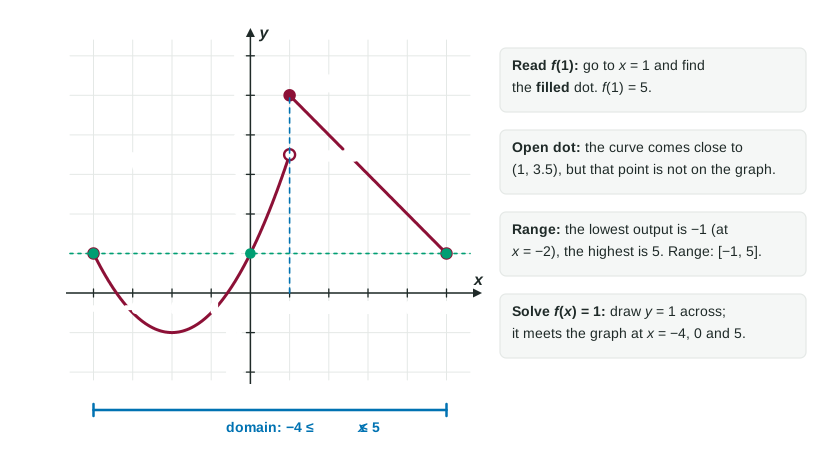
Graph of a piecewise function f from x = -4 to x = 5: a parabola piece from the filled point (-4, 1) down to (-2, -1) and up toward an open circle at (1, 3.5), then a line from the filled point (1, 5) down to the filled point (5, 1). Notes beside it: f(1) = 5 is the filled dot; the open circle is not on the graph; the range is from -1 to 5; the line y = 2 meets the graph at x = 0 and x = 4.
Reading a graph: f(1)f(1) is the height of the filled dot, an open circle is a point left out, and the domain and range come from the graph's left-right and up-down extent. LevlPrep original diagram.

Part 3 · Step by step

How it works, step by step

  1. A function assigns exactly one output to each inputf(3)f(3) names one number: the height of the graph above x=3x = 3
  2. Some inputs break a formula (a zero denominator, the square root of a negative)those inputs are left out of the domain
  3. Feeding one function's output into another builds a composite functionf(g(x))f(g(x)) means: do gg first, then ff
  4. Replacing xx by x−hx - h and adding kk to the outputmoves the whole graph hh units right and kk units up

Part 4 · Key ideas

Key ideas

  • A function gives one output for each input. Substitute with parentheses: if f(x)=x2−3xf(x) = x^2 - 3x, then f(a+1)f(a + 1)=(a+1)2−3(a+1)= (a + 1)^2 - 3(a + 1).
  • The domain is every input the rule accepts; the range is every output it produces. Rule out zero denominators and square roots of negatives.
  • On a graph, a filled dot is on the graph and an open circle is not. f(a)f(a) is the height of the graph at x=ax = a.
  • A line through (x1,y1)(x_1, y_1) with slope mm is y−y1=m(x−x1)y - y_1 = m(x - x_1) (point-slope form). Slope is rise over run.
  • f(g(x))f(g(x)) means gg first, then ff. Order matters: usually f(g(x))≠g(f(x))f(g(x)) \ne g(f(x)).
  • A rational function has a vertical asymptote where the denominator is 0 and the numerator is not.

Part 5 · Misconception

A common mistake

The wrong idea: f(g(x))f(g(x)) means f(x)f(x) times g(x)g(x).

What actually happens: f(g(x))f(g(x)) is a composition: the output of gg becomes the input of ff. With f(x)=x2f(x) = x^2 and g(x)=x+1g(x) = x + 1, f(g(x))=(x+1)2f(g(x)) = (x + 1)^2, while f(x)g(x)=x2(x+1)f(x)g(x) = x^2(x + 1).

Part 6 · Check yourself

Check yourself

Exam-style questions. Anything you miss goes into your review queue.

Graph

The graph of gg

The function gg is defined on −3≤x≤4-3 \le x \le 4. Its graph is a line segment from (−3,2)(-3, 2) toward an open circle at (1,−2)(1, -2), then a curved piece from the filled point (1,2)(1, 2) through (3,0)(3, 0) to (4,0.5)(4, 0.5).
−3−2−11234−3−2−1123xyg

1. What is g(1)g(1)?

  1. 22
  2. −2-2
  3. 00
  4. g(1)g(1) is not defined
Show the answer

At x=1x = 1 the filled dot is at height 2, so g(1)=2g(1) = 2. The open circle at (1,−2)(1, -2) marks a point that is not on the graph.

  • Correct: 22: The filled dot at x=1x = 1 sits at height 2.
  • −2-2: That height belongs to the open circle, which is not part of the graph.
  • 00: The curved piece reaches 0 at x=3x = 3, not at x=1x = 1.
  • g(1)g(1) is not defined: There is a filled dot at x=1x = 1, so g(1)g(1) is defined.

2. What is the range of gg?

  1. −2<y≤2-2 < y \le 2
  2. −2≤y≤2-2 \le y \le 2
  3. 0≤y≤20 \le y \le 2
  4. −3≤y≤4-3 \le y \le 4
Show the answer

The line takes every height from 2 down toward −2-2, but −2-2 itself is the open circle, so it is left out. The curve's heights, from 0 to 2, are already inside. Range: −2<y≤2-2 < y \le 2.

  • Correct: −2<y≤2-2 < y \le 2: The line covers (−2,2](-2, 2]; the curve's heights [0,2][0, 2] add nothing new.
  • −2≤y≤2-2 \le y \le 2: The height −2-2 occurs only at the open circle, which is not on the graph.
  • 0≤y≤20 \le y \le 2: The line piece also gives every negative height down toward −2-2.
  • −3≤y≤4-3 \le y \le 4: Those are the domain's endpoints; the range is about outputs (heights).

3. What is g(g(4))g(g(4))?

  1. −1.5-1.5
  2. 0.50.5
  3. 0.250.25
  4. 3.1253.125
Show the answer

Work from the inside out. g(4)=0.5g(4) = 0.5. Then g(0.5)g(0.5) uses the line, because 0.5<10.5 < 1: g(0.5)=−0.5−1=−1.5g(0.5) = -0.5 - 1 = -1.5.

  • Correct: −1.5-1.5: g(4)=0.5g(4) = 0.5, and g(0.5)=−0.5−1=−1.5g(0.5) = -0.5 - 1 = -1.5 on the line.
  • 0.50.5: That is only the inside step, g(4)g(4). Feed 0.5 back into gg.
  • 0.250.25: That is g(4)⋅g(4)g(4) \cdot g(4). A composition feeds one output into the function again; it does not multiply.
  • 3.1253.125: That uses the curved piece's formula at x=0.5x = 0.5, but the curve only covers 1≤x≤41 \le x \le 4.

4. Let f(x)=x2+1f(x) = x^2 + 1 and g(x)=2x−3g(x) = 2x - 3. Find f(g(x))f(g(x)).

Type an expression for f(g(x))=f(g(x)) =.

Show the answer

Replace xx in ff by (2x−3)(2x - 3): f(g(x))=(2x−3)2+1f(g(x)) = (2x - 3)^2 + 1, which expands to 4x2−12x+104x^2 - 12x + 10. Either form is right.

  • Answer: f(g(x))=f(g(x)) = (2x−3)2+1(2x - 3)^{2} + 1

5. Find an equation of the line through (−1,5)(-1, 5) and (3,−3)(3, -3). Write yy in terms of xx.

Type an expression for y=y =.

Show the answer

Slope: mm=−3−53−(−1)= \frac{-3 - 5}{3 - (-1)}=−2= -2. Point-slope form with (−1,5)(-1, 5): y−5=−2(x+1)y - 5 = -2(x + 1), so y=−2x+3y = -2x + 3. Check with (3,−3)(3, -3): −6+3=−3-6 + 3 = -3.

  • Answer: y=y = −2x+3-2 x + 3

6. The graph of y=|x|y = |x| is moved 3 units left and 2 units down. Which equation describes the new graph?

  1. y=|x+3|−2y = |x + 3| - 2
  2. y=|x−3|−2y = |x - 3| - 2
  3. y=|x+3|+2y = |x + 3| + 2
  4. y=|x−2|+3y = |x - 2| + 3
Show the answer

Replacing xx by x+3x + 3 moves a graph 3 units left; subtracting 2 outside moves it 2 units down. The point of the V moves from (0,0)(0, 0) to (−3,−2)(-3, -2).

  • Correct: y=|x+3|−2y = |x + 3| - 2: Left 3 is x+3x + 3 inside; down 2 is −2-2 outside.
  • y=|x−3|−2y = |x - 3| - 2: x−3x - 3 inside moves the graph right, not left.
  • y=|x+3|+2y = |x + 3| + 2: +2+2 outside moves the graph up, not down.
  • y=|x−2|+3y = |x - 2| + 3: This mixes up which number goes inside and the directions: it moves the graph right 2 and up 3.

7. Let f(x)f(x)={x2x<23x−1x≥2= \begin{cases} x^2 & x < 2 \\ 3x - 1 & x \ge 2 \end{cases}. What is f(2)+f(−1)f(2) + f(-1)?

  1. 66
  2. 55
  3. 11
  4. 44
Show the answer

x=2x = 2 satisfies x≥2x \ge 2, so f(2)=3(2)−1=5f(2) = 3(2) - 1 = 5. x=−1x = -1 satisfies x<2x < 2, so f(−1)=(−1)2=1f(-1) = (-1)^2 = 1. The sum is 6.

  • Correct: 66: f(2)=5f(2) = 5 from the second piece and f(−1)=1f(-1) = 1 from the first.
  • 55: That uses x2x^2 at x=2x = 2, giving 4+14 + 1. The boundary point 2 belongs to the piece with x≥2x \ge 2.
  • 11: That uses 3x−13x - 1 at x=−1x = -1, giving 5+(−4)5 + (-4). Since −1<2-1 < 2, use x2x^2.
  • 44: (−1)2=1(-1)^2 = 1, not −1-1: the parentheses keep the sign inside the square.

Part 7 · Summary

Summary

A function sends each input to one output. Read it from a formula (substitute with parentheses), a graph (heights, filled and open dots) or a table. Know the domain, write lines in point-slope form, compose functions inside first, move graphs with f(x−h)+kf(x - h) + k, and find vertical asymptotes where a denominator is 0.

Part 8 · Up next

What comes next

Part 9 · Connections

Connections