Skills Beta
Exponent Rules and Rewriting Powers
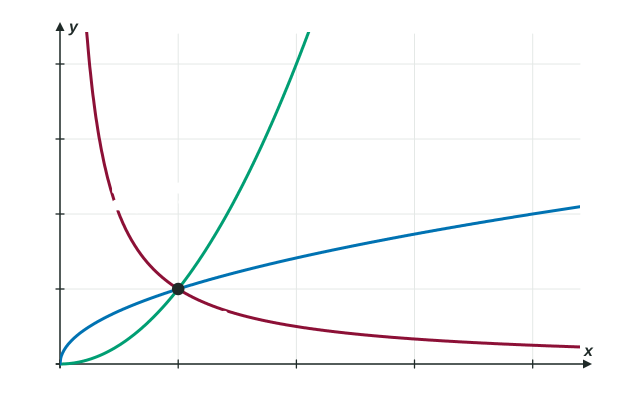
Exponent rules let you write every root and fraction as a power: 1/(x^n) = x^(−n) and n√(x^m) = x^(m/n) .
Practice 1: Implementing Mathematical Processes
Question set for this topic
Part 1 · Hook
Why this matters
A single rule in Unit 2 will handle
,
and
in one stroke, but only if they are written as powers of
first. Rewriting roots and fractions as exponents is the quiet skill behind half of the algebra in calculus, and the place where many small sign slips start. Ten minutes here pays off all year.
Part 2 · Prerequisite check
Quick check before you start
1. If , what is ?
Show the answer
. Substitute with parentheses.
- Correct: :
- :
- :
- :
2. What is the domain of ?
- every real number
Show the answer
A square root needs .
- Correct: :
- :
- :
- every real number:
Part 4 · Step by step
How it works, step by step
- multiplies copies of by more→so , and
- and →a negative exponent is a reciprocal:
- →a fractional exponent is a root: and
- Every root and reciprocal can be written as a power→expressions like become , ready for calculus
Part 5 · Key ideas
Key ideas
- Multiply powers of the same base: add exponents. Divide: subtract. Power of a power: multiply.
- . A negative exponent means reciprocal, never a negative number.
- . Take the root first to keep numbers small: .
- An exponent applies only to what it touches: , but .
- Exponents do not split over sums: and .
Part 6 · Misconception
A common mistake
The wrong idea: , so a fraction can be split into separate powers.
What actually happens: Only a single base can be raised to a power. ; test : is not .
Part 7 · Check yourself
Check yourself
Exam-style questions. Anything you miss goes into your review queue.
1. Which expression equals written as a power of ?
Show the answer
Only is in the denominator, so only it moves up: .
- Correct: : The 3 stays where it is; .
- : : the exponent would apply to the 3 as well.
- : That is . The 3 was in the numerator, so it stays a multiplier of 3.
- : Moving a power out of the denominator flips the sign of its exponent: , not .
2. Which expression equals ?
Show the answer
, and one over a power is the power with the opposite sign: .
- Correct: : Root means exponent ; in the denominator it becomes .
- : That is itself. Being in the denominator makes the exponent negative.
- : A negative exponent is not a negative number: is positive for .
- : A square root is the power , not 2.
3. Evaluate exactly.
No calculator. Type the exact value (a fraction, π, e or a root is fine).
Show the answer
. Take the root first: the numbers stay small.
4. Evaluate exactly.
No calculator. Type the exact value (a fraction, π, e or a root is fine).
Show the answer
.
- Answer: ≈ 0.125
5. Which expression equals for , written as a sum of powers of ?
Show the answer
Split the fraction so each term is divided by : .
- Correct: : .
- : Both terms are divided by , including the 1: .
- : Dividing by subtracts from the exponent; it does not multiply it by 2.
- : The term is divided by too: .
6. Which expression is NOT equal to for ?
Show the answer
, so the expression is . But : the exponent there applies only to , so it is 16 times too big.
- Correct: : , which is not .
- : A negative exponent on the whole base is one over : equal.
- : : equal.
- : : equal.
7. Which expression equals for ?
Show the answer
The exponent applies to the whole sum: . It cannot be split into separate terms.
- Correct: : One over the whole base .
- : Exponents do not distribute over a sum. Test : , but .
- : The exponent means reciprocal, not negative.
- : The exponent applies to the whole base , not only to .
Part 8 · Summary
Summary
Exponent rules let you write every root and fraction as a power:
and
. Add exponents to multiply, subtract to divide, multiply for a power of a power, and remember an exponent applies only to the base it touches and never splits over a sum.
Part 9 · Up next
What comes next
Part 10 · Connections
Connections