A slope field shows the direction a solution curve takes at every point, but not a formula for the curve. Euler's method turns the slope field into numbers: it estimates the value of a solution by walking along short tangent segments, reading a new slope from the differential equation at the start of each one. It works for any differential equation , including ones you cannot solve.
One step is a tangent line
Suppose a solution passes through . The equation gives its slope there, . For a short run , the tangent line rises by about , so
This is the local linearization of topic 4.6, with the slope supplied by the differential equation. Euler's method simply repeats it: from , read the slope and step again.
Several steps, in a table
Worked example 1. The solution of passes through . Use Euler's method with two steps of equal size to approximate .
Two equal steps from to : .
| 0 | 1 | 1 | 0.5 | 0.5 |
| 0.5 | 1.5 | 2 | 0.5 | 1 |
| 1 | 2.5 |
So . Each row's slope comes from that row's own and .
On the exam, show each step: the slope used, the point it was read at, and the new value. Arithmetic does not need simplifying, so earns the point as written. Take exactly the number of steps asked for: a third step overshoots.
Too big or too small?
Each Euler step follows a tangent line, so the shape of the solution decides the error. The figure shows two steps on from . The solution through that point is (check: its derivative is itself), which is concave up, so the steps fall below it: Euler gives for a true value of .
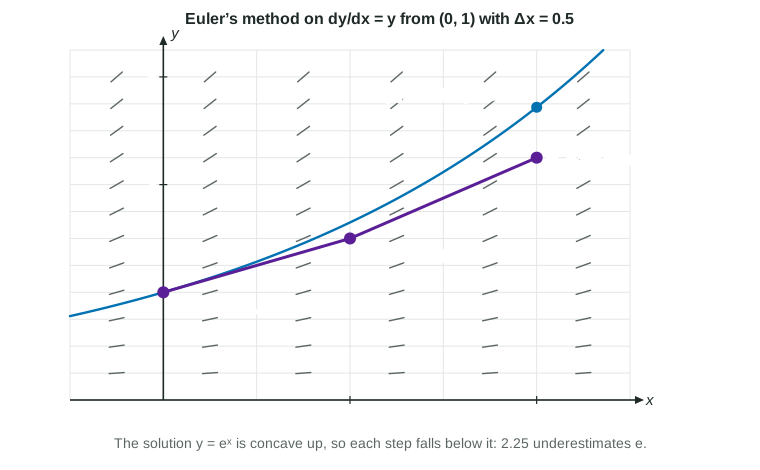
To find the concavity without solving, differentiate the equation implicitly. For :
which is positive for and . The solution curves there are concave up, so the estimate 2.5 in worked example 1 is an underestimate. With more than one step, the concavity must hold for every solution curve a step starts on, not only for : each step lies below the curve through its own starting point, and that curve stays below because solution curves do not cross. Here every step stays where and . Concave down curves lie below their tangent lines, so Euler's method would give an overestimate. Name the concavity and say why it decides the answer; "the solution is increasing" is not a reason.
Step size
Shorter steps update the slope more often and follow the curve more closely. For from , the true value at is :
| Steps | Estimate of | |
|---|---|---|
| 0.5 | 2 | 2.25 |
| 0.25 | 4 | 2.441 |
| 0.1 | 10 | 2.594 |
A step can also go left: to estimate from a point at , use .
Euler's method in context
Worked example 2. The volume of water in a tank, in liters, satisfies , with in minutes, and at . Estimate at with two steps of size .
At : , so liters at .
At : , so
The rate has units of liters per minute and has units of minutes, so each is in liters, the units of the estimate.