Euler's Method
Euler's method approximates a solution of dy/dx = F(x, y) by short tangent steps: from a known point, y_new = y + F(x, y) Δx , then repeat from the new point.
Part 1 · Hook
Why this matters
Part 2 · Before you start
What this builds on
Part 3 · Prerequisite check
Quick check before you start
1. and . The tangent line at estimates as
- 5.3
- 5.03
- 8
- 3.5
Show the answer
.
- Correct: 5.3:
- 5.03:
- 8:
- 3.5:
2. For , the slope field segment at has slope
- 2
- 3
- 1
Show the answer
.
- Correct: 2:
- 3:
- :
- 1:
Part 4 · See it
See it first
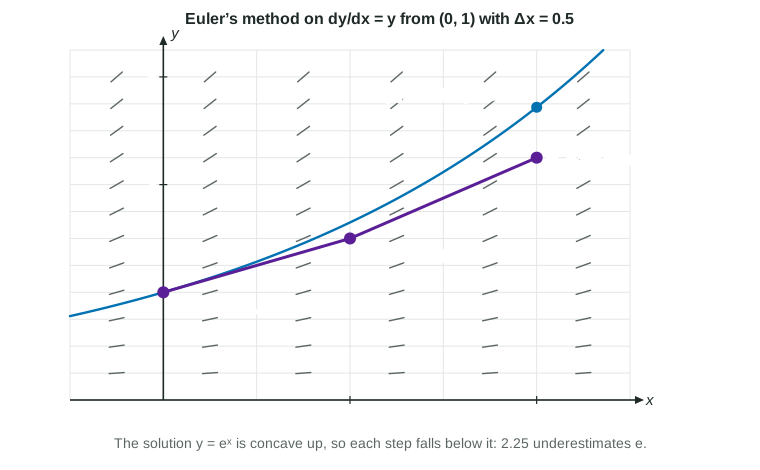
Part 5 · Step by step
How it works, step by step
- The differential equation gives the slope at every pointat a known point you know the direction of the solution curve
- Follow that slope for a short run the rise is , and the new point is
- At the new point, read a new slope from the equationtake the next step; repeat until you reach the you want
- The solution curves are concave up (or down) along the wayeach step falls below (or above) them, so the estimate is too small (or too large)
Part 6 · Key ideas
Key ideas
- One step:
, using the slope at the point you are at. - Lay the work out in a table with columns , , , , ; take exactly the steps asked for.
- Smaller steps give better estimates. A negative steps to the left.
- Over or under: find by differentiating the equation. Concave up curves lie above their tangent steps (underestimate); concave down, below (overestimate).
Part 7 · Misconception
A common mistake
The wrong idea: For from with : the slope is 1, so and .
What actually happens: Each step needs a new slope at its own point. At the slope is , so
Part 8 · Check yourself
Check yourself
Exam-style questions. Anything you miss goes into your review queue.
Graph
Two Euler steps on the slope field of
1. What slope does the first Euler step use?
No calculator. Type the exact value (a fraction, π, e or a root is fine).
Show the answer
At : .
- Answer: 1
2. What is the Euler approximation of ?
No calculator. Type the exact value (a fraction, π, e or a root is fine).
Show the answer
Step 1: at . Step 2: slope , so at .
- Answer: 2.5
3. For and , . Is the estimate of too large or too small?
- Too large: the slopes increase from one step to the next
- Too small: , so the solution is increasing
- No conclusion is possible without solving the equation
- Too small: , so the solution curves are concave up and the steps fall below them
Show the answer
- Too large: the slopes increase from one step to the next: Increasing slopes mean concave up, and a tangent segment lies below a concave up curve, so the estimate is too small.
- Too small: , so the solution is increasing: The conclusion is right but the reason is not: increasing says nothing about the gap. Concavity, from , decides it.
- No conclusion is possible without solving the equation: comes from the differential equation itself, so its sign can be read without solving.
- Correct: Too small: , so the solution curves are concave up and the steps fall below them: Right: each tangent step lies below the concave up solution curve it starts on, and a curve that starts lower stays below the graph of , since solution curves do not cross.
4. The function satisfies and . Use one Euler step of size to approximate .
No calculator. Type the exact value (a fraction, π, e or a root is fine).
Show the answer
- Answer: 1.9
5. For and step size , which formula is one Euler step?
Show the answer
Follow the tangent line: new = old + slope × , with the slope from the differential equation at the current point.
- : The change is added to , not multiplied by it.
: Euler's method uses the slope at the point you are at, , not ahead of it. - Correct: : Right: the slope at the current point times the run gives the rise.
- : That adds the run, not the rise. Multiply the run by the slope first.
6. A solution has and , and its graph is concave down for . One Euler step gives . Which is true?
- is an overestimate: the tangent step lies above the graph
- is an underestimate, because means is increasing
- is exact, because one step of Euler's method is exactly the tangent line
- is an underestimate, because the graph is concave down
Show the answer
One Euler step from is the tangent line: . A concave down graph lies below its tangent lines, so .
- Correct: is an overestimate: the tangent step lies above the graph: Right: a concave down graph lies below its tangent lines, so the estimate is too large.
- is an underestimate, because means is increasing: Increasing is not the reason. Concave down puts the graph below its tangent line, so the estimate is too large.
- is exact, because one step of Euler's method is exactly the tangent line: It is the tangent line value, which differs from whenever the graph bends.
- is an underestimate, because the graph is concave down: Concave down graphs lie below their tangent lines, which makes a tangent estimate too large.
Part 9 · Summary
Summary
Part 10 · Up next
What comes next
Part 11 · Connections