Tonicity and Osmoregulation
Osmosis is the net movement of water across a membrane toward the side with more non-crossing solute, from higher to lower water potential (Ψ = Ψs + Ψp; pure water in an open container is 0).
Part 1 · Hook
Why this matters
Leave a bunch of limp celery in a glass of cold water overnight and by morning the stalks snap crisply. Sprinkle salt on a slug and it shrivels. Give a hospital patient pure water straight into a vein and their red blood cells start to burst. All three are the same event: water crossing membranes toward the side with more dissolved stuff.
Part 2 · Before you start
What this builds on
Part 3 · Prerequisite check
Quick check before you start
1. Which describes diffusion?
- Net movement of particles from where they are more concentrated to where they are less concentrated.
- Net movement of particles from where they are less concentrated to where they are more concentrated.
- Movement of particles that requires ATP from the cell.
- Movement of particles that happens only in living cells.
Show the answer
Random motion spreads particles out, so more of them move from crowded regions to scarce ones than the reverse, until they are evenly spread.
- Correct: Net movement of particles from where they are more concentrated to where they are less concentrated.:
- Net movement of particles from where they are less concentrated to where they are more concentrated.:
- Movement of particles that requires ATP from the cell.:
- Movement of particles that happens only in living cells.:
2. What do aquaporins do?
- They are channel proteins that let water cross the membrane quickly.
- They pump water into the cell using ATP.
- They block water from crossing the membrane.
- They carry sugars across the membrane in exchange for water.
Show the answer
Aquaporins are water channels. Some water slips through the bilayer, but aquaporins let it cross far faster, with no energy spent.
- Correct: They are channel proteins that let water cross the membrane quickly.:
- They pump water into the cell using ATP.:
- They block water from crossing the membrane.:
- They carry sugars across the membrane in exchange for water.:
Part 4 · See it
See it first
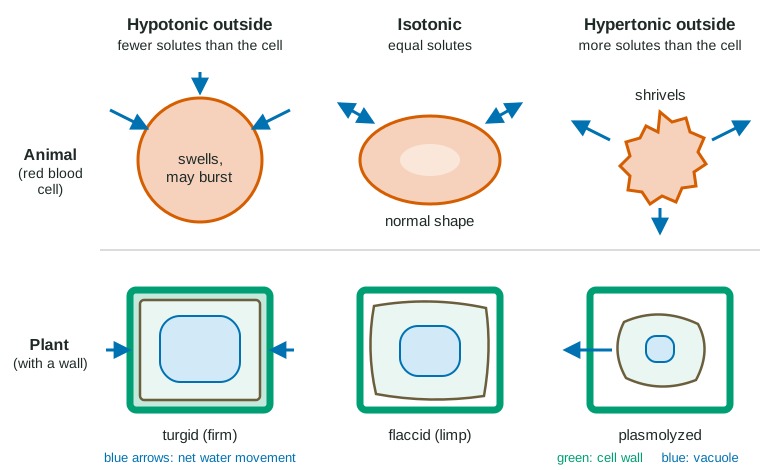
Part 5 · Step by step
How it works, step by step
- Dissolved solutes hold water molecules around them, so a solution with more solute has fewer water molecules free to move.That solution has a lower water potential: a lower tendency for water to leave it.
- A membrane lets water through but holds back many solutes.Water moves by osmosis from the side with higher water potential (fewer solutes, hypotonic) to the side with lower water potential (more solutes, hypertonic).
- An animal cell in a hypotonic solution keeps gaining water, and nothing resists its swelling.It swells and may burst; in a hypertonic solution it loses water and shrivels; in an isotonic solution it stays the same.
- A plant cell gaining water swells against its cell wall, and the wall pushes back.Pressure builds inside (turgor), raising the cell's water potential until net water entry stops: the cell is firm, not burst.
- A plant cell in a hypertonic solution loses water.Turgor drops (the cell goes flaccid), and with more loss the membrane pulls away from the wall: plasmolysis.
- Organisms whose surroundings differ from their cells keep gaining or losing water.They osmoregulate: contractile vacuoles bail water out, kidneys adjust how much water leaves, and cells control their solute levels.
Part 6 · Key ideas
Key ideas
- Hypotonic, isotonic and hypertonic are comparisons. A solution is hypertonic to something. Always say what you are comparing.
- Water moves toward more solute, which is the same as saying from higher to lower water potential.
- Water potential: Ψ = Ψs + Ψp. Pure water in an open container is 0. Solutes make Ψs negative; pressure from a cell wall makes Ψp positive.
- Only solutes that cannot cross the membrane set tonicity. A solute that crosses spreads out evenly and stops mattering.
- Count particles, not molecules: salt (NaCl) splits into two ions, so it lowers water potential about twice as much as the same amount of sugar.
Part 7 · Misconception
A common mistake
The wrong idea: In osmosis, the solute moves from the concentrated side to the dilute side until the two sides are equal.
What actually happens: In osmosis it is water that moves, toward the side with more solute, because the membrane holds the solute back. Solutes that can cross simply diffuse; that is not osmosis.
Part 8 · Check yourself
Check yourself
Exam-style questions. Anything you miss goes into your review queue.
Graph
Potato and sweet potato cores in sucrose
Students cut cylinders (cores) of potato and sweet potato with the same borer, blotted and weighed them, and placed five cores of each in each of six sucrose solutions in open beakers at room temperature. After 24 hours they blotted and reweighed the cores and calculated the percent change in mass. Points are means of the five cores; error bars show ±2 standard errors of the mean.
PotatoSweet potato
Data table
| Sucrose concentration (mol/L) | Potato (± error) | Sweet potato (± error) |
|---|---|---|
| 0 | 18.5 ± 1.4 | 21 ± 1.6 |
| 0.2 | 7.6 ± 1.1 | 12.4 ± 1.2 |
| 0.4 | -2.4 ± 0.9 | 4.1 ± 1 |
| 0.6 | -11.8 ± 1.2 | -4 ± 1.1 |
| 0.8 | -18.6 ± 1.3 | -11.2 ± 1.4 |
| 1 | -22.1 ± 1.5 | -16.3 ± 1.6 |
1. Based on the graph, at about what sucrose concentration would potato cores show no net change in mass?
- About 0.20 mol/L
- About 0.35 mol/L
- About 0.50 mol/L
- About 0.75 mol/L
Show the answer
The potato line crosses 0% between 0.2 mol/L (+7.6%) and 0.4 mol/L (−2.4%). It falls 10 points over that 0.2 mol/L step, so it reaches zero about three-quarters of the way along, near 0.35 mol/L.
- About 0.20 mol/L: At 0.2 mol/L the potato cores still gained 7.6% in mass, so water was still moving in.
- Correct: About 0.35 mol/L: Correct: interpolating between +7.6% at 0.2 mol/L and −2.4% at 0.4 mol/L puts the zero crossing near 0.35 mol/L.
- About 0.50 mol/L: That is where the sweet potato line crosses zero, not the potato line.
- About 0.75 mol/L: By 0.75 mol/L the potato cores were losing well over 15% of their mass.
2. Which explanation best accounts for the potato cores gaining mass in 0 mol/L sucrose (plain water)?
- The water potential of the cells was lower than that of the water, so water moved into them by osmosis.
- The water potential of the cells was higher than that of the water, so water was drawn in to balance them.
- Sucrose diffused out of the cells into the water, and the cores took up water to replace the lost sugar.
- The cells used ATP to pump water inward until their cell walls stopped them from swelling any further.
Show the answer
Plain water in an open beaker has a water potential of 0. The cells hold dissolved solutes, so their water potential is negative. Water moves from higher to lower water potential, into the cells.
- Correct: The water potential of the cells was lower than that of the water, so water moved into them by osmosis.: Correct: solutes inside make the cells' water potential negative, below the 0 of pure water, so water moves in.
- The water potential of the cells was higher than that of the water, so water was drawn in to balance them.: Water moves from higher to lower water potential. If the cells' water potential were higher, water would leave them.
- Sucrose diffused out of the cells into the water, and the cores took up water to replace the lost sugar.: Mass rose, so water came in; losing sugar would lower mass. The mass change is driven by osmosis, not sugar loss.
- The cells used ATP to pump water inward until their cell walls stopped them from swelling any further.: Cells have no pumps for water. Water crosses passively, following water potential.
3. A potato core weighed 3.20 g before it was placed in 0.8 mol/L sucrose. Using the mean change from the graph, what would you expect it to weigh after 24 hours? Give your answer in grams to two decimal places.
Type a number in g.
Show the answer
The mean change at 0.8 mol/L is −18.6%, so the core keeps 100 − 18.6 = 81.4% of its mass: 3.20 g × 0.814 = 2.60 g.
- Answer: 2.60 g
4. Which claim about the two tissues do the data best support?
- Sweet potato cells have a lower water potential than potato cells, because they hold more dissolved solute.
- Sweet potato cells have a higher water potential than potato cells, because they gain more mass in water.
- The two tissues have the same water potential, because their error bars overlap at each concentration tested.
- Potato cells hold more dissolved solute, because they lose more mass in the strongest sucrose solutions.
Show the answer
Each tissue shows no change where the outside solution matches its own water potential. Sweet potato balances at about 0.50 mol/L, potato at about 0.35 mol/L. A stronger balancing solution means more solute inside the cells and a lower (more negative) water potential.
- Correct: Sweet potato cells have a lower water potential than potato cells, because they hold more dissolved solute.: Correct: sweet potato's zero point is at a higher sucrose concentration, so its cells hold more solute and have the lower water potential.
- Sweet potato cells have a higher water potential than potato cells, because they gain more mass in water.: Gaining more mass in water means water was drawn in more strongly, which points to a lower water potential inside, not a higher one.
- The two tissues have the same water potential, because their error bars overlap at each concentration tested.: The error bars do not overlap at 0.2, 0.4 or 0.6 mol/L, where the means differ by 4.8 to 7.8 points.
- Potato cells hold more dissolved solute, because they lose more mass in the strongest sucrose solutions.: Potato loses more mass because its cells have less solute, so a given sucrose solution is more strongly hypertonic to them.
5. Why did the students report percent change in mass instead of the change in grams?
- Cores did not start at identical masses, and percent change lets cores of different sizes be compared fairly.
- Percent change removes the need for repeated trials, because it already corrects for random error.
- A mass in grams does not go below zero, while a percent change can show both water gained and water lost by a core.
- Percent change measures water potential directly, while change in grams measures sucrose uptake.
Show the answer
A large core gains or loses more grams than a small one in the same solution. Dividing by the starting mass puts every core on the same scale.
- Correct: Cores did not start at identical masses, and percent change lets cores of different sizes be compared fairly.: Correct: dividing by starting mass corrects for small differences in core size.
- Percent change removes the need for repeated trials, because it already corrects for random error.: Random error is reduced by repeating trials (here, five cores), not by how the result is expressed.
- A mass in grams does not go below zero, while a percent change can show both water gained and water lost by a core.: A change in grams can be negative too: a core that loses 0.4 g has a change of −0.4 g.
- Percent change measures water potential directly, while change in grams measures sucrose uptake.: Both measures track the same thing, water gained or lost; neither measures water potential or sucrose directly.
6. A U-shaped tube is divided at the bottom by a membrane that lets water through but not sucrose. Side 1 is filled with 0.1 mol/L sucrose and side 2 with 0.5 mol/L sucrose, to the same height. What happens over the next hour?
- The liquid level rises on side 2, because water moves toward the side with more solute.
- The liquid level rises on side 1, because water moves toward the side with less solute.
- Sucrose moves from side 2 to side 1 until both sides hold 0.3 mol/L, and the levels stay equal.
- The levels stay equal, because sucrose does not cross the membrane and so neither side can change.
Show the answer
Side 2 has more solute, so its water potential is lower. Water moves from side 1 into side 2, and the side 2 level rises until the extra weight of the taller column balances the pull.
- Correct: The liquid level rises on side 2, because water moves toward the side with more solute.: Correct: water moves toward lower water potential, the more concentrated side, raising its level.
- The liquid level rises on side 1, because water moves toward the side with less solute.: Water moves toward the side with more solute, not less.
- Sucrose moves from side 2 to side 1 until both sides hold 0.3 mol/L, and the levels stay equal.: The membrane does not let sucrose through, so only water can move.
- The levels stay equal, because sucrose does not cross the membrane and so neither side can change.: Water still crosses, even though sucrose cannot; that net flow of water is osmosis.
7. A trout lives in fresh water, which has far fewer solutes than its blood. Which set of responses helps it keep its water balance?
- It makes large volumes of dilute urine and takes up salts across its gills.
- It drinks large volumes of water and gets rid of extra salts through its gills.
- It produces small volumes of concentrated urine to keep water in its body.
- It keeps the solute concentration of its blood equal to that of the fresh water.
Show the answer
Fresh water is hypotonic to the fish, so water keeps entering by osmosis and salts keep leaking out. Its kidneys get rid of the extra water as dilute urine, and gill cells take salts back in, spending ATP.
- Correct: It makes large volumes of dilute urine and takes up salts across its gills.: Correct: dump extra water, recover lost salts.
- It drinks large volumes of water and gets rid of extra salts through its gills.: That is how a saltwater fish copes: it loses water to the sea, so it drinks and gets rid of salt.
- It produces small volumes of concentrated urine to keep water in its body.: Saving water would make its problem worse; water is already pouring in.
- It keeps the solute concentration of its blood equal to that of the fresh water.: Blood that dilute could not keep the fish's cells working; osmoregulation keeps the blood far saltier than the surrounding water.
Part 9 · Summary
Summary
Osmosis is the net movement of water across a membrane toward the side with more non-crossing solute, from higher to lower water potential (Ψ = Ψs + Ψp; pure water in an open container is 0). Compared with a cell, a hypotonic solution makes it gain water, a hypertonic one makes it lose water, and an isotonic one causes no net change. Animal cells burst or shrivel; plant cells become turgid against their walls or plasmolyze. Organisms osmoregulate with contractile vacuoles, kidneys and control of their own solute levels.
Part 10 · Up next
What comes next
Part 11 · Connections