Water potential calculations
Water potential is Ψ = ΨP + Ψs.
Part 1 · Hook
Why this matters
Drop slices of potato into salty water and in an hour they go limp; leave them in plain water and they turn crisp. Water potential predicts which way water will move, and the formula sheet gives you the equation to put a number on it. The arithmetic is short, but nearly every lost point comes from the same three slips: i, kelvin and the sign.
Part 2 · Before you start
What this builds on
Part 3 · Prerequisite check
Quick check before you start
1. Water moves by osmosis from…
- higher (less negative) water potential to lower (more negative) water potential
- lower water potential to higher water potential
- higher solute concentration to lower solute concentration
Show the answer
Water moves down its water potential gradient, toward the more negative Ψ, which is where solutes are more concentrated.
- Correct: higher (less negative) water potential to lower (more negative) water potential:
- lower water potential to higher water potential:
- higher solute concentration to lower solute concentration:
2. What does turgor pressure do to a plant cell's pressure potential?
- Makes it positive, raising the cell's water potential
- Makes it negative, lowering the cell's water potential
- Has no effect; pressure potential depends on solutes alone
Show the answer
A turgid cell pushes on its wall and the wall pushes back, so ΨP is positive and adds to Ψ.
- Correct: Makes it positive, raising the cell's water potential:
- Makes it negative, lowering the cell's water potential:
- Has no effect; pressure potential depends on solutes alone:
Part 4 · See it
See it first
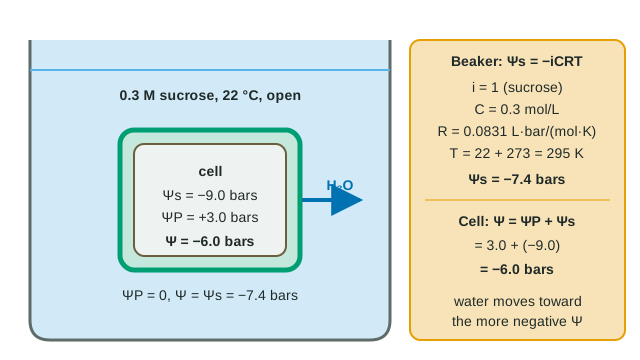
Part 5 · Step by step
How it works, step by step
- A solute dissolves and each formula unit makes i particles (1 for sucrose, about 2 for NaCl).The concentration of dissolved particles is i × C.
- Dissolved particles attract and hold water molecules, lowering water's tendency to move.Solute potential is negative and proportional to particles and temperature: Ψs = −iCRT.
- R = 0.0831 L·bar/(mol·K) is defined per kelvin.T must be in kelvin (°C + 273), and the answer comes out in bars.
- A cell wall pushing back on a swollen cell adds pressure; an open beaker adds none.Water potential is Ψ = ΨP + Ψs, with ΨP = 0 in an open container.
- A cell and its surroundings have different water potentials.Net water moves from the higher (less negative) Ψ to the lower (more negative) Ψ until they are equal.
Part 6 · Key ideas
Key ideas
- Worked example. 0.30 M sucrose, 22 °C, open beaker. i = 1, C = 0.30 mol/L, R = 0.0831 L·bar/(mol·K), T = 295 K. Ψs = −(1)(0.30)(0.0831)(295) = −7.35 bars. ΨP = 0, so Ψ = −7.35 bars (−0.74 MPa).
- Same molarity is not same water potential: 0.1 M NaCl (i = 2) has Ψs = −4.95 bars at 25 °C, twice the 0.1 M sucrose value of −2.48 bars.
- A potato-core graph crossing 0% mass change at about 0.30 M sucrose means the cells' Ψ equals that solution's Ψ: about −7.4 bars at 22 °C.
- Three classic slips: using °C instead of kelvin, forgetting i for salts, and dropping the minus sign.
Part 7 · Misconception
A common mistake
The wrong idea: Two solutions with the same molar concentration have the same water potential.
What actually happens: Water potential depends on the number of dissolved particles. 0.1 M NaCl makes about 0.2 M of ions (i = 2), so its Ψ is about twice as negative as 0.1 M sucrose (i = 1).
Part 8 · Check yourself
Check yourself
Exam-style questions. Anything you miss goes into your review queue.
Graph
Potato cores in sucrose solutions
Students weighed cores cut from one potato, left five cores in each of six sucrose solutions in open beakers at 22 °C for 24 hours, and weighed them again. The graph shows the mean percent change in mass; error bars show 95% confidence intervals.
Data table
| Sucrose concentration (mol/L) | Potato cores (± error) |
|---|---|
| 0 | 17 ± 2 |
| 0.2 | 5 ± 1.5 |
| 0.4 | -5 ± 1.5 |
| 0.6 | -12 ± 2 |
| 0.8 | -17 ± 2 |
| 1 | -20 ± 2.5 |
1. Estimate the sucrose concentration at which the potato cores would neither gain nor lose mass. Give your answer in mol/L to two decimal places.
Type a number in mol/L.
Show the answer
The line crosses 0% between 0.2 M (+5%) and 0.4 M (−5%). Zero is halfway along that segment: 0.2 + 0.2 × (5 ÷ 10) = 0.30 mol/L.
- Answer: 0.30 mol/L
2. Calculate the solute potential of a 0.30 mol/L sucrose solution at 22 °C. Give your answer in bars to one decimal place.
Type a number in bars.
Show the answer
Ψs = −iCRT = −(1)(0.30 mol/L)(0.0831 L·bar/(mol·K))(295 K) = −7.35, about −7.4 bars. Sucrose does not ionize, so i = 1; T = 22 + 273 = 295 K.
- Answer: -7.4 bars
3. What does the concentration where the cores neither gain nor lose mass tell you?
- At that concentration the solution's water potential equals the potato cells' water potential, so there is no net water movement.
- At that concentration the potato cells contain exactly 0.30 mol/L of sucrose, the same as the surrounding solution in the beaker.
- At that concentration water stops crossing the membranes in either direction, because the aquaporins close.
- At that concentration the cores are plasmolyzed, so they can no longer take in or lose water by osmosis.
Show the answer
No net mass change means no net water movement, which happens when Ψ outside equals Ψ inside. So the cells' water potential is about −7.4 bars. Water still crosses both ways; the flows just balance.
- Correct: At that concentration the solution's water potential equals the potato cells' water potential, so there is no net water movement.: Correct: equal water potentials, no net flow.
- At that concentration the potato cells contain exactly 0.30 mol/L of sucrose, the same as the surrounding solution in the beaker.: Cell water potential depends on all its solutes and its pressure potential, not only on sucrose.
- At that concentration water stops crossing the membranes in either direction, because the aquaporins close.: Water keeps crossing in both directions at equal rates; the balance is dynamic.
- At that concentration the cores are plasmolyzed, so they can no longer take in or lose water by osmosis.: Plasmolysis happens in solutions much more concentrated than this, where cells lose a lot of water.
4. Why did the cores in 0.8 mol/L sucrose lose mass?
- The solution had a lower (more negative) water potential than the cells, so water moved out of the cells by osmosis.
- Sucrose moved into the cells by diffusion and pushed water out, so the cores became lighter as a result.
- The solution had a higher water potential than the cells, so water moved from the solution into the cells.
- The high sucrose concentration dissolved part of the potato cell walls, so the cores lost solid mass.
Show the answer
0.8 M sucrose at 295 K has Ψ = −(1)(0.8)(0.0831)(295) ≈ −19.6 bars, far below the cells' ≈ −7.4 bars. Water moves from higher to lower Ψ, out of the cells.
- Correct: The solution had a lower (more negative) water potential than the cells, so water moved out of the cells by osmosis.: Correct.
- Sucrose moved into the cells by diffusion and pushed water out, so the cores became lighter as a result.: Sucrose moving in would add mass; the loss is water leaving.
- The solution had a higher water potential than the cells, so water moved from the solution into the cells.: If the solution's Ψ were higher, water would move in and the cores would gain mass.
- The high sucrose concentration dissolved part of the potato cell walls, so the cores lost solid mass.: Sucrose does not dissolve cell walls; the change is water.
Data table
Three solutions at 25 °C
A teacher prepared three solutions in open beakers at 25 °C. Use R = 0.0831 L·bar/(mol·K) and T = 298 K.
| Solution | Concentration (mol/L) | Ionization constant, i | Solute potential (bars) |
|---|---|---|---|
| Sucrose | 0.1 | 1 | −2.48 |
| Sodium chloride (NaCl) | 0.1 | 2 | ? |
| Calcium chloride (CaCl₂) | 0.1 | 3 | −7.43 |
5. Calculate the solute potential of the 0.1 mol/L NaCl solution at 25 °C. Give your answer in bars to two decimal places.
Type a number in bars.
Show the answer
Ψs = −iCRT = −(2)(0.1)(0.0831)(298) = −4.95 bars. NaCl splits into Na⁺ and Cl⁻, so i = 2.
- Answer: -4.95 bars
6. A bag made of membrane that lets water through but not sucrose or ions is filled with the 0.1 mol/L sucrose solution and placed in a beaker of the 0.1 mol/L NaCl solution. What happens?
- Water leaves the bag, because the NaCl solution's water potential (−4.95 bars) is lower than the sucrose solution's (−2.48 bars).
- Water enters the bag, because sucrose molecules are larger than ions and attract more water molecules to them.
- Nothing happens, because the two solutions have the same molar concentration of solute, 0.1 mol/L each, on both sides of the bag.
- Sodium and chloride ions enter the bag until both sides have equal numbers of dissolved particles.
Show the answer
Equal molarity is not equal water potential. NaCl gives twice as many particles, so its Ψ is lower, and water moves from the bag (−2.48 bars) to the beaker (−4.95 bars).
- Correct: Water leaves the bag, because the NaCl solution's water potential (−4.95 bars) is lower than the sucrose solution's (−2.48 bars).: Correct.
- Water enters the bag, because sucrose molecules are larger than ions and attract more water molecules to them.: Particle number, not particle size, sets solute potential.
- Nothing happens, because the two solutions have the same molar concentration of solute, 0.1 mol/L each, on both sides of the bag.: Same molarity, different i: the NaCl solution has twice as many particles.
- Sodium and chloride ions enter the bag until both sides have equal numbers of dissolved particles.: The membrane in the question lets water through but not ions.
7. A plant cell has a solute potential of −9.0 bars and a pressure potential of +3.0 bars. Calculate its water potential in bars, to one decimal place.
Type a number in bars.
Show the answer
Ψ = ΨP + Ψs = 3.0 + (−9.0) = −6.0 bars.
- Answer: -6.0 bars
Part 9 · Summary
Summary
Water potential is Ψ = ΨP + Ψs. Solute potential is Ψs = −iCRT: i is the number of particles per formula unit (1 for sucrose, about 2 for NaCl), C the molar concentration, R = 0.0831 L·bar/(mol·K) and T the temperature in kelvin. In an open container ΨP = 0. Water moves from higher to lower water potential. 10 bars = 1 MPa.
Part 10 · Up next
What comes next
Part 11 · Connections