Proteins
Proteins are polymers of amino acids joined by peptide bonds.
Part 1 · Hook
Why this matters
Hemoglobin, the protein that carries oxygen in your red blood cells, is built from four chains of amino acids; two of them are 146 amino acids long. In people with the inherited disorder that bends red blood cells into sickle shapes, one amino acid in each of those chains, the sixth, is valine instead of glutamic acid. That single swap, on the outside of the molecule, makes hemoglobin molecules stick to each other in long, stiff fibers that bend red blood cells into sickles and block small blood vessels. One amino acid out of 146 changes a life, because a protein's sequence sets its shape, and its shape sets what it does.
Part 2 · Before you start
What this builds on
Part 3 · Prerequisite check
Quick check before you start
1. Which two functional groups does every amino acid carry?
- An amino group and a carboxyl group
- A hydroxyl group and a phosphate group
- A methyl group and a carbonyl group
Show the answer
Every amino acid has an amino group (–NH2) and a carboxyl group (–COOH); that is where its name comes from.
- Correct: An amino group and a carboxyl group:
- A hydroxyl group and a phosphate group:
- A methyl group and a carbonyl group:
2. How do nonpolar molecules behave in water?
- They dissolve evenly
- They cluster together, away from water
- They form hydrogen bonds with water
Show the answer
Nonpolar (hydrophobic) molecules cannot hydrogen-bond with water, so water pushes them together.
- They dissolve evenly:
- Correct: They cluster together, away from water:
- They form hydrogen bonds with water:
3. How many water molecules are released when a chain of 10 monomers is built by dehydration synthesis?
- 9
- 10
- 11
Show the answer
A straight chain of n monomers has n − 1 links, each releasing one water: 10 − 1 = 9.
- Correct: 9:
- 10:
- 11:
Part 4 · See it
See it first
Part 5 · Step by step
How it works, step by step
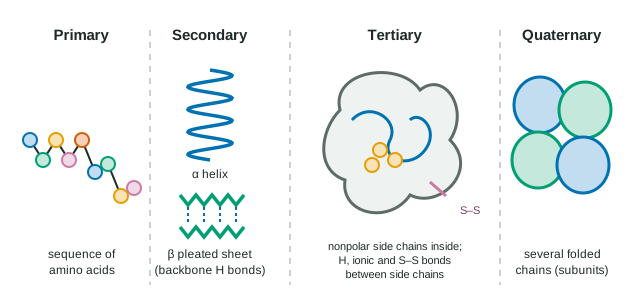
- Every amino acid has the same backbone (amino group, central carbon, carboxyl group) plus one of 20 different side chains, its R group.Amino acids differ only in their R groups, which may be nonpolar, polar, or charged (acidic or basic).
- Dehydration synthesis joins the carboxyl group of one amino acid to the amino group of the next by a peptide bond.A polypeptide forms, with an amino end (N-terminus) and a carboxyl end (C-terminus); its order of amino acids is its primary structure.
- C=O and N–H groups along the backbone hydrogen-bond with each other a few amino acids apart.Parts of the chain coil into α helices or fold into β pleated sheets: secondary structure.
- Nonpolar R groups are pushed together away from water, while polar and charged R groups face the water and form hydrogen bonds, ionic bonds and disulfide bridges with each other.The whole chain folds into one specific 3-D shape: tertiary structure. Some proteins join two or more folded chains: quaternary structure.
- A protein's function depends on its exact shape, and its shape depends on its sequence and its surroundings.Changing one amino acid, or changing temperature or pH enough to break the weak bonds (denaturation), can change the shape and stop the protein from working.
Part 6 · Key ideas
Key ideas
- Primary = sequence (peptide bonds). Secondary = helices and sheets (backbone hydrogen bonds). Tertiary = overall 3-D fold (R-group interactions). Quaternary = several chains together (as in hemoglobin's four subunits).
- R-group chemistry drives folding: nonpolar side chains cluster inside (hydrophobic interactions), polar and charged ones face the water, opposite charges form ionic bonds, and two cysteines can form a covalent disulfide bridge.
- Denaturation unfolds a protein by breaking the weak bonds of its higher levels of structure. The peptide bonds survive, so the primary structure is unchanged, but the shape, and the function, are lost.
Part 7 · Misconception
A common mistake
The wrong idea: Denaturing a protein by heat breaks it down into its amino acids, like digestion.
What actually happens: Denaturation breaks the hydrogen bonds, ionic bonds and hydrophobic interactions that hold the shape, so the chain unfolds. The peptide bonds, and so the sequence of amino acids, stay intact. Breaking peptide bonds is hydrolysis, which needs enzymes in the gut (or strong acid and long heating). A cooked egg white is unfolded, tangled protein, not free amino acids.
Part 8 · Check yourself
Check yourself
Exam-style questions. Anything you miss goes into your review queue.
1. In the inherited disorder that makes red blood cells sickle-shaped, valine (nonpolar) replaces glutamic acid (charged) at a position on the outer surface of a hemoglobin subunit. Which explanation best accounts for the problem this causes?
- A nonpolar patch on the surface sticks to nonpolar areas of other hemoglobin molecules, forming long fibers.
- Valine breaks the peptide bonds around it, so the hemoglobin chain falls apart into several shorter pieces.
- The change removes a disulfide bridge, so the four subunits come apart.
- Valine carries a positive charge that repels the other subunits of the same hemoglobin molecule.
Show the answer
A surface position normally faces water, where a charged side chain fits well. A nonpolar side chain there creates a sticky hydrophobic spot that binds neighboring molecules.
- Correct: A nonpolar patch on the surface sticks to nonpolar areas of other hemoglobin molecules, forming long fibers.: Correct. A hydrophobic patch exposed to water binds other hydrophobic surfaces, stacking hemoglobin into fibers when oxygen is low.
- Valine breaks the peptide bonds around it, so the hemoglobin chain falls apart into several shorter pieces.: A side-chain swap does not break the backbone; the chain stays full length.
- The change removes a disulfide bridge, so the four subunits come apart.: Glutamic acid has no sulfhydryl group, so no disulfide bridge is lost.
- Valine carries a positive charge that repels the other subunits of the same hemoglobin molecule.: Valine is nonpolar and uncharged; the problem is extra stickiness, not repulsion.
2. An egg white protein is heated until it turns from clear to white. Predict how each feature of the protein changes.
| Variable | Change |
|---|---|
| Number of peptide bonds in each chain | — |
| Number of hydrogen bonds holding helices and sheets | — |
| Number of nonpolar side chains exposed to water | — |
Show the answer
Denaturation breaks the weak bonds of secondary and tertiary structure but not peptide bonds. Unfolding exposes hydrophobic side chains, which clump with other chains, so the protein does not refold on cooling.
- Number of peptide bonds in each chain: no change. Cooking temperatures do not break peptide bonds; the sequence of each chain is unchanged.
- Number of hydrogen bonds holding helices and sheets: decreases. Heat makes the chain vibrate hard enough to break these weak bonds, so secondary structure is lost.
- Number of nonpolar side chains exposed to water: increases. As the chain unfolds, nonpolar side chains that were buried in the core are exposed; they then stick to other unfolded chains, turning the egg white solid and white.
Data table
Single amino acid changes in Enzyme Q
Enzyme Q is a single polypeptide of 240 amino acids. Researchers made six versions, each with one amino acid replaced, and measured each version's activity as a percent of the normal enzyme's. In the normal enzyme, position 45 is buried in the hydrophobic core, position 112 is on the surface facing water, cysteine 78 forms a disulfide bridge with cysteine 150, and position 160 lies in the middle of an α helix.
| Version | Position | Change | Side chain change | Activity (% of normal) |
|---|---|---|---|---|
| V1 | 45 (core) | Leucine → isoleucine | nonpolar → nonpolar | 96 |
| V2 | 45 (core) | Leucine → aspartic acid | nonpolar → negative charge | 3 |
| V3 | 112 (surface) | Lysine → arginine | positive → positive | 99 |
| V4 | 112 (surface) | Lysine → glutamic acid | positive → negative | 91 |
| V5 | 78 (core) | Cysteine → serine | –SH → –OH | 18 |
| V6 | 160 (helix) | Alanine → proline | small → rigid ring that kinks the backbone | 22 |
3. Which statement best describes the pattern in the data?
- Swaps that kept similar chemistry had little effect; a charge buried in the core had the largest.
- Each of the six changes reduced the enzyme's activity by about the same amount, whatever the side chain.
- Changes at the surface reduced activity more than changes in the core.
- Swapping a positive side chain for a negative one had the largest effect of the six.
Show the answer
Compare versions that differ in one thing. At position 45, a similar swap (V1) kept 96% while a charged one (V2) left 3%. At the surface even a charge reversal (V4) kept 91%.
- Correct: Swaps that kept similar chemistry had little effect; a charge buried in the core had the largest.: Correct. V1 and V3 (similar chemistry) kept 96% and 99%; V2 (a charge placed in the core) fell to 3%.
- Each of the six changes reduced the enzyme's activity by about the same amount, whatever the side chain.: Activity ranged from 3% to 99%, so the effects were very different.
- Changes at the surface reduced activity more than changes in the core.: The surface changes (V3, V4) kept 99% and 91%, more than any core change except the similar swap in V1.
- Swapping a positive side chain for a negative one had the largest effect of the six.: That swap (V4) kept 91% of activity, among the smallest effects.
4. Which explanation best accounts for the very low activity of V2?
- A buried charged side chain disrupts the hydrophobic core, so the chain folds into a different shape.
- Aspartic acid breaks peptide bonds near position 45, cutting Enzyme Q into two pieces.
- Aspartic acid is a larger amino acid than leucine, so it makes the whole polypeptide too long to fold.
- The new side chain forms a disulfide bridge with cysteine 78, locking the core in the wrong place.
Show the answer
R-group chemistry drives folding. Nonpolar side chains pack into the core by hydrophobic interactions. A charged side chain there is out of place, so the protein folds differently and loses its working shape.
- Correct: A buried charged side chain disrupts the hydrophobic core, so the chain folds into a different shape.: Correct. The core is held together by nonpolar side chains clustering away from water; a charge there is unstable and disrupts the tertiary structure.
- Aspartic acid breaks peptide bonds near position 45, cutting Enzyme Q into two pieces.: Swapping a side chain does not break the backbone; V2 is still one intact polypeptide.
- Aspartic acid is a larger amino acid than leucine, so it makes the whole polypeptide too long to fold.: Each version still has 240 amino acids. The problem is chemistry, a charge in a nonpolar region, not length.
- The new side chain forms a disulfide bridge with cysteine 78, locking the core in the wrong place.: Disulfide bridges form between two cysteines; aspartic acid has no sulfhydryl group.
5. Serine differs from cysteine only in having –OH where cysteine has –SH. Why did V5 lose most of its activity?
- Serine's –OH group makes the core so polar that the whole protein falls apart into its separate amino acids.
- Without an –SH at position 78, the disulfide bridge to cysteine 150 cannot form, so that fold is no longer locked.
- Serine does not form peptide bonds, so the chain is broken at position 78.
- Serine's –OH group forms a new disulfide bridge with cysteine 150 that holds that part of the protein too tightly.
Show the answer
A disulfide bridge is a covalent bond between two cysteine sulfhydryl groups. Replace one cysteine with serine and the bridge is lost, so the fold it held is free to shift.
- Serine's –OH group makes the core so polar that the whole protein falls apart into its separate amino acids.: Dissolving would not break peptide bonds; the chain stays intact. The loss is in the shape.
- Correct: Without an –SH at position 78, the disulfide bridge to cysteine 150 cannot form, so that fold is no longer locked.: Correct. Two –SH groups are needed for an S–S bridge. Losing the bridge leaves the tertiary structure less stable.
- Serine does not form peptide bonds, so the chain is broken at position 78.: Every amino acid forms peptide bonds through its amino and carboxyl groups; the side chain does not take part.
- Serine's –OH group forms a new disulfide bridge with cysteine 150 that holds that part of the protein too tightly.: A disulfide bridge needs sulfur on both sides; serine has oxygen, not sulfur.
6. Researchers plan a seventh version with a different amino acid at position 45. Which replacement for leucine is most likely to leave activity close to normal?
- Lysine, which has a positively charged side chain
- Glutamic acid, which has a negatively charged side chain
- Valine, which has a nonpolar side chain
- Serine, which has a polar side chain with an –OH group
Show the answer
Position 45 sits in the nonpolar core. The safest replacement keeps the side chain nonpolar; V1 shows that such a swap barely changes activity.
- Lysine, which has a positively charged side chain: A charge buried in the core would disrupt folding, as V2 shows.
- Glutamic acid, which has a negatively charged side chain: This is nearly the same change as V2, which left 3% activity.
- Correct: Valine, which has a nonpolar side chain: Correct. A nonpolar side chain fits the hydrophobic core, as isoleucine did in V1.
- Serine, which has a polar side chain with an –OH group: A polar group buried in the core is less disruptive than a charge but still does not fit the hydrophobic environment.
7. A student claims that where a change happens in a protein matters more than how different the new side chain is. Which pair of versions gives the best evidence for this claim?
- V1 and V2, which both change the buried position 45
- V3 and V4, which both change the surface position 112
- V2 and V4: a new negative charge at two positions
- V5 and V6, which end with similar activities
Show the answer
To test the effect of position, compare two changes that are chemically alike but at different positions. V2 and V4 both introduce a negative side chain; the core change is devastating, the surface change mild.
- V1 and V2, which both change the buried position 45: Both are at the same position, so this pair tests how different the new side chain is, not where the change is.
- V3 and V4, which both change the surface position 112: Both are at the same surface position; again only the side chain differs.
- Correct: V2 and V4: a new negative charge at two positions: Correct. Both put a negative side chain in place, and V4's change (positive to negative) is if anything the bigger one, yet it kept 91% at the surface while V2 kept 3% in the core. Position made the difference.
- V5 and V6, which end with similar activities: These differ in both position and kind of change, and their similar activities do not separate the two factors.
Part 9 · Summary
Summary
Proteins are polymers of amino acids joined by peptide bonds. The sequence (primary structure) determines how the chain folds: backbone hydrogen bonds make α helices and β pleated sheets (secondary structure); interactions among R groups, especially nonpolar side chains clustering away from water, fold the whole chain into its 3-D shape (tertiary structure); and some proteins combine several chains (quaternary structure). A protein's shape determines its function, so changing a single amino acid or denaturing the protein can stop it from working.
Part 10 · Up next
What comes next
Part 11 · Connections