Standard deviation and standard error
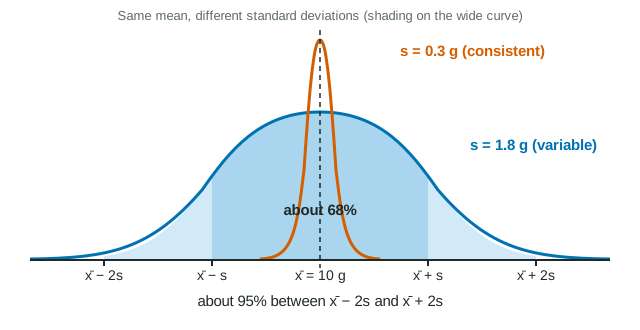
The standard deviation, s = √[Σ(x − x̄)² ÷ (n − 1)], is the typical distance of a value from the mean, in the data's units.
Part 1 · Hook
Why this matters
Five eggs in the same 85 °C bath set in 62, 58, 66, 60 and 64 seconds. Five eggs at 65 °C took between 380 and 445 seconds. The range says the second set is more spread out, but it uses only two of the five values. Standard deviation uses all of them, and standard error tells you how far to trust the mean. Both are on the exam's formula sheet.
Part 2 · Before you start
What this builds on
Part 3 · Prerequisite check
Quick check before you start
1. Heat makes egg white turn white and firm. What happens to its proteins?
- They denature: heat breaks the weak interactions that hold their folded shape.
- Their peptide bonds break, splitting them into single amino acids.
- They gain new amino acids, changing their primary structure.
Show the answer
Denaturation disrupts hydrogen bonds and other weak interactions in secondary and tertiary structure. The amino acid sequence (primary structure) is unchanged.
- Correct: They denature: heat breaks the weak interactions that hold their folded shape.:
- Their peptide bonds break, splitting them into single amino acids.:
- They gain new amino acids, changing their primary structure.:
2. What is the mean of 58, 60, 62, 64 and 66?
- 62
- 60
- 64
Show the answer
Sum = 310; 310 ÷ 5 = 62.
- Correct: 62:
- 60:
- 64:
Part 4 · See it
See it first
Part 5 · Step by step
How it works, step by step
- Each value in a sample sits some distance from the mean.You find each deviation (x − x̄); positive and negative deviations would cancel, so you square them.
- You add the squared deviations and divide by n − 1.This gives the average squared distance from the mean (dividing by n − 1 corrects for using the sample's own mean).
- Taking the square root brings the units back to those of the data.The result is the standard deviation, s: a typical distance of a value from the mean.
- A mean from many values wobbles less than single values do.The standard error, SE = s ÷ √n, estimates how much the mean itself would vary if you repeated the sample.
- Increasing n shrinks SE by the square root of n but does not make individual values less variable.Larger samples pin down the mean more precisely, while the standard deviation stays about the same.
Part 6 · Key ideas
Key ideas
- Worked example. 58, 60, 62, 64, 66 s. x̄ = 62. Deviations −4, −2, 0, 2, 4; squares 16, 4, 0, 4, 16; sum 40. 40 ÷ (5 − 1) = 10. s = √10 = 3.16 s. SE = 3.16 ÷ √5 = 1.41 s.
- Formula sheet: s = √[Σ(xi − x̄)² ÷ (n − 1)] and SEx̄ = s ÷ √n. The standard deviation has the same units as the data.
- In a normal distribution, about 68% of values lie within ±1 SD of the mean and about 95% within ±2 SD.
- SD answers "how much do individuals vary?"; SE answers "how precisely do I know the mean?". To halve SE, collect four times as many values.
Part 7 · Misconception
A common mistake
The wrong idea: Testing more samples makes the standard deviation smaller, because the data become more reliable.
What actually happens: More samples make the standard error smaller (it falls with √n). The standard deviation reflects how much individuals really differ, so it stays about the same however many you test.
Part 8 · Check yourself
Check yourself
Exam-style questions. Anything you miss goes into your review queue.
Data table
How long egg white takes to set
Heat unfolds (denatures) egg-white proteins; the unfolded chains tangle together and the clear liquid turns white and firm. A student put 5 mL of raw egg white from five different eggs into thin tubes in water baths at three temperatures and timed how long each took to turn fully opaque.
| Water bath (°C) | Egg 1 (s) | Egg 2 (s) | Egg 3 (s) | Egg 4 (s) | Egg 5 (s) | Mean (s) | Standard deviation (s) |
|---|---|---|---|---|---|---|---|
| 65 | 410 | 380 | 445 | 395 | 420 | 410 | 24.7 |
| 75 | 150 | 162 | 141 | 158 | 149 | 152 | 8.2 |
| 85 | 62 | 58 | 66 | 60 | 64 | 62 | ? |
1. Calculate the standard deviation of the set times at 85 °C. Give your answer in seconds to one decimal place.
Type a number in s.
Show the answer
Mean = 310 ÷ 5 = 62 s. Deviations: 0, −4, 4, −2, 2. Squares: 0, 16, 16, 4, 4; sum = 40. Divide by n − 1 = 4: 10. s = √10 = 3.16, about 3.2 s.
- Answer: 3.2 s
2. Calculate the standard error of the mean set time at 75 °C. Give your answer in seconds to one decimal place.
Type a number in s.
Show the answer
SE = s ÷ √n = 8.2 ÷ √5 = 8.2 ÷ 2.236 = 3.67, about 3.7 s.
- Answer: 3.7 s
3. Which statement best describes the variability in these data?
- The standard deviation is largest at 65 °C, but compared with each mean, the spread is similar at all three temperatures.
- The 65 °C eggs were handled least carefully, because their standard deviation is about eight times the value measured at 85 °C.
- The spread is identical at the three temperatures, because each row contains exactly five eggs.
- The 85 °C data are the most variable, because their mean is the smallest of the three temperatures tested.
Show the answer
In seconds, the 65 °C times spread most (s = 24.7 s). But 24.7 is about 6% of 410 s, 8.2 is about 5% of 152 s and 3.2 is about 5% of 62 s: relative to how long each takes, the eggs vary by a similar fraction.
- Correct: The standard deviation is largest at 65 °C, but compared with each mean, the spread is similar at all three temperatures.: Correct: compare the size of the spread with the size of the mean.
- The 65 °C eggs were handled least carefully, because their standard deviation is about eight times the value measured at 85 °C.: A bigger SD on a much longer time is expected; it does not by itself show sloppier handling.
- The spread is identical at the three temperatures, because each row contains exactly five eggs.: The same n does not give the same spread; the SDs differ.
- The 85 °C data are the most variable, because their mean is the smallest of the three temperatures tested.: A small mean does not mean high variability; the 85 °C SD is the smallest.
Data table
Protein in two breakfast cereals
A food lab measured the protein content of six boxes of each of two cereals, taken from different factory batches.
| Cereal | Box values (g/100 g) | Mean (g/100 g) | Standard deviation (g/100 g) |
|---|---|---|---|
| A | 10.2, 9.8, 10.5, 9.9, 10.1, 10.3 | 10.1 | 0.26 |
| B | 12.1, 8.4, 10.9, 9.2, 11.6, 7.9 | 10.0 | 1.75 |
4. The two cereals have nearly the same mean protein content. What do the standard deviations show?
- Cereal B varies far more from box to box, so a single box of B is a less dependable guide to its protein content.
- Cereal B contains more protein than cereal A, because a larger standard deviation means larger values overall.
- Cereal A was measured less precisely, because its standard deviation is close to zero and so tells us little.
- The two cereals are identical, because standard deviation does not matter when the means are the same.
Show the answer
Standard deviation measures spread around the mean. B's 1.75 g/100 g is almost seven times A's 0.26 g/100 g: B's boxes range from 7.9 to 12.1.
- Correct: Cereal B varies far more from box to box, so a single box of B is a less dependable guide to its protein content.: Correct: same center, much wider spread.
- Cereal B contains more protein than cereal A, because a larger standard deviation means larger values overall.: Standard deviation is about spread, not about how large the values are.
- Cereal A was measured less precisely, because its standard deviation is close to zero and so tells us little.: A small SD means the boxes are consistent, which is good, not imprecise.
- The two cereals are identical, because standard deviation does not matter when the means are the same.: Equal means with very different spreads describe different products.
5. Calculate the standard error of the mean for cereal B. Give your answer in g/100 g to two decimal places.
Type a number in g/100 g.
Show the answer
SE = s ÷ √n = 1.75 ÷ √6 = 1.75 ÷ 2.449 = 0.714, about 0.71 g/100 g.
- Answer: 0.71 g/100 g
6. The lab wants the standard error for cereal B to be about 0.36 g/100 g instead of about 0.71. Assuming the standard deviation stays near 1.75, how many boxes should it test?
- About 24 boxes, four times as many
- About 12 boxes, twice as many
- About 3 boxes, half as many
- About 36 boxes, six times as many
Show the answer
SE = s ÷ √n. Halving SE needs √n to double, so n must be four times as large: 4 × 6 = 24. Check: 1.75 ÷ √24 = 0.357.
- Correct: About 24 boxes, four times as many: Correct: SE falls with the square root of n.
- About 12 boxes, twice as many: Doubling n divides SE by √2 ≈ 1.41, giving about 0.51, not 0.36.
- About 3 boxes, half as many: Fewer boxes would make the standard error larger, not smaller.
- About 36 boxes, six times as many: Six times the boxes gives 1.75 ÷ √36 ≈ 0.29, smaller than needed.
7. If the lab tested 60 boxes of cereal B instead of 6, what would most likely happen to the standard deviation and the standard error?
- The standard deviation would stay about the same, and the standard error would get much smaller.
- Both the standard deviation and the standard error would get much smaller, by about the same factor.
- The standard deviation would get much smaller, and the standard error would stay about the same.
- Both would get larger, because more boxes give more chances for unusual values to appear.
Show the answer
Standard deviation describes how much boxes really differ; testing more boxes estimates it better but does not shrink it. Standard error describes how well the mean is pinned down; it falls as 1/√n, here by about √10 ≈ 3.2.
- Correct: The standard deviation would stay about the same, and the standard error would get much smaller.: Correct: SD is a property of the cereal; SE is a property of the mean.
- Both the standard deviation and the standard error would get much smaller, by about the same factor.: Box-to-box variation is real; more sampling does not make boxes more alike.
- The standard deviation would get much smaller, and the standard error would stay about the same.: This swaps the two: SE depends on n, SD does not.
- Both would get larger, because more boxes give more chances for unusual values to appear.: Extra boxes can include unusual values, but the estimates settle down rather than grow.
Part 9 · Summary
Summary
The standard deviation, s = √[Σ(x − x̄)² ÷ (n − 1)], is the typical distance of a value from the mean, in the data's units. In a normal distribution about 68% of values lie within 1 SD and about 95% within 2 SD. The standard error, SE = s ÷ √n, measures how precisely the sample mean is known; it shrinks as n grows, while the SD does not.
Part 10 · Up next
What comes next
Part 11 · Connections